Other Martial Arts
Banzuke
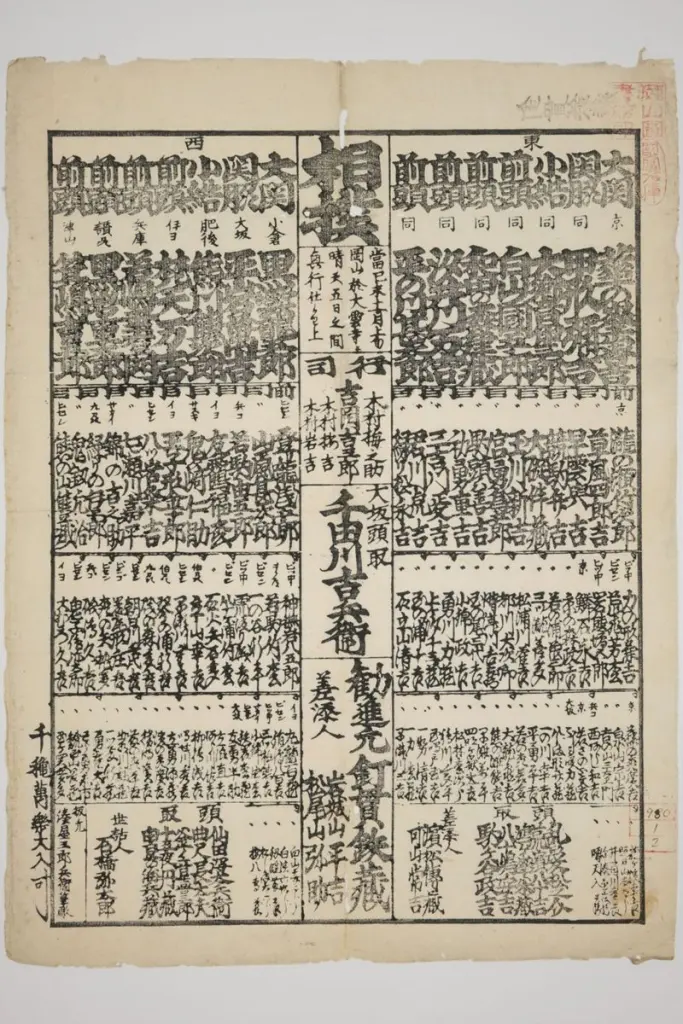
Image: Unknown / Okayama City Library Digital Archive (ADEAC) · CC BY (Attribution)
Banzuke (番付) is the official ranking list issued for professional Grand Sumo. Revised after each honbasho, it places wrestlers within six divisions and, at the top level, among ranks headed by yokozuna and ōzeki. The traditional printed sheet divides names into East and West wings and uses a dense calligraphic style written by a gyōji. It also records referees, ring announcers, hairdressers, and other members of the institution, making it more than a league table. Recent results drive promotion and demotion, but rank, available places, and exceptional rules for senior ranks prevent the process from being a simple points formula. Historically, the format developed as publicity and documentation for sumo events, then inspired theatrical programmes and playful Edo-period rankings of places, foods, celebrities, and ideas.
Overview
| Japanese | 番付 |
|---|---|
| Romanization | Banzuke |
| Primary meaning | Official professional sumo ranking list |
| Issuer | Japan Sumo Association |
| Issue cycle | Revised after each Grand Tournament and released before the next |
| Basic layout | Six divisions, rank order, and East–West wings |
Meaning and institutional function
The ranking document becomes a daily order of appearance at the dohyō, from the lower divisions through the final makuuchi bouts.
The banzuke is inseparable from the cycle of Great Sumo Tournaments (honbasho): one tournament is contested under the published ranking, and its results help shape the next.
In present-day professional sumo, banzuke normally means the Japan Sumo Association’s official hierarchy for an upcoming Grand Tournament. It determines status within the competition, but it also affects daily life: salary, dress, privileges, duties, ceremony, and public attention differ sharply by rank and by whether a wrestler has entered the salaried juryō and makuuchi divisions.
A banzuke belongs to a particular tournament cycle. It should therefore be dated when used as evidence, and a current web list should not be mistaken for a permanent roster. Wrestlers can retire, sit out, change ring names, or move substantially between editions.
Divisions and ranks
The hierarchy contains six divisions. Makuuchi and juryō are the salaried sekitori divisions; the four lower divisions contain many more wrestlers whose competitive records are organised through a shorter tournament schedule. Within makuuchi, the named senior ranks sit above the numbered maegashira positions.
| Order | Division or rank | Position in the hierarchy |
|---|---|---|
| 1 | Makuuchi | Top division: yokozuna, ōzeki, sekiwake, komusubi, and maegashira |
| 2 | Jūryō | Second division and lower salaried division |
| 3 | Makushita | Highest unsalaried division |
| 4 | Sandanme | Third division from the bottom |
| 5 | Jonidan | Second division from the bottom |
| 6 | Jonokuchi | Entry division on the published ranking |
How promotion and demotion work
After a tournament, a ranking committee reviews results and constructs the next list. A winning record generally moves a wrestler upward and a losing record downward, but the amount depends on the starting rank, the records of nearby wrestlers, vacancies, and the number of available places in each division. A record does not convert automatically into one predetermined line on the next sheet.
Senior ranks have additional rules and expectations. Ōzeki status has formal mechanisms for losing and regaining rank, while yokozuna are not demoted through the ordinary ladder. These exceptions are one reason a banzuke is an institutional judgement built from results rather than a transparent points table.
East, West, and how to read the sheet
The traditional sheet is divided into East and West wings. On a printed banzuke, East appears on the viewer’s right and West on the left. Wrestlers at the same named or numbered level form an East–West pair, with East conventionally listed first. The largest characters belong to the highest ranks; type-like bands of progressively smaller hand lettering descend through the divisions.
The central columns and margins identify the tournament and list officials or institutional roles. Reading therefore moves both across paired positions and down through diminishing status. A digital database may flatten this design into rows, but the printed hierarchy communicates rank through spatial arrangement and scale.
People listed beyond the wrestlers
A professional banzuke records more than rikishi. The Japan Sumo Association’s explanatory material includes gyōji, the referees and ceremonial officials; yobidashi, who announce wrestlers and carry out arena work; and tokoyama, the specialist hairdressers responsible for topknots. Senior association members and other offices also appear in designated areas.
This wider roster makes the sheet a compact map of Grand Sumo as an organisation. It documents the labour surrounding the bouts and preserves career hierarchies that are less visible to spectators than the wrestler rankings.
Sumo calligraphy and production
The writing work belongs to the wider profession of the gyōji, whose duties connect refereeing, ceremony and tournament administration.
Banzuke are written in a distinctive, compressed form of sumo calligraphy. Thick, tightly packed strokes allow hundreds of names and titles to occupy a single sheet while making rank visible through character size. A gyōji prepares the master lettering, and printed copies reproduce that hand-written design.
The calligraphy is functional as well as decorative. It must keep similar ring names legible at very small sizes, balance two wings, and fit late ranking decisions into a fixed format. Modern websites make the hierarchy searchable, but the printed sheet remains a recognizable object associated with each tournament.
Historical development
Research on Edo-period print culture places early eighteenth-century sumo ranking sheets in a landscape format, sometimes with the two sides on separate sheets. Around the 1730s, a single-page portrait arrangement emerged and became a principal way to publicise participants and authorised events. The modern banzuke inherits this vertical information design, although its institutional rules and titles developed over time.
Ritsumeikan University’s Sumo Digital Institute illustrates the depth of the surviving record. Its Teiji Kojima Collection contains about one thousand paper documents and related volumes, mainly banzuke, spanning 1742 to 2006. Such archives allow changes in names, ranks, printing, and tournament organisation to be studied edition by edition.
Banzuke beyond sumo
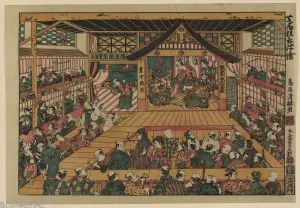
Banzuke also names a broader early modern print genre. Theatre and festival programmes used the term, while mitate banzuke borrowed sumo’s East–West hierarchy to rank famous places, foods, medicines, entertainers, poems, and other subjects. These sheets combined useful information with comparison, satire, collecting, and visual play.
A modern ranking advertised as a banzuke may continue this metaphor without having any authority in professional sumo. Context matters: sumō banzuke is an official sporting document, whereas a culinary or cultural banzuke may be editorial, promotional, or humorous.
Boundaries and common misconceptions
The sumo championship system explains how tournament wins and playoffs determine a title, separately from rank on the banzuke.
Banzuke rank is not the same kind of status as a martial-arts dan or kyū grade. A judo grade is awarded to an individual under a grading system and is normally retained; a sumo position is rebuilt for the next tournament in relation to the rest of the field. Translating both simply as “rank” can hide that difference.
The banzuke is also not a prediction of a tournament’s final standings. It records the hierarchy entering the event, based mainly on earlier performance and institutional rules. The champion of a tournament and the highest-ranked wrestler are therefore separate distinctions.
Sources
- Japan Sumo Association, Sumo Introduction.
- Japan Sumo Association, Match Flow and Banzuke.
- Japan Sumo Association, Find Rikishi and Current Banzuke.
- Ritsumeikan University Art Research Center, The Sumo Digital Institute Has Been Launched.
- James Harry Morris and Christoph Reichenbaecher, Notes on an Edo Period Ranking of Tautological Expressions, Waseda Institute for Advanced Study Research Bulletin.
Last updated: