
Music
Japanese Rock

Image: Fuzzy Gerdes / Wikimedia Commons · CC BY 2.0
Overview
Many sounds, scenes, and ways to belong.
Japanese rock is a broad term for rock music made within, or closely connected with, Japan’s musical cultures. Often shortened to J-rock, it includes many sounds, performance styles, and routes to an audience rather than a single recognisable formula. Its history involves the circulation of overseas records, postwar popular entertainment, local songwriting, and changing spaces for live performance. Debates about singing in Japanese were important, but musicians developed several different answers rather than one agreed solution. Later scenes such as visual kei and major outdoor festivals added further forms of expression and circulation. The category is most useful as a starting point for exploring particular artists, periods, and communities.
Musicians adapt a wide range of rock approaches.
Japanese, English, and mixed phrasing offer different possibilities.
Live venues and festivals connect artists with audiences.
At a glance
- Common label
- Japanese rock; J-rock
- Scope
- An umbrella for multiple musical scenes
- Historical frame
- Postwar popular music and later developments
- Language
- Japanese, English, and mixed-language approaches
- Performance settings
- Clubs, concert halls, arenas, and festivals
01
An umbrella category
The label groups artists through a relationship to Japan rather than a shared tempo, instrumentation, or visual appearance. It can encompass sharply contrasting approaches and overlaps with categories used by record companies, audiences, and musicians themselves. As a result, J-rock and J-pop do not form a reliable either-or test for every recording. An individual artist’s work and context are more informative than the national label alone.
02
Postwar pathways
Scholar Michael Bourdaghs places Japanese rock within a larger history of postwar popular music, including boogie, rockabilly, Group Sounds, and folk-rock. That sequence is also a history of cultural exchange and changing ideas about Japan’s relationship with the United States. It should not be reduced to simple imitation followed by independence: musicians selected, translated, and reworked sounds in different social circumstances.
03
Language and songwriting
The early 1970s provide a useful comparison. Research by Lee Seok examines Happy End and Carol as different responses to the possibilities of Japanese rock. Happy End worked with everyday Japanese phrasing, while Carol combined Japanese and English within a contrasting style. Their differences also involved fashion, audiences, and cultural positioning. Neither approach exhausts the ways later musicians could connect language with rock performance.
Happy End
- Language approach
- Colloquial Japanese phrasing
- Why it matters
- Shows songwriting built around the sound of everyday Japanese
Carol
- Language approach
- A mixture of Japanese and English
- Why it matters
- Shows a different relationship between language and rock style
Later artists
- Language approach
- Multiple inherited and revised approaches
- Why it matters
- No single language formula defines the category
04
Visual kei
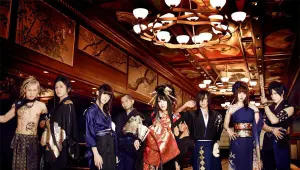
Visual kei brings image and staged appearance into the discussion: costume, hair, make-up, and a constructed performance persona can be central to an artist’s presentation. It is not a precise label for one sound. A 2010 Web Japan account of the 2009 V-Rock Festival illustrates both the scene’s variety and its international audience. X Japan, pictured here in 2010, is one example within this wider history, not a stand-in for all Japanese rock.
05
Festivals and live culture
Festival programmes make the category’s connections visible. The first Fuji Rock Festival in 1997 placed Japanese acts alongside overseas performers at Fuji Tenjinyama; severe weather led to cancellation of its second day. The archive preserves a mixed bill, including The High-Lows, Hotei, The Yellow Monkey, Shonen Knife, and Boredoms. Such programmes show how a shared event can bring together artists whose music and audiences differ considerably.
06
Listening across boundaries
A productive route through Japanese rock is to compare a specific recording, its live presentation, and the scene in which it circulated. Language choices, visual style, and venues answer different questions; none alone determines a genre. Connections with animation songs, popular music, and artists using Japanese instruments can provide further routes into the subject. Those overlaps are best treated as relationships between particular works, rather than evidence that all of these fields sound alike.
Sources
Last updated:



.jpg)