Music
X Japan
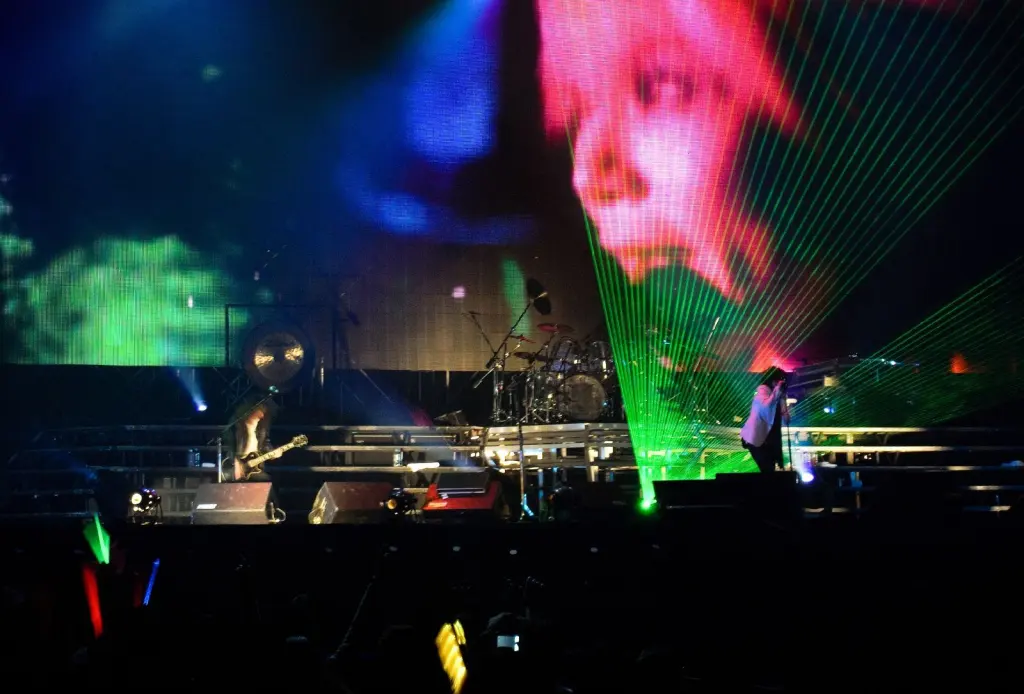
Image: Jase The Bass / Wikimedia Commons, from Flickr · Creative Commons Attribution-ShareAlike 2.0 Generic
Visual rock at arena scale
Metal force, vulnerable balladry and image form one dramatic system.
X Japan is a Japanese rock band founded around drummer, pianist and composer Yoshiki and vocalist Toshl. Its roots reach to their childhood bands, while the name X and a more stable Tokyo line-up emerged in the early 1980s. The group’s 1988 independent album Vanishing Vision and 1989 major-label album Blue Blood joined speed-metal intensity to piano-led ballads, extended compositions and a deliberately extravagant visual identity. That combination made X central to later histories of visual kei, although visual kei names a scene and mode of presentation rather than one musical genre. The band dissolved after a final concert in 1997 and reunited in 2007, later touring internationally. Guitarist hide died in 1998 and bassist Heath in 2023; both remain essential to an accurate account of the group.
Double-bass drumming, distorted guitars and high-register voice.
Slow harmonic time, strings and long melodic arcs.
Repetition and climax turn songs into arena-length narratives.
Style, gesture and fan ritual make the music physically public.
- Japanese name
- X JAPAN / エックス・ジャパン
- Core founders
- Yoshiki and Toshl
- Name X adopted
- 1982
- Major-label debut
- Blue Blood, 1989
- Renamed
- X Japan, 1992
- Main periods
- 1982–1997; reunited from 2007
01From childhood band to X
Independent production was part of the breakthrough, not merely a prelude.
Live-house audience building and Extasy Records created a route outside conventional development.
A long musical partnership begins in Tateyama.
The name stabilises as activity moves towards Tokyo.
Vanishing Vision reaches listeners through an independent structure.
Yoshiki and Toshl began playing together as schoolchildren in Tateyama, Chiba. Names and supporting musicians changed before the group settled on X in 1982 and moved its centre of activity to Tokyo. The independent live-house circuit allowed it to build an audience outside conventional major-label development.
Yoshiki founded Extasy Records to release the band’s work, including the 1988 album Vanishing Vision. The line-up associated with the major breakthrough brought together Yoshiki, Toshl, guitarists hide and Pata, and bassist Taiji.
02Speed, scale & ballad
The extremes share one method of pacing and climax.
Heavy velocity and exposed melody are complementary parts of the arena language.
Double-bass propulsion
Distortion, speed and high voice create sustained forward pressure.
Piano-led balladry
Space, strings and long phrases expose melodic vulnerability.
Art of Life
A twenty-nine-minute form makes pacing itself the subject.
X Japan’s catalogue can turn from rapid double-bass drumming, distorted guitar and high-register vocals to slow piano, strings and long melodic arcs. Blue Blood and Jealousy established this double image, while the twenty-nine-minute Art of Life treated the rock song as an extended dramatic form.
The contrast is not a split between a real metal band and commercial ballads. Both depend on Yoshiki’s sense of large-scale pacing, repetition and climax, and both became part of the group’s arena language.
03Visual kei & image
Image, virtuosity and fan gesture became one public system.
The term visual kei helps map a scene, but it does not flatten every participating band into one sound.
High hair, make-up, leather, lace, colour and theatrical staging made early X visually unmistakable. The slogan Psychedelic Violence Crime of Visual Shock became closely associated with accounts of visual kei, a term that later gathered many bands with very different sounds.
Visual kei should not be treated as a rigid music genre or a claim that appearance matters more than performance. In X Japan’s case, visual design, fan gesture, virtuosity, emotional excess and self-produced media formed one public system.
04Major success & renaming
National scale and international ambition changed the name, line-up and production cycle.
The 1992 change to X Japan belongs inside the same history as Tokyo Dome scale and personnel transition.
Vanishing Vision
Independent scale demonstrates a self-produced audience.
Blue Blood
Major-label debut brings the contrast of metal and ballad to a national public.
X becomes X Japan
The new name avoids confusion during international preparation; Heath replaces Taiji.
Last Live
A formal dissolution closes the first period.
Blue Blood brought the band to a national major-label audience in 1989, and Tokyo Dome concerts made its scale visible. After Taiji left, Heath joined on bass. The group adopted the name X Japan in 1992 as it prepared for international activity and to avoid confusion with other bands named X.
The later album Dahlia and the 1997 Last Live closed a period marked by large venues, long production cycles and growing strain. The formal dissolution made the concert a historical boundary rather than an ordinary pause.
05Loss & reunion
Remembrance became part of the reunited band’s live form.
The reunion restored activity without restoring the exact first-period line-up.
His guitar work, songs and visual imagination remain present in the band’s memory.
Yoshiki, Toshl, Pata and Heath resume activity.
Guitar and violin enter the continuing line-up.
A second central loss changes the conditions of future group activity.
Lead guitarist hide died in May 1998, only months after the dissolution. His musicianship, songs and visual imagination remained part of the band’s memory. Yoshiki and Toshl reunited X Japan in 2007, with Pata and Heath returning and Sugizo later joining as guitarist and violinist.
The reunited group performed at Tokyo Dome, toured North America, Europe, South America and Asia, and played Madison Square Garden and Wembley Arena. Concerts often incorporated images or recordings of hide, making remembrance part of the live form.
06Current status & influence
Influence is clear; continuous present activity is not.
Precise status language avoids turning the absence of a dissolution announcement into an invented schedule.
Heath died in October 2023. X Japan’s official site has not announced another dissolution, but as of September 2026 it does not present a current full-band touring schedule. It is therefore more accurate to describe the group as reunited without implying continuous live activity.
X Japan’s influence includes independent production strategy, arena-scale visual rock, fan ritual and the model of combining extreme volume with vulnerable balladry. Later visual-kei histories often place the band at the beginning, but the scene grew through many labels, magazines, venues and musicians rather than one origin story alone.
Sources and further reading
Last updated: