Music
LUNA SEA
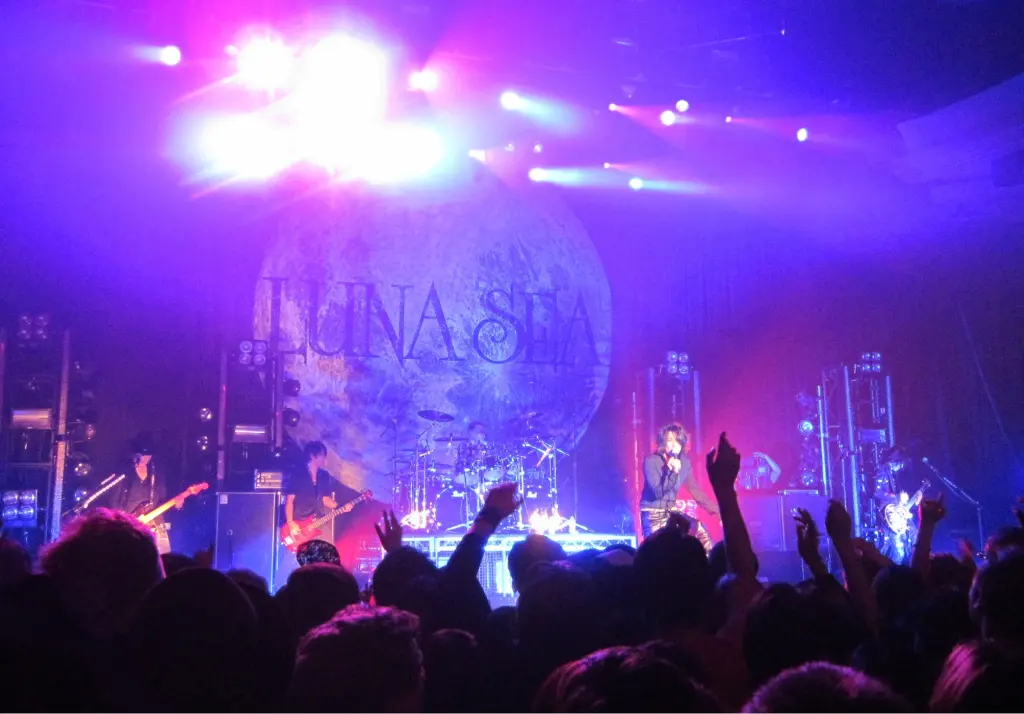
Image: E. Jones / Wikimedia Commons · Creative Commons Attribution 4.0 International
Five-way ensemble
Individual musical identities become one band through arrangement.
LUNA SEA is a Japanese rock band whose roots lie in the Kanagawa live-house scene. Bassist J and guitarist Inoran began the group as Lunacy in 1986; vocalist Ryuichi, guitarist and violinist Sugizo, and drummer Shinya completed the classic five-member line-up in 1989. Major-label debut album Image followed in 1992. LUNA SEA became central to 1990s visual-kei history while developing a sound that exceeded any single scene label: interlocking guitars, prominent melodic bass, forceful drums, expressive vocals and songs contributed by several members. The band declared an end to activity in 2000, returned for one concert in 2007 and formally rebooted in 2010. Shinya died on 17 February 2026; the remaining members continued a nationwide programme that treated his final recorded performance as part of the band’s continuing story.
Expressive melody and physical stage presence.
Sustain, noise and violin interlock with clean arpeggio and space.
Bass often carries a hook instead of merely supporting harmony.
Pulse, syncopation and cymbal colour shape the ensemble’s scale.
- Japanese name
- LUNA SEA / ルナシー
- Early name
- Lunacy
- Roots
- Kanagawa, 1986
- Classic line-up completed
- 1989
- Major-label debut
- Image, 1992
- Major transitions
- End in 2000; reboot in 2010; Shinya died in 2026
01Formation & line-up
An unusually stable five-person line-up created room for strong individual voices.
The group is best understood as a meeting of musicians, not a hierarchy around one songwriter.
J and Inoran begin the group in Kanagawa.
Ryuichi, Sugizo and Shinya complete the enduring line-up.
A local venue network becomes the platform for national development.
J and Inoran formed an early version of Lunacy in 1986. By 1989 the group included Ryuichi on vocals, Sugizo on guitar and violin, Inoran on guitar, J on bass and Shinya on drums. It worked from venues including Machida Play House and adopted the name LUNA SEA.
That five-person configuration remained unusually stable through the band’s first period and reunion. Each member also developed a solo career, making the group a meeting of established individual musical identities rather than a hierarchy built around one songwriter.
02Sound & composition
The recognisable sound lies in interaction, not one fixed genre.
Several writers bring songs; ensemble arrangement changes their centre of gravity.
Melodic bass
J often carries the hook and redirects harmonic weight.
Elastic drums
Shinya moves between drive, syncopation and large cymbal colour.
Interlocking guitars
Clean arpeggio, noise, sustain and violin occupy different depths.
Expressive voice
Ryuichi binds contrasting textures into a single dramatic address.
LUNA SEA’s rhythm section is highly exposed: J’s bass often carries a melodic hook while Shinya’s drums shift between driving pulse, syncopation and large cymbal colour. Inoran and Sugizo create contrasting guitar layers, with clean arpeggios, noise, sustained lines and violin opening different spaces around Ryuichi’s voice.
Several members bring songs to the group, and ensemble arrangement transforms the initial demos. This plural authorship helps explain why the catalogue moves among alternative rock, progressive scale, punk energy, ballad, electronic texture and darker atmospheric writing without losing a recognisable band sound.
03Visual kei & beyond
Reduced styling expanded the public language; it did not erase the scene history.
Sound, silhouette, light and bodily performance continued to work together after the most conspicuous early image changed.
Hair · make-up · costume
Live houses, labels and specialist media make visual identity part of discovery.
Lighting · silhouette · movement · ensemble sound
Expanded presentation
Less conspicuous styling coexists with a scene-shaped performance language.
Early costumes, hair, make-up and stage design placed LUNA SEA within the visual-kei scene that grew around live houses, record labels and specialist media. The band later reduced the most conspicuous styling while continuing to treat lighting, silhouette and bodily performance as central to its concerts.
This change is sometimes described as leaving visual kei, but the history is better understood as an expansion. The group helped bring a scene-associated visual language into mainstream rock while developing musical and public identities that could not be contained by the label.
04Major debut & the 1990s
Audience scale grew without replacing the five-player centre.
Albums and venues widened the frame while detailed instrumental interaction remained the identity.
Image
The major-label debut follows an independent first album.
Mother
The catalogue and audience enter a larger national phase.
Style
Alternative, progressive and electronic colour continue to expand.
Shine
Mainstream reach coexists with a band-centred arrangement method.
After an independent first album, LUNA SEA made its major-label debut with Image in 1992. Albums including Mother, Style and Shine widened both sound and audience, while Nippon Budokan, Tokyo Dome and large outdoor concerts established the band as a major live act.
The 1990s career shows how visual-kei networks and the wider Japanese rock industry overlapped. The band’s reach expanded, but its identity still depended on the detailed interaction of five players rather than on spectacle alone.
05End, return & reboot
Three transition words mark three different conditions.
End, one-night return and reboot should not be collapsed into a generic hiatus.
Two Tokyo Dome concerts close the first period.
A single concert reopens live memory without yet restoring sustained activity.
Recording and touring resume as an ongoing band project.
New versions of Mother and Style treat earlier work as living material.
LUNA SEA announced its shūmaku, or end, in November 2000 and closed the first period with two Tokyo Dome concerts in December. A one-night reunion followed on 24 December 2007. In 2010 the group declared a reboot and resumed sustained recording and touring.
Later albums included A Will, Luv and Cross. The band also recorded new versions of Mother and Style, treating its own 1990s catalogue as living material whose performance, sound and production could be reconsidered.
06Shinya & the 2026 transition
Continuation now carries grief and an irreversible change in ensemble identity.
The final recording and the remaining members’ tour belong to one transition without pretending the classic five are restored.
Shinya died on 17 February 2026 after treatment for cancer and a brain tumour. The official announcement described him as LUNA SEA’s irreplaceable drummer and emphasised his wish that the five would return to the stage. His recorded performance appears on the single Forever, released on the band’s anniversary, 29 May.
The remaining members continued the 2026 Unending Journey – Forever tour. This does not restore the classic line-up or settle every question about the band’s future; it marks a transition in which new performance, grief and the sound of Shinya’s final recording coexist.
Sources and further reading
Last updated: