Performing Arts
Sumo Jinku
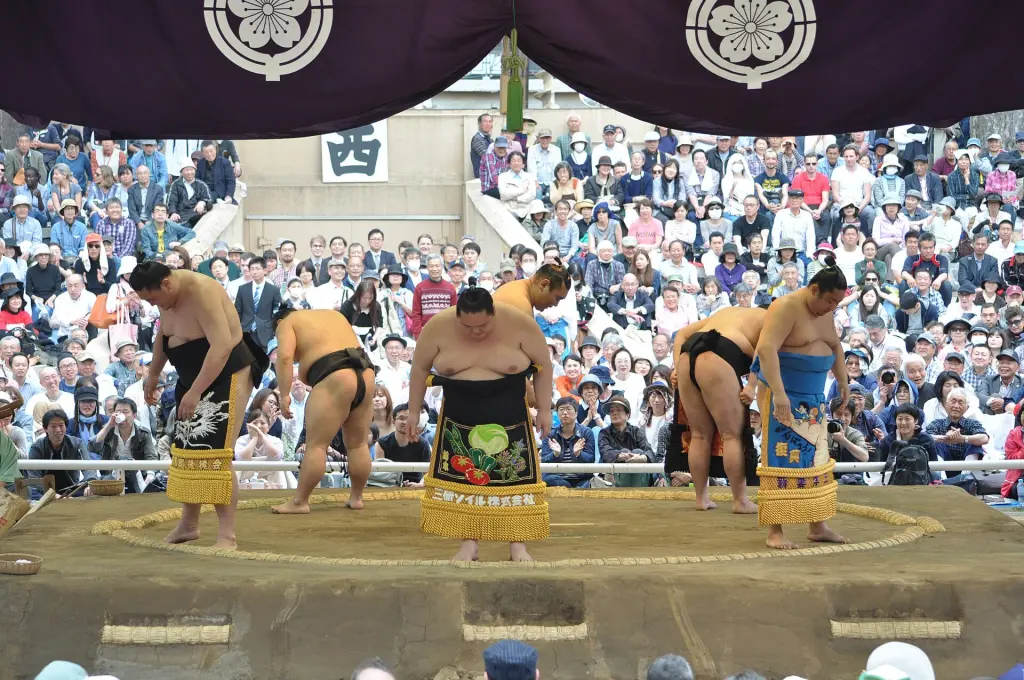
Image: 江戸村のとくぞう / Wikimedia Commons · CC BY-SA 4.0
Overview
One voice, answering calls, shared occasions.
Sumo jinku (相撲甚句) is an unaccompanied song tradition associated with sumo wrestlers and also practised by community singing groups. A solo singer carries the melody while companions supply answering calls, including the familiar “dosukoi.” Its words draw on a folk-song pattern of seven- and five-mora phrases, but performances can adapt their subject to a place, an occasion, or the people being honoured. Audiences may encounter it at regional sumo tours and special exhibitions. Understanding sumo jinku therefore involves both its place in professional sumo entertainment and the wider network of enthusiasts who learn, perform, and compose songs outside the ring.
A soloist shapes the verse through breath and melody.
Short calls connect the surrounding singers with the solo.
Tours and community gatherings give the song its setting.
At a glance
- Japanese name
- 相撲甚句
- Performance
- Unaccompanied solo voice with answering calls
- Verse pattern
- Commonly seven, seven, seven, and five morae
- Sumo settings
- Regional tours and special exhibitions
- Community practice
- Local clubs, public events, and volunteer performances
01
Voice and response
The texture is built from a leading voice and a surrounding group rather than an instrumental ensemble. The singer stretches and ornaments the melodic line; the others punctuate it with responses. Listen for the space between those two functions: the solo delivers the verse, while the calls make the performance a shared event. “Dosukoi” is an audible part of that exchange, not a substitute for the song’s main text.
Solo voice
- Function
- Carries the verse and melody
- Listening cue
- Sustained notes and melodic inflection
Answering voices
- Function
- Frame and support the solo
- Listening cue
- Short calls around the melodic line
Unaccompanied delivery
- Function
- Keeps attention on breath and text
- Listening cue
- No instrumental backing is required
02
Verse and lyrics
The Japan Sumo Association describes jinku through a four-phrase pattern of seven, seven, seven, and five morae. Morae are units of Japanese sound, so this is a description of verbal structure rather than a musical time signature. Subject matter is flexible: singers can introduce a locality, celebrate an event, or offer words of encouragement. Community practitioners also write new verses, allowing inherited melodic conventions to carry contemporary subjects.
03
Edo-period roots
Accounts place the tradition’s development in the Edo period, but they do not identify one securely documented moment of invention. The Japan Sumo Association describes jinku sung by wrestlers as becoming popular in the late Edo period. The Japan Sumo Jinku Association traces its roots further back to the Kyōhō era. These emphases are best read as different accounts of a developing practice, rather than a single fixed origin story.
04
Tours and exhibitions
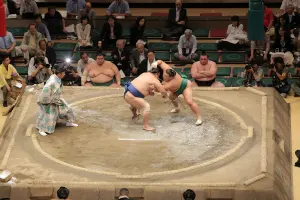
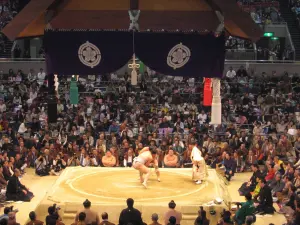
Sumo jinku belongs to the entertainment surrounding sumo as well as to its vocal culture. Regional tours, called jungyō, and special events known as hanazumō provide settings in which spectators can encounter wrestlers beyond a competitive bout. Singing is one part of that broader programme. It should not be confused with the announcements of a ring announcer or described as a standard contest between ranked singers.
05
Community practice
The Japan Sumo Jinku Association, established in 1995, supports a network of local groups. Its activities include learning songs, performing for community audiences, and volunteer visits to welfare facilities. A municipal profile of the Keiyō Sumo Jinku group in Mobara likewise presents jinku as a locally sustained performing activity. These settings show how the repertoire circulates among people who are not professional wrestlers.
06
Continuity and change
Preservation does not mean that every performance repeats identical words. The association explicitly encourages topical composition and describes performances connected with community support. The balance is between a recognisable way of singing and lyrics responsive to an occasion. For a first listening, follow one complete solo phrase, then notice where the answering voices enter; this makes the relationship between individual delivery and collective participation easier to hear.
Sources
Last updated: