Music
Min’yō
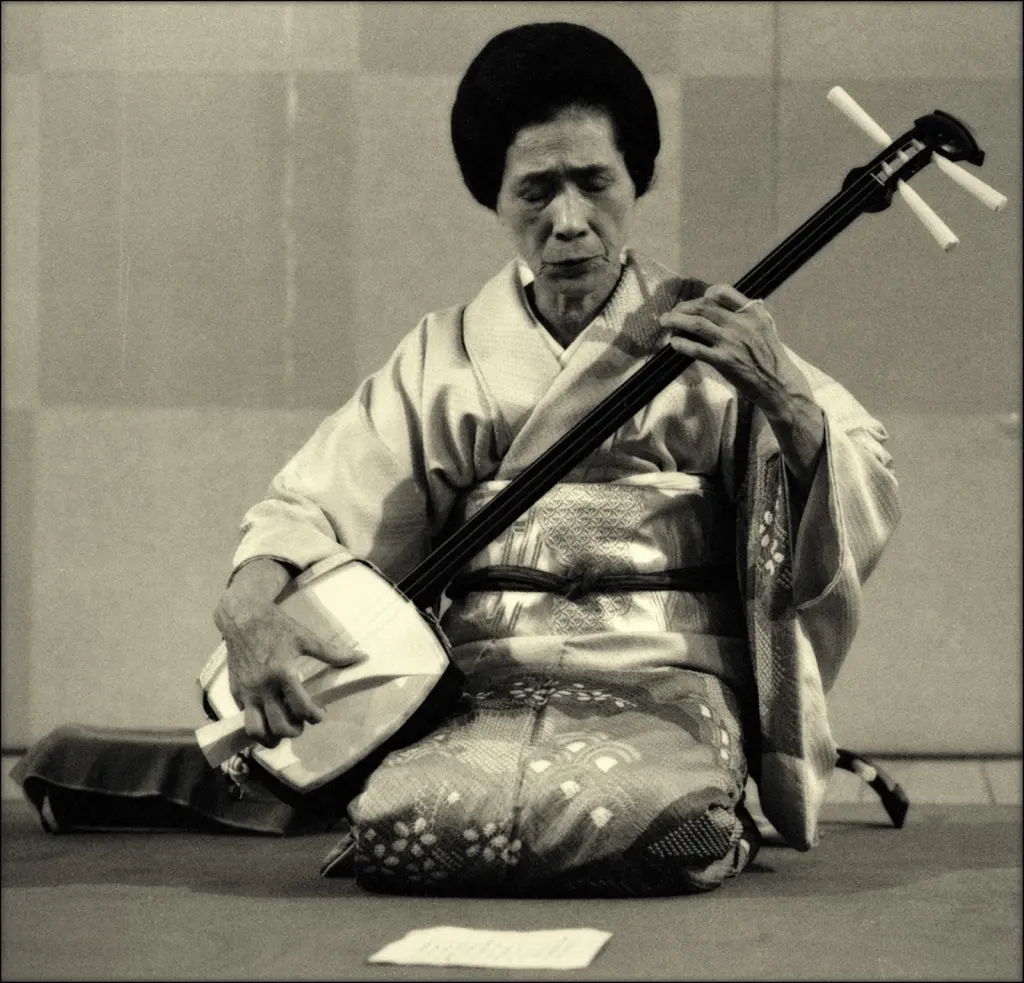
Image: Marco Tambara / Wikimedia Commons · CC BY-SA 3.0
Overview
A song connects voice, place and occasion.
Min’yō (民謡) is the Japanese term commonly used for folk song and for a recognised performance genre built around regional song traditions. Its repertories include songs associated with work, celebration, dance and everyday life, as well as versions reshaped for public performance and recording. The word describes more than one kind of relationship between a song and its community. Some performances follow a regular beat; others give the solo voice considerable rhythmic freedom. Instrumental accompaniment also varies. Although many songs have older local histories, min’yō as a modern category developed through scholarship, collecting, professional performance and media. It should not be treated as a single unchanged national sound.
Phrasing can follow a pulse or stretch freely.
Work, dance and celebration give songs context.
Community, teachers and media shape later versions.
At a glance
- Japanese name
- 民謡
- Romanisation
- Min’yō
- Core meaning
- Folk song; also a recognised performance genre
- Contexts
- Work, celebrations, dance and entertainment
- Rhythm
- Regular pulse or freer solo phrasing
- Accompaniment
- Unaccompanied singing, clapping or instruments
01
Old songs and a modern category have different histories
Ethnomusicologist David W. Hughes traces the wider adoption of the term min’yō to the late nineteenth century, in dialogue with European ideas of folk song. This does not mean the songs themselves began then. His account also notes that local singers and urban audiences can use the same label differently. The term’s history belongs to the modern organisation of musical knowledge as well as to performance.
03
Regular pulse and flexible phrasing offer two listening paths
The Japan Arts Council distinguishes regularly pulsed Yagibushi-type singing from freer Oiwake-type singing. The former can support group singing or leader-and-group responses; the latter is often solo and uses sustained, ornamented phrases. These are useful listening distinctions rather than a complete taxonomy of every regional style.
Regular pulse
- Characteristic
- A beat supports collective singing or responses.
- Example used by the Japan Arts Council
- Yagibushi
Flexible phrasing
- Characteristic
- A solo line can stretch and ornament the melody.
- Example used by the Japan Arts Council
- Esashi Oiwake
04
The voice does not require one fixed ensemble
Min’yō can be sung without instruments or with handclapping. Shamisen, drums, shakuhachi and flutes are among the instruments used in accompaniment. Kobushi refers to small ornamental movements of pitch; it should not simply be equated with vibrato. Hearing the relationship between voice and accompaniment is more informative than assuming that a particular instrument defines the entire genre.
05
Recording and professional performance reshape transmission
Hughes describes how urbanisation, leisure and professional performance helped min’yō develop beyond its earlier local settings. His 1986 account documents recorded and broadcast versions, specialist venues and organised learning. It is evidence for that historical moment, not a census of present-day participation. Kei Saitō’s research into early shin-min’yō further shows that newly created folk-style songs and debates about terminology were part of modern musical life.
06
Regional traditions deserve their own names and context
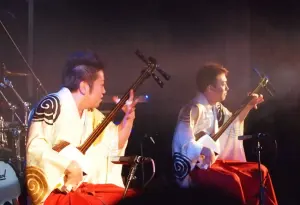
Min’yō is a broad starting point, not a substitute for a song title, locality, performer or version. It also differs from court music such as Gagaku and from the modern popular-music field covered by J-pop. The Yoshida Brothers offer a related route into contemporary shamisen performance without representing all folk singing.
Sources
Last updated: