
Music
Yoshida Brothers
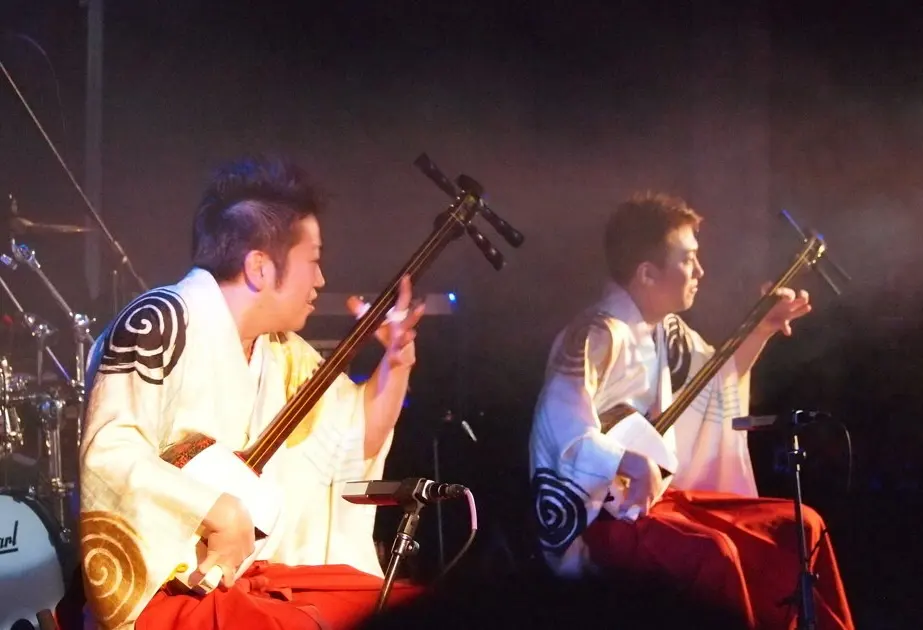
Image: May S. Young / Wikimedia Commons, from Flickr · Creative Commons Attribution-ShareAlike 2.0 Generic
Duet and tradition
Two players turn inherited technique into dialogue, scale and contrast.
Yoshida Brothers is a Tsugaru-shamisen duo formed by Ryoichiro Yoshida and Kenichi Yoshida, brothers from Noboribetsu in Hokkaido. Both began learning shamisen at the age of five and, from 1990, studied Tsugaru shamisen under Takashi Sasaki I. Competition success preceded their 1999 debut album Ibuki, after which the pair developed a concert style that could move from unaccompanied dialogue between two instruments to arrangements with rock, electronic and orchestral forces. Their work is often described as a fusion of tradition and modernity, but that shorthand can hide the specific performance culture of Tsugaru shamisen: forceful plectrum attack, flexible timing, ornament, variation and an important history of solo display. The brothers remain active through touring, education, solo projects and international collaboration.
Common patterns, tunings and technique make coordination possible.
Attack, timing, ornament and register stay personally legible.
Parts shadow, answer, displace and reinforce one another.
Amplification and arrangement change context without replacing technique.
- Japanese name
- 吉田兄弟
- Members
- Ryoichiro Yoshida and Kenichi Yoshida
- From
- Noboribetsu, Hokkaido
- Instrument
- Tsugaru shamisen
- Debut album
- Ibuki, 1999
- International debut
- United States, 2003
01Brothers & training
Shared training created a common language, not identical parts.
Duet clarity depends on hearing two individual attacks inside coordinated form.
Both brothers start young in Noboribetsu.
A shared Tsugaru-shamisen apprenticeship.
National contests reward individual command before the recording debut.
Ryoichiro and Kenichi grew up in Noboribetsu rather than in the Tsugaru region of northern Honshu from which the style takes its name. Each began shamisen lessons at five. Their shared apprenticeship under Takashi Sasaki I from 1990 gave them a common technical foundation while national competitions encouraged distinct solo identities.
The family relationship is audible but does not make the parts identical. In duet playing, one brother may state a phrase while the other shadows, interrupts or changes its weight; unison can then shift into call-and-response or contrasting registers.
02Tsugaru-shamisen context
Improvisation means variation inside an inherited language.
Instrument, repertoire, setting and individual timing all matter more than a generic “traditional” label.
Futozao
A large-necked shamisen supports a forceful stage sound.
Bachi on string and skin
Plectrum technique makes rhythm and timbre inseparable.
Patterns and tunings
Shared material gives variation a recognisable frame.
Timing and density
Accent, ornament and connection shape a player’s voice.
Tsugaru shamisen is associated with a large futozao instrument, a strong bachi attack and repertories shaped by northern itinerant performance, local song accompaniment, solo display and later stage competition. It is one branch of shamisen culture, not a synonym for every shamisen practice in Japan.
Improvisation in this setting does not mean playing without inherited material. Performers learn characteristic patterns, tunings, phrases and formal expectations, then vary timing, density, accent and connection. Individuality emerges through command of a shared language.
03Debut & recordings
Production can enlarge the sound without burying the plectrum attack.
The useful question is not “traditional or modern?” but which details remain audible after arranging.
Shared apprenticeship
Study under Takashi Sasaki I begins.
Ibuki
The national recording debut keeps two shamisen at the centre.
United States debut
Touring and collaboration enter a larger international circuit.
Expanded forces
Rock, electronics and orchestra become optional frames rather than replacements.
The brothers came to national attention through Tsugaru-shamisen competitions and released Ibuki in 1999. The album introduced the pair to a wider recording audience while keeping the sound of the two instruments central. Subsequent releases placed traditional pieces beside newly composed and arranged material.
Their United States debut in 2003 widened touring and collaboration. Studio production could add drums, guitar, synthesiser or orchestra, but the strongest arrangements preserve the shamisen’s percussive attack and allow small differences of timing and articulation to remain legible.
04The duet in performance
Drama comes from contrast between coordination and resistance.
Speed attracts attention, but silence, resonance and imperfectly matched edges give the form depth.
Matched unison
Shared attacks make precision and weight immediately visible.
Call and response
A phrase is restated, displaced or answered in another register.
Rough-edged variation
Small timing and articulation differences preserve individual voice.
A Yoshida Brothers concert makes physical technique visible: the large plectrum strikes both string and skin, the left hand shifts rapidly along the neck, and the musicians coordinate through posture, breath and glance. Amplification enlarges details that an acoustic setting would distribute differently.
Speed is only one part of the effect. Sustained resonance, silence, repeated figures and the contrast between tightly matched unison and rough-edged variation give the duo its dramatic shape.
05Collaboration & media
Each collaboration selects from a practice broader than the soundtrack moment.
Film, animation and public events create entry points; they do not define the whole tradition.
The durable language learned through teachers and performance networks.
A production foregrounds only part of that language.
Audiences may begin here, then listen more specifically.
The duo has worked with performers and producers in different genres and contributed music to animation, film and large public events. A 2017 arrangement of While My Guitar Gently Weeps accompanied the Japanese version of Kubo and the Two Strings, and later projects linked the brothers to cyalume dance and anime production.
These collaborations create new listening contexts rather than proving that Tsugaru shamisen has one natural path into rock or global media. Each arrangement selects particular timbres and gestures from a broader practice.
06A living tradition
Popular visibility becomes useful when it leads back to specific practice.
Responsible listening replaces “fusion” with concrete questions about teachers, tuning, repertory and setting.
- 1Name the branch
Tsugaru shamisen is more precise than shamisen alone.
- 2Identify the setting
Competition, concert, teaching, recording and media commission produce different choices.
- 3Listen for arrangement
Ask what amplification and added instruments reveal or conceal.
- 4Return to lineage
Teacher, inherited patterns and local performance history remain central.
Ryoichiro and Kenichi also maintain separate projects, educational work and collaborations. Their careers show that traditional-instrument musicians may operate simultaneously within competitions, teaching, regional networks, commercial recording and international touring.
The duo’s significance lies in making specialist technique audible to audiences who may first encounter it through popular media. Responsible listening then moves beyond the fusion label to ask which tuning, piece, teacher, performance setting and arranging choices are actually present.
Sources and further reading
Last updated:

.jpg)