
Music
Wagakki Band
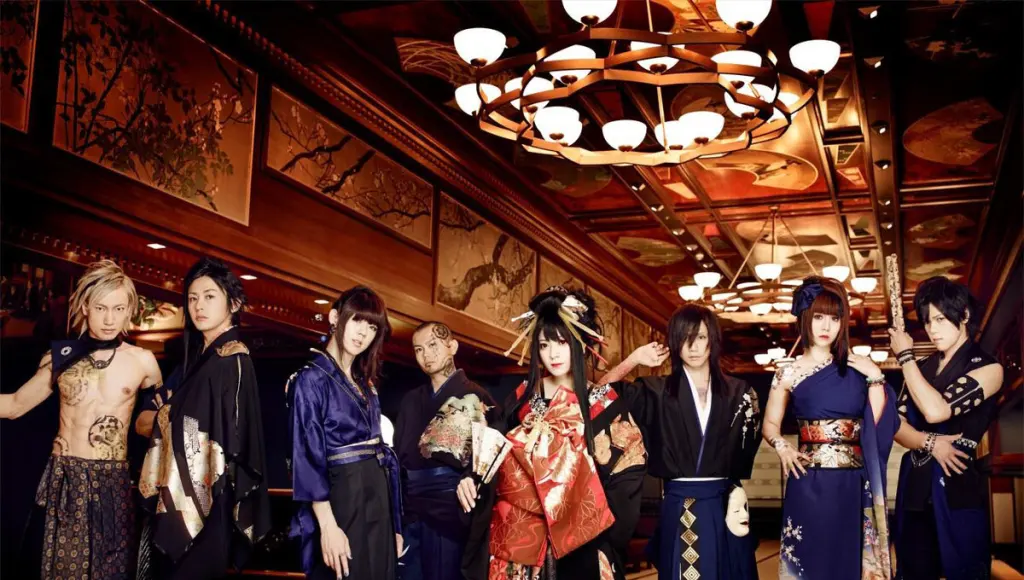
Image: AkumaRei / Wikimedia Commons · Creative Commons Attribution-ShareAlike 4.0 International
Ensemble architecture
Eight specialists make tradition and rock negotiate in real time.
Wagakki Band (和楽器バンド) is an eight-member Japanese rock ensemble that places shigin-influenced singing, koto, shakuhachi, Tsugaru shamisen and wadaiko beside electric guitar, bass and drums. Formed in 2013 and commercially launched with the 2014 album Vocalo Zanmai, the group became widely recognised through highly staged performances and arrangements of songs associated with Vocaloid culture, especially Senbonzakura. Its sound is not simply traditional music with a rock beat: each instrument retains a distinct attack, range and performance practice, and the arrangements depend on negotiation among them. After a tenth-anniversary year, the band entered an indefinite hiatus on 31 December 2024 so its members could pursue individual work; the announcement did not describe the group as dissolved.
Ornament and projection move inside a rock vocal frame.
Koto, shakuhachi, Tsugaru shamisen and wadaiko keep different attacks and histories.
Amplified weight, pulse and harmonic mass create the shared stage.
Attention moves among melody, counter-line, texture and spectacle.
- Japanese name
- 和楽器バンド
- Formed
- 2013
- Commercial debut
- Vocalo Zanmai, 23 April 2014
- Core format
- Eight-member rock band with four Japanese-instrument specialists
- Vocal approach
- Rock singing shaped by shigin training
- Current status
- Indefinite hiatus since 31 December 2024
01Name & formation
The name describes a modern meeting, not a historical ensemble.
Wagakki is an umbrella term; the band turns it into a precise eight-person format.
Specialists from different performance worlds enter one project.
All eight roles appear together on stage.
Vocalo Zanmai frames the ensemble through shared online repertoire.
The name joins wagakki, a modern umbrella term for Japanese instruments, with the English word band. The ensemble formed in March 2013 and first performed with all eight members that August. Its line-up brought together vocalist Yuko Suzuhana, koto player Kiyoshi Ibukuro, shakuhachi player Daisuke Kaminaga, Tsugaru-shamisen player Beni Ninagawa, wadaiko player Kurona, guitarist Machiya, bassist Asa and drummer Wasabi.
These categories require care. Wagakki does not describe one historical ensemble, and koto, shakuhachi, shamisen and taiko belong to different lineages and settings. The band presents a contemporary collaboration among named specialists rather than a reconstruction of a single traditional genre.
02Instrument roles
The mix works because every timbre remains legible.
The arrangement repeatedly decides who leads, who supports and who changes the colour.
Koto + shamisen
Bright transients can cut through amplified guitars.
Shakuhachi
Sustained colour, bends and audible breath occupy a different space.
Wadaiko + drums
Two percussion languages share pulse, impact and visual scale.
Guitar + bass
Distortion, low end and harmony supply the rock architecture.
The sound is built from contrast. Plucked koto and shamisen attacks can cut through amplified guitars; shakuhachi adds breath, pitch inflection and sustained colour; wadaiko supplies large gestures and timbral weight beside a modern drum kit. Bass and guitar provide the low-end, distortion and harmonic mass expected of rock, while Suzuhana moves between direct rock delivery and ornaments informed by shigin.
Balance is an arranging problem as much as an instrumental one. The acoustic instruments are amplified and placed within a dense stage mix, so their roles may alternate between melody, counter-line, punctuation and texture rather than remaining fixed as exotic decoration.
03Vocaloid route
Online repertoire supplied a network, not a simple old–new contrast.
Songs already shaped by software voices, covers and user circulation became material for live specialists.
Networked songs
Vocaloid culture circulates compositions beyond one definitive performer.
Eight live roles
Arrangements redistribute melody, rhythm and texture.
Music video
Visible instruments and costume make the new format immediately readable.
Global discovery
Senbonzakura becomes a major route to the band.
The debut album Vocalo Zanmai consisted of arrangements of Vocaloid-associated songs. That choice linked performers trained in live and traditional-instrument practices to an online culture in which songs circulate through software voices, user-made videos, covers and reinterpretation. The band’s version of Senbonzakura became a signature work and a major route by which overseas viewers encountered the ensemble.
This path should not be reduced to a simple opposition between old Japan and new technology. The repertoire was already collaborative and digitally networked, while the instruments and vocal techniques were living practices used by contemporary musicians.
04Records & stages
Scale made the arrangement visible as well as audible.
Albums, arena staging and international appearances enlarged the same eight-person logic.
Vocalo Zanmai
Commercial debut through Vocaloid-associated arrangements.
Yasou Emaki
A number-one Oricon weekly album and a Japan Record Awards planning award.
Japan Foundation programme
A New York appearance within a wider history of overseas concerts and festivals.
Tenth-anniversary year
The final full year before an indefinite pause.
The second album Yasou Emaki reached number one on the Oricon weekly chart in 2015 and received a planning award at the Japan Record Awards. Later releases expanded the band’s original repertoire while retaining its mixed instrumental identity. Concerts at Nippon Budokan and other large venues placed solo passages, costume, lighting and spatial movement at the centre of the experience.
International appearances included Japan Expo in Paris, an Anime Expo performance in Los Angeles, a New York concert, a North American tour and a 2019 Japan Foundation programme in New York. These routes show how festival, anime and online audiences could overlap without making the band an anime act alone.
05Visual presentation
Costume clarifies eight roles—and can also imply a timeless Japan.
The most accurate reading holds spectacle and contemporary production together.
Fast role recognition
Contrasting silhouettes, fabrics, instruments and stage positions help audiences read a large ensemble.
Deliberate spectacle
Temples, theatres and constructed sets form a modern visual language.
Historical documentation
Costume does not prove one continuous or uniform traditional setting.
Costume and music video are integral to the band’s public identity. Designs often combine contemporary stagewear with silhouettes, fabrics or motifs associated with Japanese clothing and performance, while videos place the musicians in temples, theatres or highly constructed sets. The result is a deliberate spectacle rather than documentary evidence of historical dress.
The visual layer helps audiences identify eight contrasting roles quickly. It can also encourage an overly timeless image of Japan, so the performers’ modern training, amplification, recording technology and online circulation remain essential parts of the story.
06Status & significance
Indefinite hiatus is a status, not a dissolution.
The distinction matters because it preserves uncertainty rather than inventing a return or an ending.
In January 2024 the band and its management announced that group activity would pause indefinitely after 31 December, following the tenth-anniversary year. The statement said the members intended to concentrate on individual work and hoped to stand together again; it did not give a return date.
Wagakki Band matters less as a formula to copy than as a sustained experiment in arranging, staging and audience translation. Its career makes visible the practical work required when instruments with different histories, volumes and symbolic meanings share one contemporary rock ensemble.
Sources and further reading
Last updated:

.jpg)