Karate
Naihanchi Shodan
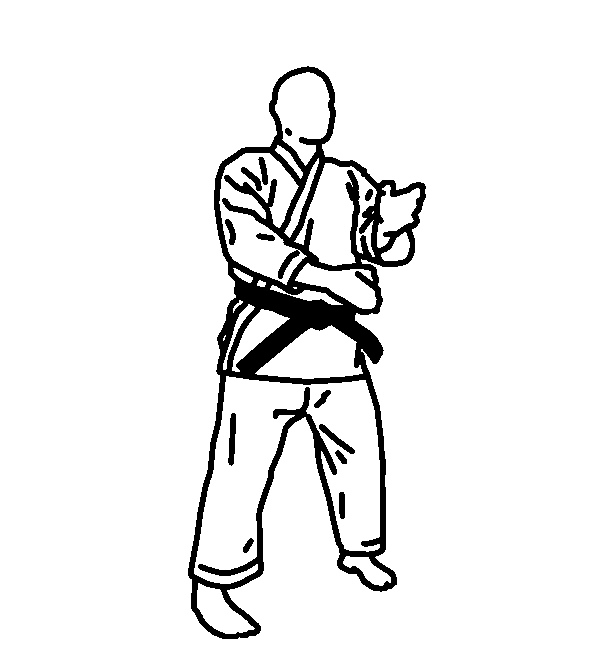
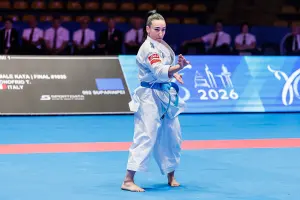
Image: Judcosta / Wikimedia Commons · CC BY 3.0
Naihanchi Shodan (ナイハンチ初段) is an Okinawan Karate kata organised mainly along a lateral embusen. It appears in several Shuri- and Tomari-linked traditions and in modern styles including Wadō-ryū, while Shotokan transmits related material under the name Tekki Shodan. The Japan Karate Association counts 29 movements in its Tekki Shodan version and states that it was originally called Naihanchi, but the two names should not be used to imply that every surviving sequence is identical. Naihanchi is closely associated with a laterally oriented stance called Naihanchi-dachi in some systems; Shotokan commonly uses kiba-dachi in its Tekki presentation. This article treats stance, name, movement count and application as lineage-specific evidence rather than one universal formula.
JKF framework
Where this kata sits
Official competition placement and broader guide context are shown separately.Official JKF position
Tokui kata
- Shitō
The dated JKF amendment records Naifanchin Shodan in the Shitō-ryū Tokui list. It separately records Naihanchi for Wadō-ryū and Tekki Shodan for Shōtōkan-ryū.
Guide context
Naihanchi / Tekki
- Shōtōkan
- Wadō
- Shitō
These related labels support comparison, not a claim that every Naihanchi, Naifanchin or Tekki sequence is identical.
Overview
| Japanese | ナイハンチ初段 |
|---|---|
| Reading | ないはんちしょだん |
| Romanisation | Naihanchi Shodan |
| Alternative spelling | Naifanchi Shodan |
| Classification | Okinawan Karate kata |
| Characteristic pattern | Predominantly lateral embusen |
| Related Shotokan name | Tekki Shodan |
| JKA Tekki count | 29 movements |
Name and scope
Naihanchi is also romanised Naifanchi. The word's original derivation is uncertain, so confident literal translations should be treated cautiously; shodan identifies a first level in systems that preserve more than one Naihanchi form.
The modern label can refer to related but distinct performances. School, teacher or organisation should be named when describing exact hand positions, stance dimensions, count or rhythm.
Okinawan transmission
Naihanchi is associated with teaching networks later grouped under Shuri-te and Tomari-te. These regional labels are useful for orientation but do not identify one frozen historical syllabus.
The 2nd Okinawa Karate World Tournament lists Naihanchi Shodan, Nidan and Sandan within its Shuri-te/Tomari-te competition appendix. That list records current event grouping, not proof that all three forms had one origin or identical transmission.
Relationship with Tekki Shodan
Funakoshi's mainland presentation renamed Naihanchi as Tekki, a name commonly explained through the image of an iron rider. Shotokan Karate now widely uses Tekki Shodan.
The JKA instructor manual counts 29 movements and notes the older Naihanchi name for its Tekki Shodan. This documents the JKA relationship; it does not make every Okinawan Naihanchi version interchangeable with modern JKA Tekki.
Lateral embusen
Naihanchi Shodan is recognised by movement concentrated along a side-to-side line. The narrow embusen places attention on lateral stepping, turning through the hips and maintaining organisation without a long forward path.
Popular stories sometimes explain the line as fighting on a boat, bridge or against a wall. Such images can support a drill, but they are not established historical explanations merely because the embusen is lateral.
Stance and body method
The JKF glossary describes Naihanchi-dachi with the feet spread laterally, toes turned somewhat inward and weight centred, while acknowledging individual and stylistic variation elsewhere in its stance material.
Other schools use different proportions or names; Shotokan Tekki commonly employs kiba-dachi. A stance diagram shows only one moment and cannot capture pressure changes, stepping or the way the torso coordinates with the arms.
Technical study
The kata combines short hand actions, changes of side and lower-body organisation within a compact path. It can be used to examine how the centre remains controlled while force and attention shift laterally.
Terms such as hip rotation, vibration or locking are used differently across schools. Comparative writing should describe the named version instead of assuming those labels refer to one identical body method.
Bunkai and application boundaries
Bunkai may examine close-distance receiving, striking, gripping, limb control or off-balancing relationships suggested by the compact actions.
The lateral solo line does not require every application to place opponents in a row. Partner drills are interpretations shaped by a teaching lineage and should not be presented as exclusive historical solutions.
How to study it safely
Learn the stance depth and foot position used by the local school, then develop lateral stepping without forcing the knees inward. Comfortable alignment matters more than imitating an extreme still photograph.
Practise partner applications slowly with agreed grips, targets and release signals. Qualified instruction is important when the drill adds joint pressure, close-range impact or balance breaking.
JKF official kata videos
Official reference
Use these federation reference films to compare named versions. Each video documents one JKF-published model for the named tradition; it does not define every dōjō or lineage.
Sources
- The 2nd Okinawa Karate World Tournament, Rules and Regulations.
- Japan Karate Association, Technical Manual for the Instructor.
- All Japan Karatedo Federation, Karate Terminology Dictionary.
- Tooru Kadekaru, The origins of the modern kata in karate-do.
- National Diet Library, Funakoshi Gichin, Karate-do Kyohan.
Last updated: