other-martial-arts
Sumo Ranks — Yokozuna to Jonokuchi
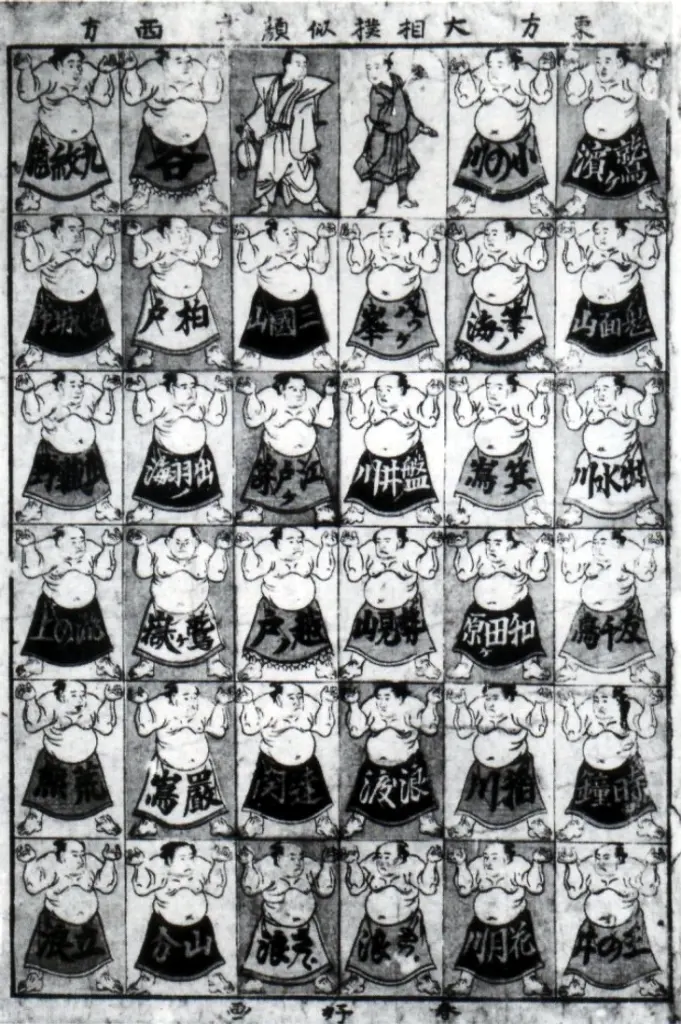
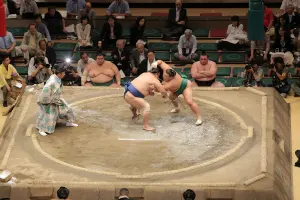
Image: Unknown / Wikimedia Commons · Public domain
The 30-second model
Six divisions. Five ranks inside the top one.
Professional sumo has two connected layers of hierarchy. The six divisions run from jonokuchi to makuuchi. Inside makuuchi, the five named ranks run from maegashira to yokozuna. The banzuke places every wrestler within that nested system for one tournament cycle. Results usually move a wrestler up or down, but the system is not a fixed points ladder: the surrounding field matters, and ōzeki and yokozuna follow special rules.
- Divisions
- Six
Makuuchi to jonokuchi - Top-division ranks
- Five
Yokozuna to maegashira - Sekitori
- Makuuchi + jūryō
Salaried divisions - Bout rhythm
- 15 in the top two
Seven below - Placement
- East usually precedes the corresponding west
- Revision
- A new banzuke for every Grand Tournament
01Structure
Read the outer ladder before the inner ladder.
A wrestler’s complete position combines a division, a rank or number, and an east–west placement. The top division is the only one with five widely recognised named ranks nested inside it.
-
01Top divisionMakuuchi幕内
- HighestYokozuna横綱
- 2Ōzeki大関
- 3Sekiwake関脇
- 4Komusubi小結
- 5Maegashira前頭
- 02Second divisionJūryō十両
Salaried sekitori; fifteen scheduled bouts.
- The sekitori boundaryCrossing between jūryō and makushita changes pay, attendants, dress, and daily status.
- 03Third divisionMakushita幕下
Highest unsalaried division; seven scheduled bouts.
- 04Fourth divisionSandanme三段目
Middle developmental division.
- 05Fifth divisionJonidan序二段
Large lower division organised by numbered east–west positions.
- 06Sixth divisionJonokuchi序ノ口
Entry division at the foot of the published hierarchy.
02Full reference
Every label answers a different question.
Use this compact reference to distinguish organisational level, competitive schedule, and institutional status. Approximate headcounts change from one banzuke to the next, so the official current list remains the source of record.
Highest rank; not demoted.
15 boutsSecond-highest rank; kadoban rules apply after a losing record.
15 boutsHighest rank below ōzeki in the normal promotion-and-demotion field.
15 boutsLowest named san’yaku position.
15 boutsNumbered east–west field below san’yaku.
15 boutsSecond division and the other salaried sekitori level.
15 boutsHighest unsalaried division.
Seven boutsThird level below the salaried boundary.
Seven boutsSecond-lowest division.
Seven boutsLowest published division.
Seven bouts03Tournament cycle
A record changes the next list, not the current one.
The banzuke fixes the hierarchy for one Grand Tournament. Results then become evidence for the next ranking meeting, where each record is judged alongside starting position, available places, and the results of others.
Banzuke
East and west positions are fixed for the coming tournament.
Record
Wins, losses, absences, and schedule produce the official result.
Whole field
Results are weighed against rank, vacancies, and nearby candidates.
Next banzuke
Promotion, demotion, or a similar position begins a new cycle.
Kachi-koshi
Usually supports promotion, with the size of the move determined by context.
Make-koshi
Usually leads to demotion, again shaped by position and the wider field.
04Special rules
The top is not governed by one formula.
Ōzeki and yokozuna are institutional offices as well as competitive positions. Promotion requires sustained elite results and formal deliberation; the consequences of a poor record also differ.
Demotion is staged
A losing tournament places an ōzeki in kadoban status. Another losing record risks demotion, with a limited immediate route back under the association’s rules.
Retirement replaces demotion
A yokozuna cannot be moved down the banzuke. If the rank’s performance and conduct expectations can no longer be met, retirement is the institutional outcome.
Do not use one tournament as a universal promotion formula. The official association’s decision and the surrounding field remain decisive, particularly at the highest ranks.
05Beyond the scorecard
Rank also organises everyday life.
Professional sumo’s hierarchy is visible in the stable, on the road, and in public ceremony. Promotion into jūryō is consequential because it crosses the boundary into salaried sekitori status.
Pay & attendants
Sekitori receive salaries and may have lower-ranked attendants; those below jūryō do not share that status.
Dress & hairstyle
Clothing, formal appearance, and the more elaborate ōichōmage help make hierarchy publicly legible.
Training & duties
Rank affects training sequence, chores, travel arrangements, and accommodation within stable life.
06Reading method
Build the complete label in four steps.
A current rank is a precise institutional address. Reading each part in order prevents the most common confusions.
- 1Name the division.
Begin with makuuchi, jūryō, makushita, sandanme, jonidan, or jonokuchi.
- 2Add the rank or number.
Inside makuuchi, distinguish the five named ranks; numbered positions order larger fields.
- 3Add east or west.
East normally ranks just above the corresponding west position; neither side is a permanent team.
- 4Add the tournament date.
The label belongs to one banzuke and can change when the next list is published.
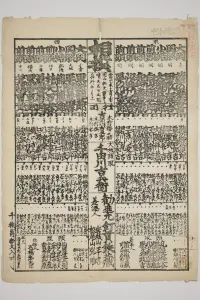
The Banzuke entry explains the printed document, calligraphy, and East–West layout. The Japan Sumo Association’s current wrestler list is the source of record for today’s positions.
Sources and further reading
Last updated: