Crafts & Skills
Origami
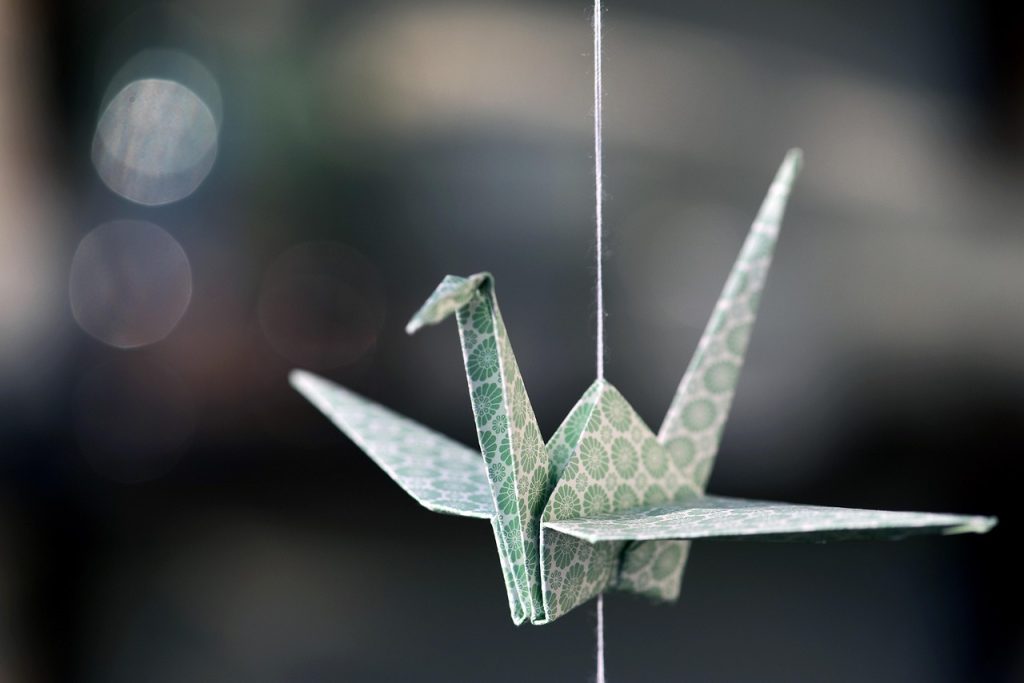
Image: asundermeier / Pixabay · Pixabay Content License
Overview
| Japanese name | 折り紙 |
|---|---|
| Meaning | Folded paper |
| Type | Paper-folding art |
| Material | Usually square paper |
| Common forms | Representational, geometric, modular, and tessellated designs |
Origami is the art of creating form through folded paper. A flat sheet becomes a crane, box, flower, mask, geometric structure, or abstract sculpture through a sequence of creases. The material is ordinary and the basic action is simple, yet the possibilities range from a child’s first model to complex design, mathematics, engineering, and contemporary art.
Name and etymology
Ori means folding and kami means paper; in the compound, kami becomes gami. The modern word is familiar around the world, but Japanese paper-folding traditions have used several names and served different purposes. Formal wrapping, ceremonial folds, recreational models, and modern design are related without being identical.
Paper before pastime
Papermaking reached Japan from the Asian continent in the early seventh century. Japanese craftspeople developed washi, a strong, flexible paper made from long plant fibers. Paper was valuable and was used for documents, Buddhist texts, ritual objects, screens, lamps, and the wrapping of offerings and gifts.
Formal decorative folding developed around etiquette. During the Muromachi period (1336–1573), warrior households established rules for presenting gifts and ceremonial objects. This tradition, often called orikata or origata, survives in forms such as noshi decorations and the folded paper butterflies used in wedding rituals.
From formal folds to popular models
As paper became more available during the Edo period, folding also grew as popular recreation. Printed books helped circulate designs. Hōketsuki (“Wrapping and Tying”), published in 1764, spread knowledge of formal wrapping, while Hiden Senbazuru Orikata, published in 1797, presented ingenious methods for folding connected cranes from a single sheet with strategic cuts.
These histories caution against the idea that one person invented origami. Ceremonial practice, children’s play, publishing, paper craft, and later international exchange all contributed to the modern field.
The language of a fold
Origami diagrams use a shared visual vocabulary. A dashed line may show a valley fold, a dot-and-dash line a mountain fold, and arrows indicate direction, rotation, opening, or reversal. In the twentieth century, organizations and designers helped standardize these conventions so a model could travel without a teacher physically present.
Basic folds combine into recurring structures called bases. The preliminary base, bird base, fish base, and frog base are not finished models; they are starting architectures from which many designs can grow.
Valleys, mountains, and reversals
- Valley fold: the crease forms a valley, bringing the paper toward the folder.
- Mountain fold: the crease peaks away from the folder.
- Inside reverse fold: a section is opened and turned inward along existing creases.
- Outside reverse fold: a point is turned around the outside of the model.
- Squash fold: a pocket is opened and flattened symmetrically.
- Petal fold: layers are opened and raised into a long point, common in the bird base.
Precision helps, but paper is not geometry without material. Thickness accumulates, fibers have direction, and repeated folding weakens a crease. Good design respects those physical limits.
The crane and the thousand-crane tradition
The folded crane, or orizuru, is the best-known Japanese model. Cranes are associated with longevity and good fortune, and groups of one thousand folded cranes—senbazuru—are offered as expressions of hope, recovery, peace, or collective support. Strings of cranes can turn many small acts of folding into one communal object.
The crane’s familiarity should not obscure its technical value. It teaches a sequence of square folds, reversals, and the bird base, giving beginners a compact introduction to several core ideas.
Traditional and modern approaches
Traditional models are often passed between generations without a named designer. Modern creative origami places greater emphasis on authorship and original design. Some folders begin with a desired animal and plan the allocation of points and layers; others explore tessellations, curved creases, or repeating geometric patterns.
“Pure” origami often means one uncut sheet without glue, but this is a creative convention rather than a rule governing every paper art. Modular origami joins many folded units. Kirigami allows cutting. Wet-folding uses lightly dampened paper to create softer, sculptural curves. Each approach asks different things of the material.
From play to mathematics and engineering
Contemporary origami connects artistic practice with mathematics, structural design, robotics, and deployable engineering. NASA and university researchers use folding principles as inspiration for structures that must pack compactly and open reliably. Interpretations of folded form may also draw on broader Japanese aesthetics or the spatial concept of ma, but these are analytical lenses rather than universal rules followed by every origami artist.
A crease pattern can be studied as a mathematical object: angles meet at vertices, flat-foldability creates constraints, and repeated folds generate complex structures. These ideas have inspired deployable forms in packaging, architecture, medical devices, robotics, and space engineering. The connection is not that every engineered fold is traditional Japanese origami, but that paper folding provides a powerful laboratory for transforming surfaces.
Paper selection
Origami can use ordinary machine-made paper as well as specialist sheets. Traditional handmade washi offers distinctive fibres, strength, texture, and surface treatments, but it is not required for a work to be considered origami. Paper choice depends on the model’s scale, fold density, desired finish, and whether the work is intended for practice, display, or engineering experimentation.
Ordinary square kami is thin, inexpensive, and ideal for learning. Washi adds texture, strength, and decorative fibers. Foil-backed paper holds sharp shaping, while heavier papers suit boxes and simple sculptural forms but become bulky in complex models.
For a first project, use a sheet large enough to see every layer. Make each crease deliberate, align corners before flattening, and run a fingernail or folding tool along the line. If the model drifts out of alignment, return to the most recent clear step rather than forcing the paper.
Origami in Tokyo
Origami is easy to encounter in workshops, community classes, stationery shops, and seasonal displays. Tokyo Origami Kaikan in Bunkyō introduces paper dyeing, demonstrations, exhibitions, and supplies. Programs and opening information can change, so check directly before visiting.
The best entry point is still a single sheet at a table. Choose a cup, box, or simple animal before attempting the crane. Learning how diagrams communicate is the key that opens thousands of models.
Terminology
- Washi: Japanese paper traditionally made from long plant fibers.
- Orikata / origata: formal systems of decorative wrapping and folding.
- Orizuru: a folded paper crane.
- Senbazuru: a group of one thousand paper cranes.
- Crease pattern: a map of the folds used to create a model.
- Kirigami: paper work that combines folding with cutting.
Origami transforms limitation into invention. A sheet begins with no front, back, inside, or outside beyond what the folder assigns to it. Through patience and sequence, the same surface becomes structure. That quiet conversion—from almost nothing to a form held in the hand—is the art’s lasting surprise.
A four-part description of an origami model
A useful model description records four things. First, identify the paper’s shape, size, and material, including whether it is washi or another paper. Second, describe the base, fold vocabulary, or sequence. Third, state the construction rules: one sheet or modules, and whether cuts, glue, wire, or wet-folding were used. Fourth, identify the designer or traditional attribution and the diagram, book, or teacher from which the version was learned.
This method avoids treating every folded-paper object as anonymous or governed by one timeless rule. Some familiar forms circulate as traditional models, while modern works have identifiable designers and carefully published sequences. It also makes contemporary applications easier to explain: the NASA Ames account of origami in art and engineering and research on modelling folding patterns use folding principles beyond recreational paper craft without erasing the differences among contexts.
Related entries
For another Japanese craft centered on material transformation and visible process, see Kintsugi.
Sources and further reading
Last updated: