Anime
Anime
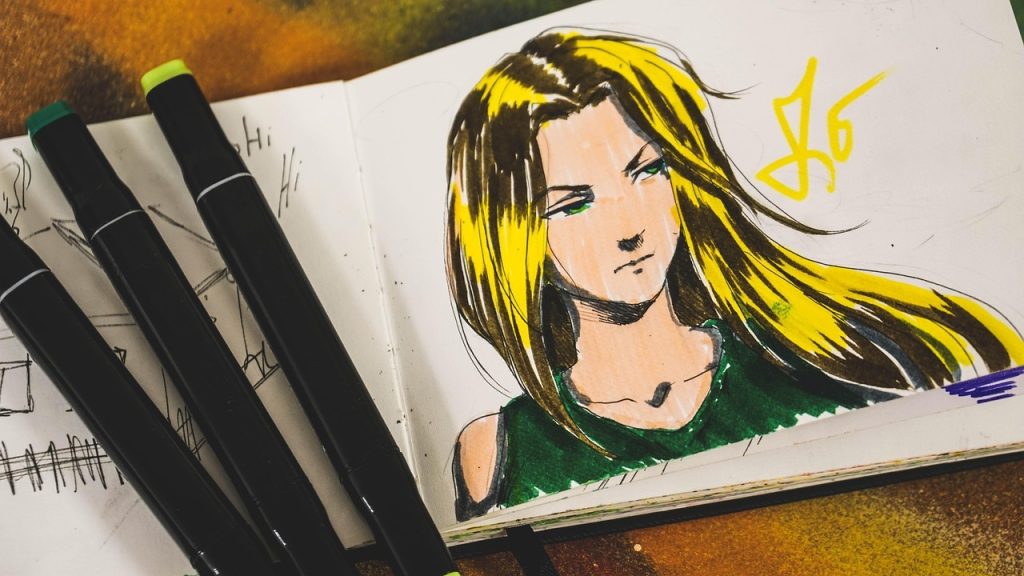
Image: SAVA86 / Pixabay · Pixabay Content License
Production · People · Moving images
Many contributions, one moving image.
Anime (アニメ) refers broadly to animation in Japanese; internationally it usually refers to Japanese animation. Television series, cinema releases and web works bring together different production arrangements, audiences and visual approaches.
See how the production comes together
This simplified map follows a common drawn-animation workflow. Teams revisit decisions, work on different shots at once and share work across studios. CG, stop-motion and experimental productions can use different processes.
02 · Parallel image work
Animation
Genga and dōga develop key drawings, movement and cleaned-up in-betweens.
Colour & backgrounds
Colour design, painted backgrounds and finishing supply complementary image elements.
CG & effects
Production-dependent models, animation and effects provide further image elements.
Middle lanes are parallel contributions, not three consecutive steps. Sound work and revision can overlap other stages; this is not a universal timetable.
Explore the full anime production overview, sakuga terminology and the role of an anime studio. The map draws on Toei Animation’s workflow and the production references below.
At a glance
- Medium
- Animation, not a single genre
- Formats
- TV series, films, OVA and web animation
- Production
- Creative work, technical processes and coordination
- Identification
- Title, version, episode or film, release and role-specific credits
Match the credit to the responsibility
| Role / institution | Main contribution | Keep distinct |
|---|---|---|
| Director / episode director | Creative direction and the staging of the work or episode. | Overall direction differs from supervision of drawings. |
| Animation director | Checks and supervises animation drawings for the production’s needs. | Not necessarily the director of the whole film or series. |
| Animators, background and compositing artists | Create movement, settings and assembled images. | The visible result combines several specialisms. |
| Seiyū and sound teams | Voice performance, music, sound effects and recording. | A voice actor’s credit is one part of a larger soundtrack. |
| Production staff / studio | Coordinate schedules, materials and production work. | The studio name alone does not identify every contributor. |
| Production committee | Participating companies arrange finance and rights exploitation. | Financing and rights organisation is not the animation workflow itself. |
The production committee model
The anime production committee is a financing and rights-management arrangement, not the animation team itself. Creative production also depends on performers, including the seiyu who record character voices and other vocal performances.
Many commercial projects are financed by a group of participating companies rather than a single studio. A production committee may include a broadcaster, publisher, music company, distributor, advertising company, toy maker, or streaming platform. Sharing investment spreads risk and connects the animation to broadcasting, publishing, music, merchandise, and international licensing.
This system helps explain why anime is often part of a larger media ecosystem. It can also make rights, credits, and long-term preservation complicated, because materials and responsibilities are divided among many organizations.
How to identify an anime production
Start with the version rather than the franchise name alone. Record whether the item is a film, television series, special, video release, short, or online production; then add the season, episode or instalment title, release or broadcast date, and whether it is an original work or an adaptation of a manga, novel, game, or other source. The Media Arts Database ontology distinguishes television programmes, video packages, films, and series as different record types, showing why one title can require several linked identities.
Next, read the credits by role: direction, script or series composition, character design, animation direction, art, photography or compositing, sound, music, voice performance, production studio, and rights or financing organizations. A studio name is not a complete authorship statement, and a production committee is not automatically the team that drew every cut. The Association of Japanese Animations production manual maps the coordinated workflow, while research on production committees addresses the industrial organisation around that work. For reliable identification, prefer the production’s on-screen credits and an institutional catalogue over promotional shorthand.
A medium, not one visual style
Large eyes, dramatic hair, and speed lines are familiar conventions, but they do not define all anime. Japanese animation ranges from spare television drawings to painterly feature films, stop motion, cut-paper work, 3D computer graphics, and abstract experiments. What connects the field is an industry, a history, and a network of creators—not a single look.
Anime also differs from manga. Manga is organised on a page and paced by the reader. Animation controls duration and adds movement, editing, colour, sound, music, and performance. Many works move between the two media, but adaptation is a new act of creation rather than a manga page made to move automatically.
Many formats, many audiences
Games remain a distinct interactive medium even when stories move between formats. The Legend of Zelda, for example, began as a video-game series and later expanded into concerts, print works, animation, and film projects.
Anime appears as television series, theatrical features, short films, web releases, music videos, commercials, and direct-to-video works known as OVA or OAV. Some projects adapt manga, novels, or games; others begin as original animation. A television story may later be re-edited for cinema, while a film may generate books, exhibitions, live events, or games.
Labels such as shōnen and shōjo refer to market categories inherited largely from publishing, not to rigid anime genres. Viewers of different ages and backgrounds frequently cross those boundaries.
Character animation and the power of the pose
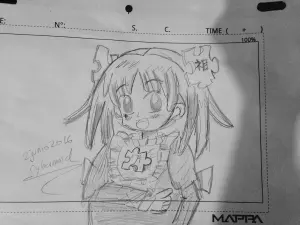
Anime often places great weight on a carefully drawn key pose. Movement may build toward that image or let it hold while sound and editing carry the scene. Facial acting can be subtle or highly symbolic. A sudden change to simplified “super-deformed” proportions may turn a serious character into a comic reaction without requiring realistic continuity.
The resulting rhythm alternates between stillness and bursts of motion. This is one reason screenshots alone cannot explain the medium: timing, cuts, voices, and music determine how an image feels.
Terminology
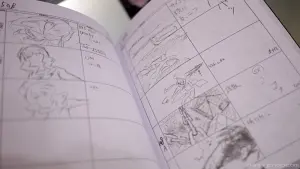
- E-konte: storyboard.
- Genga: key animation drawings.
- Dōga: in-between animation drawings; also the general Japanese word for moving images.
- Seiyū: voice performer.
- OVA / OAV: original video animation, released directly to home video rather than first broadcast or shown theatrically.
- Sakuga: literally “drawn pictures”; among fans, often used when discussing especially notable animation craft.
Anime turns drawing into a meeting place for performance, music, design, photography, editing, and industrial collaboration. Its global reach is important, but its deeper interest lies in the many ways Japanese creators have learned to make time, emotion, and imagined worlds from sequences of carefully chosen images.
The first century of Japanese animation
Imported animated films were shown in Japan in the early twentieth century, and Japanese artists soon began producing their own work. The National Film Archive of Japan marks 1917 as the year Japanese animation is believed to have been shown publicly for the first time. Much early film has been lost, but surviving works reveal experiments with drawn animation, cutouts, silhouettes, and other techniques.
Namakura Gatana (“The Dull Sword”), made by Kōuchi Jun’ichi and released in 1917, is among the earliest surviving Japanese animated films available to view today. Early production was often undertaken by very small teams, closer to a workshop than a modern studio.
From cinema to television
Animation expanded through theatrical shorts, wartime production, postwar studio rebuilding, and feature films. Television changed the scale and rhythm of the industry. Weekly broadcasting demanded efficient schedules, reusable design systems, and ways to create impact without animating every element continuously.
Tezuka Osamu’s television work in the 1960s, including Astro Boy, became influential in this environment. Limited animation was not simply “less animation.” Held drawings, strong poses, selective movement, repeated cycles, camera motion, editing, and sound could concentrate attention while meeting television constraints. Different studios developed their own solutions, and feature animation continued to pursue other levels of detail and movement.
Fans, places, and shared culture
The Slam Dunk Anime Songs reference follows nine distinct vocal themes across the television series and five Japanese theatrical films.
Television themes can become a separate route into a series. The Naruto Anime Songs reference follows all Japanese opening and ending themes across the original series and Shippuden.
Music is another route through which anime travels beyond an episode. Anison connects opening, ending and insert songs to recordings, streaming, concerts and fan performance, while remaining broader in sound than a single musical genre.
Pokémon demonstrates a different direction of adaptation: a video-game property expanded rapidly into television anime, manga, cards, films, toys, and location-based experiences.
Among the everyday venues surrounding media culture, manga cafes combine print collections with internet access, booths, drinks, and other services; they are distinct from themed character cafes.
VTuber culture in Japan overlaps with anime through character design, voice performance, events, and fan practice, but its improvised livestreaming and avatar-mediated interaction make it a distinct media form rather than a category of anime production.
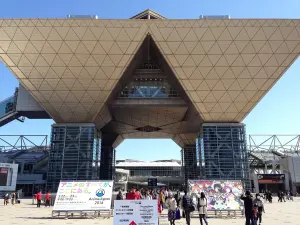
Game-focused events overlap with some of these practices without becoming anime conventions. Tokyo Game Show combines playable software and industry activity with stages, streaming, merchandise, and cosplay around cross-media franchises.
Fans do more than watch. They discuss episodes, draw fan art, collect objects, attend conventions, perform cosplay, and visit real locations that inspired fictional settings—a practice often called a “pilgrimage” or seichi junrei. Exhibitions allow viewers to see storyboards, key drawings, design sheets, and background art, making the normally invisible production process tangible.
Tokyo Anime Center in Shibuya presents changing exhibitions and events. The Suginami area is historically connected with many studios, while museums and archives across Japan preserve work from different periods. Check current schedules, because anime exhibitions are frequently temporary and ticketed.
Preserving a collaborative art
Animation preservation involves more than saving a finished video. Storyboards, cels, drawings, scripts, colour models, digital project files, and sound materials all document how a work was made. They are easily scattered or discarded after production. The National Film Archive of Japan’s Japanese Animated Film Classics project makes early works available and introduces pioneer artists; the Agency for Cultural Affairs also supports networks concerned with archiving manga, anime, and games.
Related entries
Sources
- Media Arts Database ontology
- Association of Japanese Animations production manual
- research on production committees
- Agency for Cultural Affairs, Anime Production Career Map and Workflow Report
- National Film Archive of Japan — Japanese Animated Film Classics
- Japanese Animated Film Classics — Early works and pioneer artists
- Association of Japanese Animations — Anime Industry Data
- Tokyo Anime Center — Anime as a culture shaped by creators and fans
- Kyoto International Manga Museum — Preserving manga, anime, and games
- Toei Animation, Animation production workflow
Last updated: