Crafts & Skills
Soroban
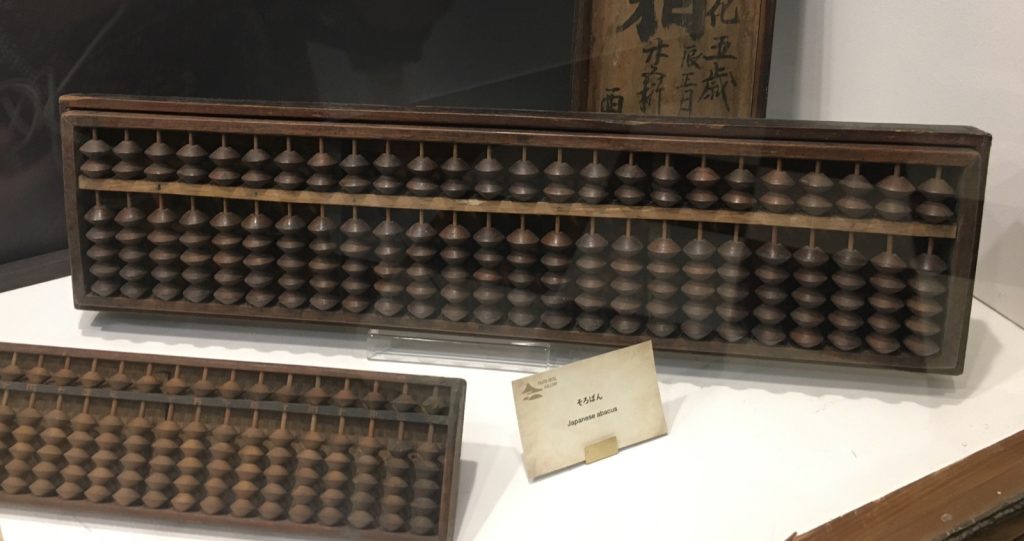
Image: Nesnad / Wikimedia Commons · CC BY 4.0
Overview
| Japanese name | 算盤 |
|---|---|
| Type | Japanese abacus |
| Structure | One upper and four lower beads per rod |
| Used for | Arithmetic and education |
| Related skill | Anzan |
Soroban (そろばん / 算盤) is the Japanese abacus: a compact calculating instrument in which beads represent numbers through place value. It is simple enough for a child to begin using, yet trained practitioners can perform long sequences of addition, subtraction, multiplication, and division at remarkable speed. The tool belongs both to the history of Japanese commerce and to the living culture of mathematical education.
Construction
A modern soroban has a rectangular frame crossed by a horizontal beam. Each vertical rod represents a decimal place. One bead above the beam is worth five units, and four beads below it are worth one unit each. Only beads moved toward the beam are counted. A small dot on the beam marks a chosen units column and helps the user locate decimal places.
This one-five and four-one arrangement is more economical than older abacus forms with additional beads. Every digit from zero to nine can be represented without redundancy. Because each rod is a place—ones, tens, hundreds, and so on—the physical layout makes the decimal system visible.
Soroban and other abacuses
The modern Japanese soroban normally has one five-value bead above the beam and four one-value beads below it on each rod. Traditional Chinese suanpan commonly used additional beads, although historical instruments and modern teaching models vary. The streamlined soroban represents every decimal digit from zero to nine without a redundant bead.
This structural difference supports the compact finger movements used in Japanese methods, but it does not make every soroban lesson or calculation unique to Japan. Abacus traditions developed through transmission, adaptation, commerce, and education across East Asia. See the League of Japan Abacus Associations for the Japanese educational context.
Numerical representation
Start with every bead moved away from the beam: this is zero. Move three lower beads up on the units rod to show 3. Add the upper bead and the same rod shows 8. On the rod to the left, those values are tens; farther left they become hundreds and thousands. Rods to the right can represent tenths and hundredths when working with decimals.
The soroban therefore does not store a number as a written symbol. It stores it as a spatial pattern. With practice, that pattern can be recognized at a glance and changed with coordinated finger movements.
History
Counting boards and abacus-like devices developed in many ancient societies. The form that shaped the Japanese soroban came through China, where the suanpan was widely used. The League of Japan Abacus Associations places the introduction of the Chinese abacus and its operating methods to Japan around the middle of the fifteenth century.
Japan’s growing cities and commerce encouraged calculation, while mathematicians and teachers adapted both the instrument and its methods. The large Chinese model became smaller and easier to handle. By the late nineteenth and early twentieth centuries, the streamlined one-five/four-one form was becoming standard. Soroban methods were included in national elementary arithmetic textbooks in 1938.
Commerce and education
During the Edo period, arithmetic was a practical skill for merchants, craftsmen, tax administration, and daily exchange. Private schools known as terakoya taught reading, writing, and calculation to children from a wide range of backgrounds. The soroban became a bridge between abstract number and the problems of weights, measures, prices, and accounts.
Modern schools reduced their reliance on the instrument as written arithmetic and electronic calculators spread, but soroban never disappeared. It remains part of Japanese elementary education and has a large network of private classes, examinations, and competitions.
Calculation principles
Beginners quickly discover that some additions cannot be made by simply moving another bead toward the beam. To add 4 when only two lower beads remain available, for example, the user may add 5 and subtract 1. These complement relationships—pairs that make 5 or 10—become automatic through practice.
Standard finger technique supports speed and accuracy. The thumb generally moves lower beads upward; the index finger moves them downward and operates the upper bead. Efficient motion matters because a long calculation is a chain of many small, precise changes.
Anzan and mental calculation
The separate Anzan entry explains how physical bead practice is internalised as visual and motor imagery for mental arithmetic.
Advanced students often practise anzan, mental calculation. Instead of depending on verbal arithmetic, they visualize an internal soroban and imagine the beads moving. In competitions, rapid sequences of numbers may be shown or read aloud, and the practitioner follows the changing image mentally.
This does not mean the physical tool becomes unnecessary. Repeated tactile practice builds the visual and motor pattern from which mental calculation develops. The hands teach the mind a stable way to organize number.
Examinations and competition
Soroban schools use graded levels called kyū and advanced ranks called dan. Tests may include multiplication, division, addition and subtraction, word problems, and mental calculation. Competitions add timed challenges such as reading long columns of figures or calculating numbers flashed briefly on a screen.
Speed is visible and exciting, but accuracy remains the foundation. A single bead moved incorrectly can change the place value of an entire result. Good training therefore develops calm repetition, consistent posture, and the habit of checking one’s work.
Contemporary practice
A calculator gives an answer; a soroban makes the structure of the answer tangible. Carrying across a decimal place is not an invisible rule—it is a physical transformation from ten units into one ten. This can help learners understand place value, decomposition, and numerical relationships before they become symbols on a page.
The appeal is also sensory. Beads click against the beam, both hands settle into a rhythm, and concentration is directed toward one changing pattern. For many practitioners, soroban is as much a disciplined skill as a computational device.
Basic operation
Basic study begins with clearing the frame, setting single digits, and reading multi-digit numbers. Simple addition without carrying is normally introduced before complements of five and ten. Instruction emphasizes accuracy before speed, together with a level frame, consistent fingering, and confirmation of each result before the instrument is cleared.
Tokyo’s Japan Soroban Museum in Taitō preserves historical instruments, books on Japanese mathematics, school textbooks, and material connected with abacus education. Visits currently require advance arrangements, so check its official information before going.
Terminology
- Ichi-dama: a lower bead worth one.
- Go-dama: an upper bead worth five.
- Hari: a vertical rod carrying the beads.
- Keta: a numerical place or digit column.
- Anzan: mental calculation, often using an imagined soroban.
- Kyū / dan: levels used in examinations and advanced ranking.
Soroban shows how a small object can shape a way of thinking. It links trade, schooling, hand movement, and mental imagery, preserving a five-century conversation between practical calculation and disciplined learning.
How to read a soroban method
When comparing instructions, first identify the active beads and the value assigned to the upper and lower beads. Then locate the ones column or chosen decimal marker, note the direction in which digits are entered, and follow the order of operations. Finally, watch for complement strategies—making five or ten—because an instruction may describe the same arithmetic through a different legal sequence of bead movements.
This checklist separates the instrument from the method used on it. Physical soroban calculation, anzan with an imagined abacus, written arithmetic, and timed examination performance are related but not interchangeable measures. The League of Japan Abacus Associations provides a useful institutional introduction; a precise account should still state the exercise format, digit length, time limit, and accuracy rule rather than report speed alone.
Related entries
For abacus-based mental arithmetic, see Anzan.
Sources and further reading
Last updated: