Karate
Karate at the Asian Games
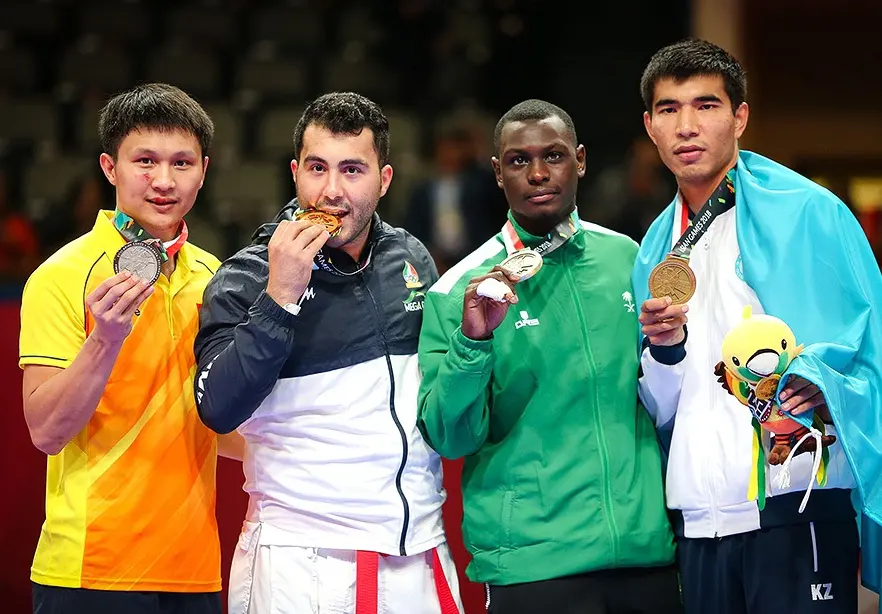
Image: Amir Hosseini / Fars News Agency via Wikimedia Commons · CC BY 4.0
Karate at the Asian Games is the sport's medal programme within the Olympic Council of Asia's continental multi-sport event. Competition is divided between kata, judged performances of prescribed forms, and kumite, controlled point fighting in weight categories. Event-specific official histories identify Hiroshima 1994 as karate's Asian Games debut, although one current OCA sport profile instead says Beijing 1990; the contradiction should be preserved rather than silently harmonised. Programmes, weight limits, team events, rules, and schedules vary by edition, so results must be read in their original context. At Aichi-Nagoya 2026, karate is scheduled for September 20–23 at Toyohashi Gymnasium, with men's and women's individual and team kata plus eleven kumite categories in the published programme.
Overview
| Sport | Karate |
|---|---|
| Multi-sport event | Asian Games |
| Organiser | Olympic Council of Asia |
| Competition forms | Kata and kumite |
| Debut in event-specific histories | Hiroshima 1994 |
| Source discrepancy | One OCA sport profile states Beijing 1990 |
| Aichi-Nagoya 2026 dates | September 20–23, 2026 |
| 2026 venue | Toyohashi Gymnasium, Aichi Prefecture |
| Published 2026 programme | Four kata and eleven kumite medal events |
Place in the Asian Games
The Asian Games are a multi-sport event for National Olympic Committees in Asia. Karate is one medal sport within that programme. Athletes enter through national delegations, while the host organising committee integrates karate into Games-wide scheduling, venues, accreditation, ceremonies, ticketing, medical services, and results systems.
This setting differs from a standalone Asian karate championship. A medal belongs to a specific Asian Games edition and event; it should not be relabelled as an Asian Championships or Olympic result even when athletes, rules, and technical officials overlap.
Debut and an official source discrepancy
The OCA's event page for Hiroshima 1994 lists karate among the sports debuting at that edition, and the Hangzhou 2022 organising committee also says karate was first incorporated into the Asian Games in 1994. These event-specific sources support Hiroshima as the programme debut used in most result chronologies.
A current OCA karate sport profile instead states that karate entered at Beijing 1990. Because these official pages conflict, the discrepancy should be reported rather than concealed. This article follows the event-specific 1994 accounts for its working chronology while preserving the contrary OCA statement for readers and future correction.
Kata and kumite
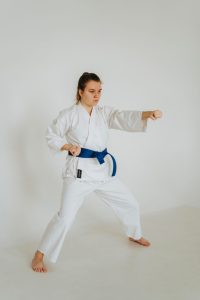
Kata competition evaluates a performed sequence of offensive and defensive movements against imagined opponents. Judges assess criteria defined by the rules in force, including technical execution and athletic performance. Team kata adds synchronised performance and, in some formats, bunkai demonstrations of application.
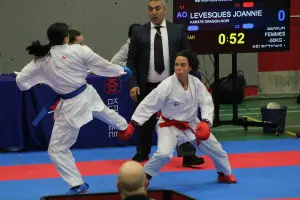
Kumite places two competitors on the tatami in a controlled point contest. Scores distinguish qualifying punches, kicks, and actions under edition-specific rules. The need for speed, distance, timing, control, tactics, and referee interpretation makes competition kumite different from unrestricted fighting and from partner practice in a dōjō.
Development of the programme
Asian Games karate programmes have changed across editions. Individual kata has been a recurring component, team kata has appeared in recent editions, and kumite has been organised through men's and women's weight categories whose number and limits are not permanently fixed.
Hangzhou 2022, staged in October 2023 while retaining its edition name, offered fourteen gold medals across individual and team kata and kumite categories. The published Aichi-Nagoya 2026 list has four kata events and eleven kumite events, adding a men's −55 kg division to a programme of six men's and five women's kumite categories.
Categories, rules, and safety
Every event has its own eligibility, draw, judging, scoring, warning, penalty, protective-equipment, and medical provisions. Current weight labels should not be projected backward onto earlier Games, and a familiar kata name does not prove that the same judging criteria applied in every edition.
Competition rules shape tactics as well as safety. Research on elite kumite distinguishes scoring and non-scoring attempts, initiated and counterattacking techniques, and different punch, kick, and takedown actions. Such analysis concerns regulated competition, not karate's entire technical or educational repertoire.
Institutions and delegations
The OCA owns the wider Games framework, the host organising committee runs the edition, and karate federations provide technical structures and national selection pathways. Japan's entries are selected through processes announced by the Japan Karatedo Federation, while other National Olympic Committees and federations use their own criteria.
Selection does not follow automatically from domestic rank, style membership, or one tournament result. Quotas, qualification policies, selection meetings, health, eligibility, and delegation rules can all affect who starts in a specific Asian Games event.
A continental field and edition-specific results
The Asian Games assemble karateka from East, Southeast, South, Central, and West Asia. Strength varies by category and generation, so a single all-time national ranking can obscure changes in programme size, women's participation, team events, political designations, and competitive depth.
A precise result identifies the edition, event, sex, weight category where relevant, athlete or team, National Olympic Committee, and medal stage. Official result books and draw sheets are more reliable than undated summary tables because they retain the structure under which the medal was awarded.
Relation to other major competitions
Asian Games karate is separate from the Asian Karate Championships, World Karate Championships, Karate 1 events, national championships, and the Olympic programme. Similar kata and kumite terminology does not merge their qualification systems, quotas, results, or institutional ownership.
Karate appeared on the Olympic programme at Tokyo 2020, but an Olympic medal and an Asian Games medal remain different achievements. The Asian Games also continue on their own cycle regardless of karate's presence or absence at a particular Olympic edition.
Aichi-Nagoya 2026
The Japan Karatedo Federation lists Asian Games karate from September 20 to 23, 2026, at Toyohashi Gymnasium. Toyohashi is in Aichi Prefecture but outside Nagoya City, an important geographical distinction within the multi-venue Aichi-Nagoya Games.
Published organising-committee materials list men's and women's individual kata, men's and women's team kata, six men's kumite categories from −55 kg to +84 kg, and five women's categories from −50 kg to +68 kg. The schedule and operational details were checked on September 10, 2026 and remain subject to official change before and during competition.
| Aichi-Nagoya 2026 group | Published medal events |
|---|---|
| Kata | Men's individual, women's individual, men's team, women's team |
| Men's kumite | −55 kg, −60 kg, −67 kg, −75 kg, −84 kg, +84 kg |
| Women's kumite | −50 kg, −55 kg, −61 kg, −68 kg, +68 kg |
Reading the 2026 record
Before the event concludes, athlete lists, draws, session times, and even programme details can change. Contemporary reporting should date-stamp provisional information and avoid treating a selection announcement as proof that an athlete started or won a bout.
After the Games, final official result books should replace preliminary schedules for medal and participation claims. Corrections should preserve the distinction between the Games dates, the four-day karate programme, and each individual medal event.
Sources
- Olympic Council of Asia, Hiroshima 1994.
- Olympic Council of Asia, Karate Sport Profile.
- Hangzhou 2022 Organising Committee, Karate.
- Aichi-Nagoya 2026 Organising Committee, Karate.
- Japan Karatedo Federation, 20th Asian Games.
- Aichi-Nagoya 2026 Organising Committee, 46th Board Meeting Materials.
- Japanese Academy of Budo, Tactical Analysis of Karate Kumite at the Tokyo 2020 Olympics.
Last updated: