Seasonal Customs
Chōyō no Sekku
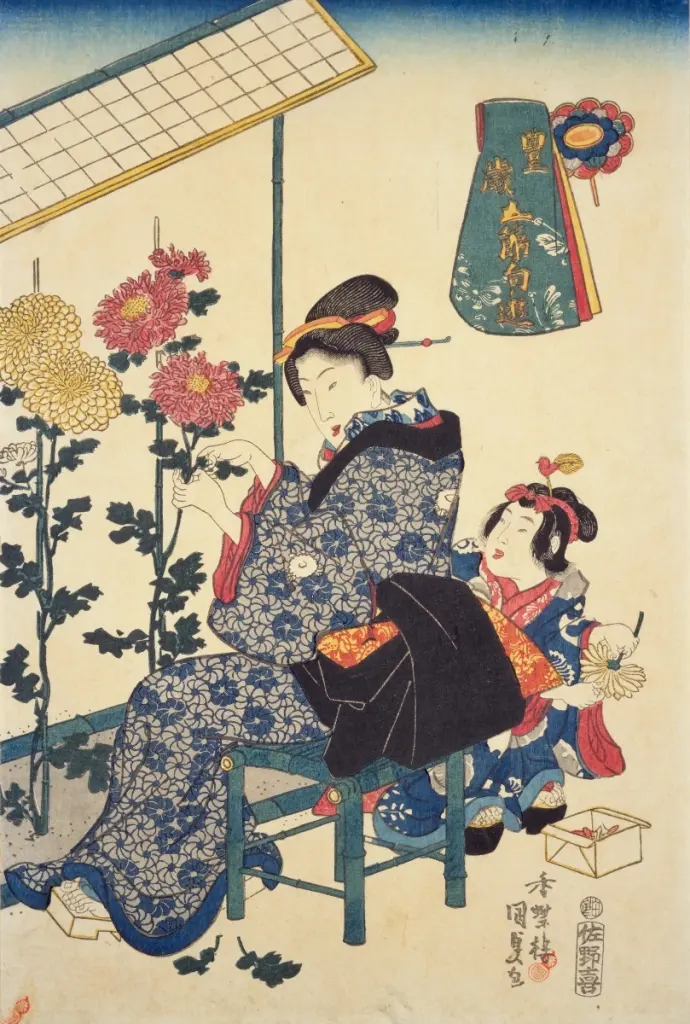
Image: Kōchōrō Kunisada (Utagawa Kunisada) / NDL Image Bank, National Diet Library, Japan · Public domain
Chōyō no Sekku (重陽の節句), observed on the ninth day of the ninth month, is the last of Japan’s five traditional seasonal festivals, or gosekku. Also called Kiku no Sekku, the Chrysanthemum Festival, it associates the doubled number nine with auspicious yang energy and chrysanthemums with longevity and protection from illness. The observance reached Japan through cultural exchange with China and became an imperial court ceremony involving chrysanthemum viewing, poetry, chrysanthemum sake, and kiku no kisewata—silk floss placed on flowers to gather dew and scent. Edo-period authorities treated the five sekku as formal ceremonial days, while popular practice linked Chōyō with chrysanthemums, chestnuts, and the autumn harvest. Calendar reform moved the fixed date ahead of its old seasonal timing, reducing its visibility, but shrines and cultural institutions still maintain or revive related rites.
Overview
| Japanese | 重陽の節句 |
|---|---|
| Romanization | Chōyō no Sekku |
| Alternative name | Kiku no Sekku, or Chrysanthemum Festival |
| Date | Ninth day of the ninth month; commonly September 9 today |
| Festival cycle | The fifth and final gosekku |
| Characteristic customs | Chrysanthemum viewing, chrysanthemum sake, kiku no kisewata, and chestnuts |
Name, date, and the double nine
Chōyō means “double yang.” Within the yin–yang numerology commonly used to explain the festival, odd numbers are associated with yang, and nine is the largest single-digit odd number. The repetition of nine on the ninth day of the ninth month therefore gave the date exceptional symbolic force. Sekku names a seasonal observance or ceremonial day, and the spelling 節供 is also encountered in historical discussion.
Modern Japanese calendars place Chōyō on September 9. Historically, however, the date belonged to the ninth month of the lunisolar calendar, which usually falls later in the Gregorian year, around the chrysanthemum season. The two dates carry the same numerical pattern but not the same seasonal conditions, an important distinction when interpreting older descriptions.
Continental origins and the Japanese court
The observance developed from East Asian Double Ninth customs transmitted from China. Japanese court records place a ninth-month banquet in 685, and later sources describe a chrysanthemum banquet restored in 807 under Emperor Heizei. By the Heian period, Chōyō had become part of courtly seasonal life, with flowers, sake, poetry, and rites of protection and longevity.
These records show early adoption, but they do not prove one unchanged ceremony running continuously to the present. Chōyō accumulated different forms as court practice, warrior government, urban culture, agricultural timing, and local religious institutions each reworked the date. Its Chinese ancestry is essential, yet the Japanese festival should not be treated as identical to every historical or contemporary form of China’s Double Ninth Festival.
Place among the five seasonal festivals
Chōyō closes the gosekku sequence. Several dates entered Japan through continental calendrical culture, and the Edo shogunate later designated the five as formal ceremonial days. Their household and public forms developed differently, so the shared numerical pattern does not imply that all five festivals have the same origin or ritual content.
| Date | Festival | Common association |
|---|---|---|
| January 7 | Jinjitsu | Seven herbs |
| March 3 | Jōshi; Hina Matsuri | Peach blossoms and hina dolls |
| May 5 | Tango | Iris and children’s celebrations |
| July 7 | Tanabata | Stars, writing, and bamboo decorations |
| September 9 | Chōyō | Chrysanthemums and longevity |
Chrysanthemums, longevity, and chrysanthemum sake
Japan’s modern national holiday Keirō no Hi also celebrates longevity, but it emerged from twentieth-century welfare and civic campaigns rather than from the ritual history of the chrysanthemum festival.
The chrysanthemum, kiku in Japanese, was transmitted from China and valued in medicinal and symbolic contexts. At Chōyō it came to represent long life, health, and the removal of harmful influence. Kiku-zake, or chrysanthemum sake, places the flower’s fragrance or petals in a ceremonial drink; recipes and presentation vary, so it is better understood as a family of practices than as one fixed preparation.
Chrysanthemum viewing also moved beyond the court. National Diet Library materials describe Edo-period observances in which people compared cultivated flowers and created chrysanthemum figures. These displays belong to the broader history of chrysanthemum culture, although a modern horticultural exhibition is not automatically a Chōyō rite.
Kiku no kisewata
Kiku no kisewata, the “chrysanthemum covering of silk floss,” is one of the festival’s most distinctive courtly practices. On the evening before Chōyō, silk floss was placed over chrysanthemum flowers. By morning it had gathered dew and fragrance, and people used it to wipe the face or body while wishing for health, youthfulness, and long life.
Court literature and later reconstructions preserve the custom, and the Costume Museum distinguishes its association with women of the inner court from the male aristocratic setting of some chrysanthemum-sake banquets. That social contrast describes particular historical settings rather than a universal rule for every period or locality. Today, kisewata may appear in shrine rites, cultural demonstrations, decorative displays, and wagashi names.
Food, harvest, and popular practice
Chōyō is also called Kuri no Sekku, the Chestnut Festival. Accounts of early modern Kyoto mention steamed chestnuts, gifts of chestnuts, and chrysanthemum sake, while chestnut rice is now a common way of presenting the autumn association. Edible chrysanthemum petals and sweets shaped or coloured like chrysanthemums provide other seasonal expressions.
The old lunar date fell near the autumn harvest, allowing court symbolism to overlap with gratitude for crops and local foodways. These foods were never a mandatory nationwide menu. Region, status, household economy, and period all affected what people prepared, and modern observances often select only one element—flowers, sake, chestnuts, or sweets.
Calendar reform and changing visibility
Japan’s shift from a lunisolar calendar to the Gregorian calendar in the early Meiji period changed the festival’s seasonal setting. A fixed September 9 arrives during lingering summer heat in much of Japan, while the corresponding old-calendar date often falls in October, when chrysanthemums and chestnuts feel more naturally timed. Kyoto cultural sources identify this mismatch as one reason Chōyō became less prominent.
The other gosekku did not all follow the same path. Hina Matsuri and Tango no Sekku retained strong household and commercial forms, while Tanabata developed major regional festivals. Chōyō survives more visibly through specialised cultural events, horticulture, food, and shrine or temple observances than through a uniform national household celebration.
Living observances
At Kamigamo Jinja, the sequence continues with Karasu-zumo: ritual officers perform crow calls and movements before children dedicate sumo bouts in two sides.
Kamigamo Jinja in Kyoto provides a prominent living example. Its official annual calendar lists a Chōyō ritual at 10:00 on September 9, followed by Karasu-zumo, a children’s ceremonial sumo observance. The pairing connects the seasonal date with the shrine’s own ritual history; it should not be taken as the standard format for Chōyō everywhere.
Other institutions present chrysanthemum displays, poetry, tea, sake, or kisewata demonstrations. Such events may preserve an inherited local rite, revive a documented court practice, or interpret the festival for present-day audiences. The specific organiser and programme matter when describing continuity.
Interpretation and boundaries
Chōyō no Sekku is broader than a single Shinto festival. Its history joins continental calendrical ideas, imperial ceremony, literature, flower cultivation, food, harvest timing, and local religious practice. A shrine’s Chōyō shinji is a Shinto rite, but the whole cultural complex cannot be reduced to that setting.
Descriptions should also state which calendar they use and avoid presenting every modern reconstruction as uninterrupted custom. The most durable thread is not one fixed ritual script, but the repeated association of the double ninth with chrysanthemums, longevity, and the turn toward autumn.
Sources
- Agency for Cultural Affairs, Cultural Heritage Database: Gosekku-zu by Kakizaki Hakyō.
- National Diet Library Image Bank: Nagatsuki (The Ninth Month).
- Kyoto Cultural Communication: Kyoto’s Five Seasonal Festivals — Chōyō.
- Costume Museum: Annual Events and Court Culture — Ninth Month.
- Kamigamo Jinja: Annual Festival Calendar.
Last updated: