Japanese New Year
Kagami Mochi
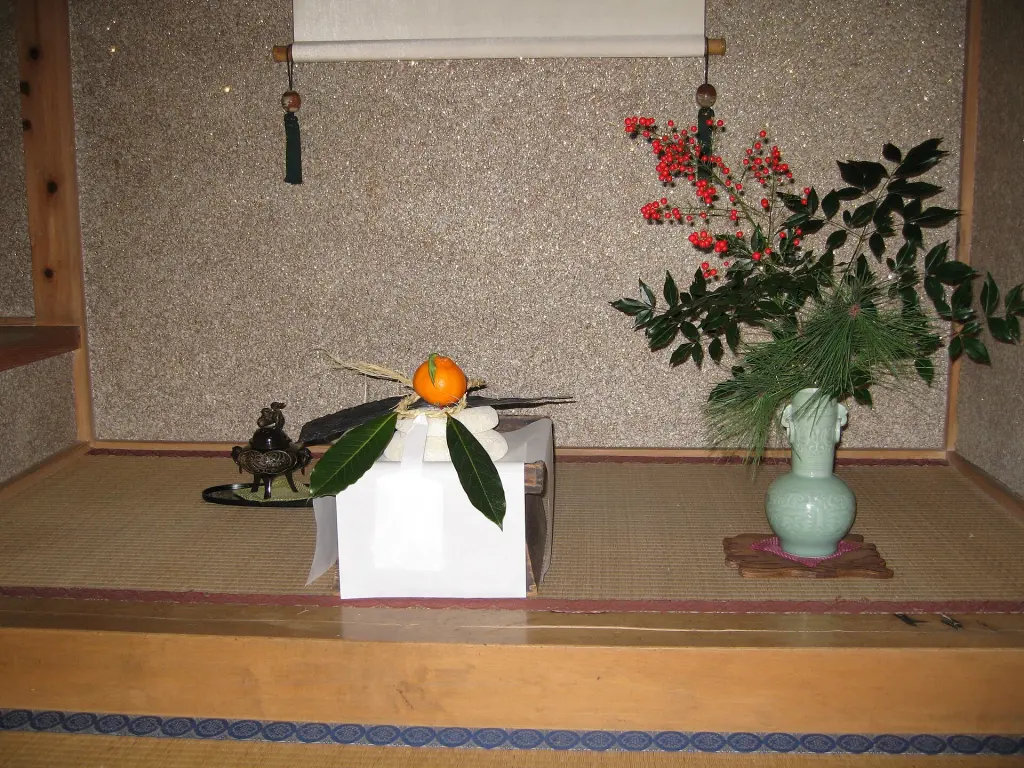
Image: サフィル / Wikimedia Commons · CC BY-SA 4.0
Kagami mochi are round rice cakes stacked and displayed during the Japanese New Year. A smaller cake usually rests on a larger one, often with a daidai citrus or another ornament above and paper, fern, kelp, or other auspicious elements around the base. The arrangement is more than decorative food: it is traditionally offered to Toshigami, the visiting New Year deity, in a household setting prepared for Shōgatsu. The name links the round form to an old-style mirror, an object with ritual associations in Japan. After the display period, the mochi is opened rather than ceremonially cut in the observance called kagami biraki and then eaten. Materials, dates, placement, and decoration vary by region and household, and many contemporary examples use sealed or molded packaging.
Overview
| Japanese name | 鏡餅 |
|---|---|
| Romanization | Kagami mochi |
| Literal meaning | Mirror rice cake |
| Basic form | Two stacked round mochi, often with an ornament above |
| Ritual role | New Year offering associated with Toshigami |
| Closing observance | Kagami biraki, followed by eating the mochi |
Name and mirror association
Kagami means mirror and mochi means glutinous rice cake. The rounded, slightly flattened cakes have been compared to the shape of early metal mirrors, which carried ritual and status associations. The name does not mean that the mochi functions as an ordinary reflective object.
The standard form uses two cakes of unequal size. Interpretations connecting the pair to sun and moon, past and coming years, or layered good fortune circulate widely, but meanings are not always documented uniformly. The offering context is more secure than any single symbolic decoding.
Offering and Toshigami
Kagami mochi is presented to Toshigami during the New Year season. Rice and mochi carry particular weight as products of cultivation, festive labor, and offerings to kami. The display helps connect the visiting deity, the household, and the meal through which the offering is eventually shared.
Kokugakuin University's Encyclopedia of Shinto lists kagami mochi among the offerings placed for Toshigami together with rice, sake, fish, salt, and other foods. Household practice may be explicitly devotional, customary, or largely seasonal, and those motives can coexist.
Form and components
A familiar arrangement places two round white cakes on a stand or tray. A daidai citrus, whose name can suggest successive generations, often sits on top. Decorative paper, urajiro fern, konbu kelp, dried persimmons, lobster, or other auspicious foods and plants may be included.
Components differ by locality, family, scale, and retailer. The small orange-colored object on a commercial display may be a mandarin, a daidai, or an imitation, so visual shorthand should not be mistaken for a fixed ritual prescription.
Placement in the home
Kagami mochi may be placed at a kamidana, in a tokonoma, or at another significant household location. Some homes prepare more than one display for different rooms or deities, while others use a single compact arrangement.
Placement depends on the architecture and religious life of the household. Modern apartments may lack both kamidana and tokonoma, prompting use of a shelf, cabinet, or other clean elevated surface. The change in setting does not by itself eliminate the seasonal meaning.
Preparation and display period
Traditionally prepared through mochi pounding or obtained from a specialist, kagami mochi is installed before New Year's Day as part of year-end preparations. As with other decorations, display beginning only on December 31 is often avoided as one-night decoration.
Fresh mochi hardens and can develop cracks during the display. Contemporary products may enclose individual rice cakes within a plastic outer shape, slowing deterioration and simplifying later eating. These packages reproduce the silhouette while changing the material experience of the offering.
Kagami biraki
Kagami biraki means opening the mirror. On a designated January date, commonly around January 11 but varying by region and institution, the hardened offering is broken into pieces and eaten in soup, sweet azuki preparation, or another dish.
The verb open avoids the language of cutting, which can evoke severing or weapons. Historically, a wooden mallet might be used on dried mochi. In present homes, the method depends on whether the display is fresh, dried, or commercially packaged.
Regional variation and food safety
Dates, decorations, cake size, and the way the mochi is eaten vary. Regional New Year calendars and household lineages may preserve practices different from those represented in national advertising. Large ceremonial kagami mochi also appear in shrines, martial arts organizations, companies, and community events.
Mochi becomes dense and sticky when eaten, creating a choking risk, especially for older adults and young children. It should be divided into manageable pieces and eaten slowly with attention. This practical caution belongs alongside, rather than outside, the object's ritual history.
Sources
- Government of Japan, The Origins and Significance of Japan's New Year's Culture.
- Government of Japan, Traditional Winter Events in Japan.
- Kokugakuin University Digital Museum, Shogatsu.
- Ministry of Agriculture, Forestry and Fisheries, Kagami Mochi.
- Web Japan Kids, Partaking of Decorative Mochi.
- Kokugakuin University Digital Museum, Toshigami, Toshitokujin.
Last updated: