Judo
Kaeshi-waza
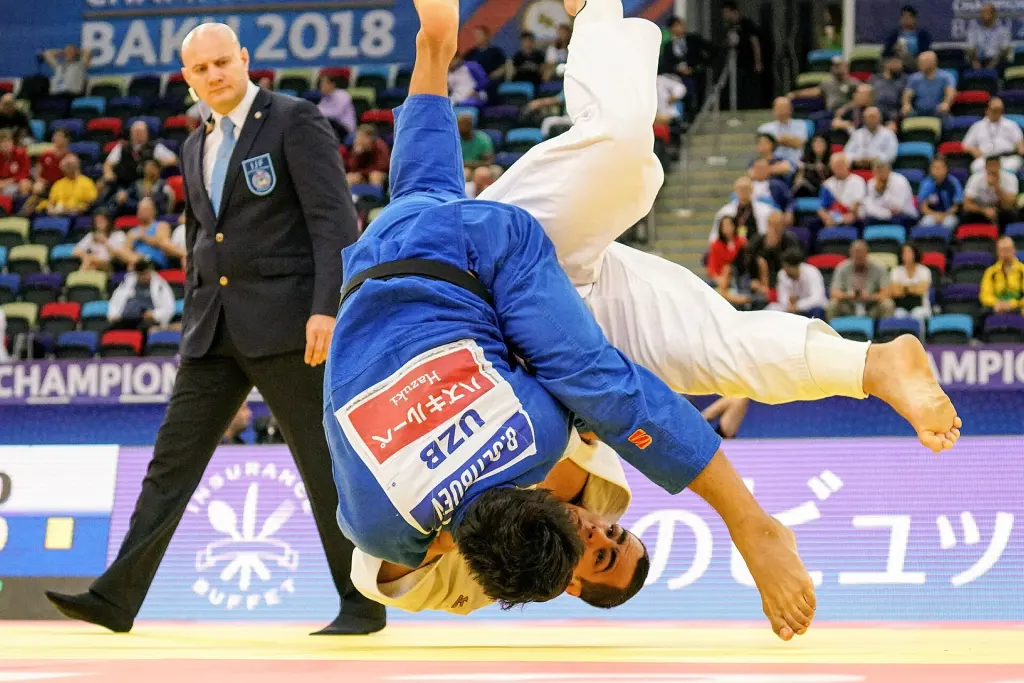
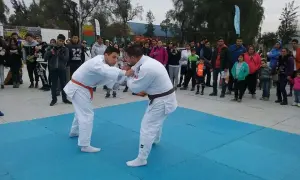
Image: Rodolfo Vilela / Rede do Esporte / Wikimedia Commons · CC BY 3.0 Brazil
Kaeshi-waza (返技) are counter techniques in Judo: responses that use the timing, direction or imbalance created by an opponent’s attack. They form a tactical relationship rather than one of the Kodokan’s five Nage-waza classes. Some officially named throws—such as tsubame-gaeshi, ko-uchi-gaeshi and uchi-mata-gaeshi—are defined through a particular countering relationship, while other recognised throws can also function as counters in context. A 2025 Kodokan study of a handwritten list attributed to Jigoro Kano documents early headings for counter and connected techniques. The sheet is undated, however, so its proposed 1886–87 context remains a scholarly inference rather than a confirmed date.
Overview
| Japanese | 返技 |
|---|---|
| Reading | かえしわざ |
| Romanisation | kaeshi-waza; common search form: kaeshi waza |
| Meaning | Counter techniques |
| Martial art | Judo |
| Classification | Tactical category, not a Kodokan nage-waza class |
| Relevant organisation | Kodokan Judo Institute |
Meaning
Kaeshi means returning, reversing or countering, and waza means technique. In Judo the term concerns the relationship between an initiating attack and a response, not simply a throw whose name ends in -gaeshi.
A counter can evade, redirect, lift, rotate or exploit the attacker’s loss of posture. What joins these actions is that the opponent’s attack supplies the timing and conditions for the response.
Counterattack in Judo
Effective counterattack requires defence without surrendering posture. The defender receives enough information to identify the attack, prevents its completion, and converts the exchange into an immediate throwing opportunity.
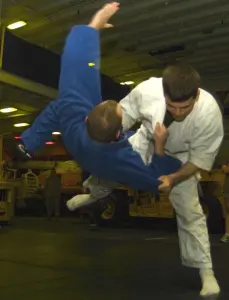
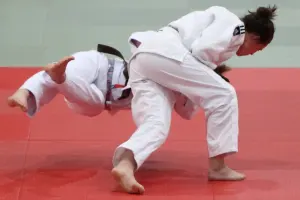
This does not mean waiting passively. Grip, stance and movement can invite or limit an attack, while the counter still depends on the opponent genuinely initiating it. The boundary between counter, reversal and new attack can be difficult to determine from a still image.
Timing
A counter is normally available before the attacking judoka regains a stable base. Acting too early can produce an unrelated attack; acting too late may leave the defender already thrown or unable to control the landing.
Different kaeshi-waza use different moments. Tsubame-gaeshi evades a foot sweep and returns it rapidly, while a hip counter may use the instant an attacker has turned and committed the body.
Kuzushi
The attacker often creates part of the counter’s Kuzushi by stepping deeply, rotating or shifting weight onto one support. The defender adds direction and control rather than relying on the attacker’s momentum alone.
Good posture remains decisive. A defender who resists only with strength may stop the first technique but lose the mobility needed to counter safely.
Kodokan counter techniques
The current Kodokan catalogue does not publish a separate closed list titled kaeshi-waza. The following officially named throws have representative definitions explicitly centred on countering or evading another named throw.
| Technique | Kodokan class | Representative counter relationship |
|---|---|---|
| Tsubame-gaeshi | Ashi-waza | Evades and returns de-ashi-harai |
| Ko-uchi-gaeshi | Ashi-waza | Counters ko-uchi-gari |
| O-uchi-gaeshi | Ashi-waza | Counters o-uchi-gari |
| O-soto-gaeshi | Ashi-waza | Counters o-soto-gari |
| Hane-goshi-gaeshi | Ashi-waza | Counters hane-goshi |
| Harai-goshi-gaeshi | Ashi-waza | Counters harai-goshi |
| Uchi-mata-gaeshi | Ashi-waza | Counters uchi-mata |
| Uchi-mata-sukashi | Te-waza | Evades uchi-mata and throws through the opening |
Classification boundaries
Throws such as utsuri-goshi, ushiro-goshi, yoko-guruma and ura-nage can occur as responses to an opponent’s entry, but their Kodokan identities are not limited to one named counter. Conversely, the suffix -gaeshi does not by itself prove that a technique belongs to a fixed counter list.
Official classification follows the principal throwing mechanism—hand, hip, foot or leg, rear sacrifice, or side sacrifice. Kaeshi-waza describes how the opportunity arises. A technique can therefore be ashi-waza by mechanism and kaeshi-waza by tactical use.
Early Kodokan documentation
In 2025 the Kodokan Science Bulletin published a study of a brush-written technique list attributed to Kano Jigoro through handwriting comparison with his known notes. The sheet includes groupings for throwing names, counter techniques and connected or changing techniques, showing that these relationships were being organised early in Kodokan development.
The document itself carries no date. The authors propose a context around 1886–87 from its terminology and place in the evolution of technical names. That dating is reasoned institutional scholarship, not a date written on the source, and the list should not be mistaken for the final modern Kodokan catalogue.
Counters in kata
Kodokan kata preserve formal attack-and-response study. Nage-no-kata, for example, requires tori to respond to defined actions with precise timing, posture and control rather than simply display isolated throws.
The standard Kodokan kata list does not contain an official kata titled “Kaeshi-no-kata.” Later or non-Kodokan counter forms may use that name, so their lineage and governing body should be identified rather than treated as one universal Kodokan form.
Counters in randori
In Randori, counters test perception and control against attacks that vary in speed and direction. Practice should begin with agreed movements and safe falling before greater uncertainty is introduced.
Overcommitting in hope of a counter can damage posture and reduce initiative. Kaeshi-waza complements Renraku-waza: one changes in response to the opponent’s attack, while the other connects one’s own attacks through reaction.
Competition
In competition, referees evaluate the scoring action and control, not a competitor’s intended label. When both judoka fall during an attack and counter, the score belongs to the action that clearly meets the current criteria; ambiguous control can make attribution difficult.
Every counter must comply with current rules on grips, leg contact, landing, head use and dangerous actions. The IJF rule source researched here is dated 14 August 2026. It governs IJF contests, while national and youth events may add restrictions.
Sources
- Kodokan Judo Institute, List of Judo Technique Names Written by Kano Jigoro, 2025.
- Kodokan Judo Institute, Judo Technique Names.
- Kodokan Judo Institute, Names of Judo Techniques.
- Kodokan Judo Institute, Definitions of Judo Techniques, 2022.
- Kodokan Judo Institute, Nage-no-kata.
- Sports Movement Studies, Analysis of Judo Combination and Counter Tactics, 1999.
- International Judo Federation, Sport and Organisation Rules, 14 August 2026.
Last updated: