Judo
Ne-waza
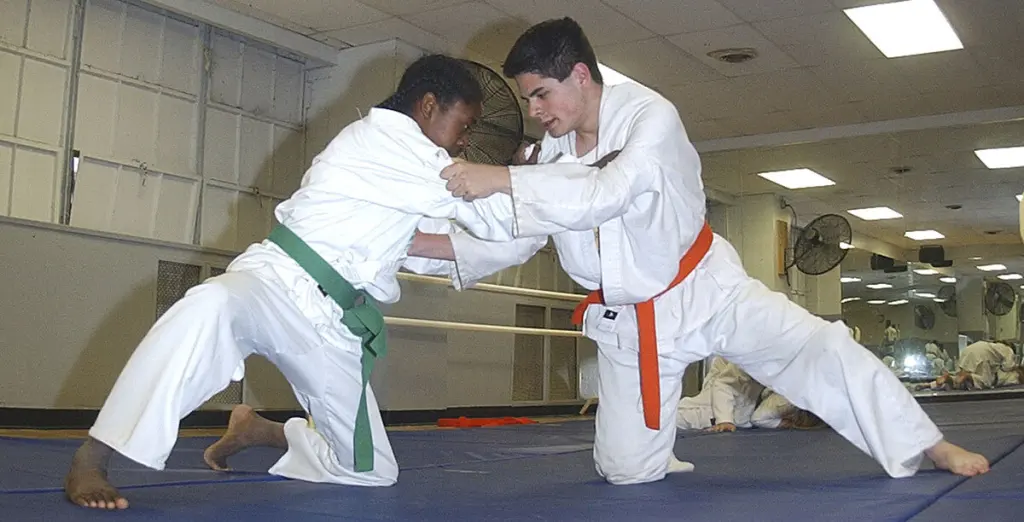
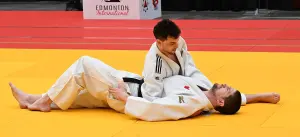
Image: Sgt. Donald Bohanner, United States Marine Corps / Wikimedia Commons · Public domain (work of the United States Marine Corps)
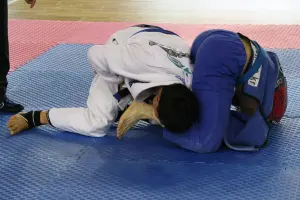
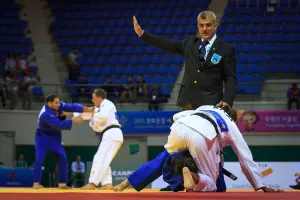
Ne-waza (寝技, ground techniques or groundwork) is the phase of Judo in which one or both judoka work from a grounded position. It includes the application of Katame-waza—pins, strangles, and joint locks—but the two terms are not synonyms. Katame-waza is the Kodokan's formal technical category of 32 named controlling techniques; ne-waza is the broader situation and practice of ground engagement, including turnovers, escapes, movement, transitions, and temporary positions that are not themselves named katame-waza. This distinction matters in teaching and competition. A judoka may be in ne-waza without having secured a recognised hold, and current IJF rules determine when standing action has become ground action and how long it may continue.
Overview
| Japanese | 寝技 |
|---|---|
| Reading | ねわざ |
| Romanisation | ne-waza; common search forms: newaza, judo groundwork |
| Meaning | Ground techniques; groundwork |
| Martial art | Judo |
| Related official category | Katame-waza |
| Competition authority researched | IJF SOR, 14 August 2026 |
Meaning of ne-waza
Ne (寝) conveys lying down or reclining, and waza (技) means technique. The term contrasts with tachi-waza, standing technique. In ordinary Judo usage, it covers the ground phase rather than one specific catalogue of names.
English speakers often write newaza as one word. TokyoWaltz uses ne-waza in article text to show the Japanese compound while recognising both search forms.
Ne-waza and katame-waza
Katame-waza is an official Kodokan classification comprising 10 osaekomi-waza, 12 shime-waza, and 10 kansetsu-waza. Ne-waza is a positional and training term. Most contest applications of katame-waza occur in ne-waza, but movement before and between them also belongs to groundwork.
For example, turning a prone opponent, replacing a trapped leg, escaping a pin, or moving from a failed throw into control is ne-waza even when no final named katame-waza has yet been established. Conversely, IJF rules may permit a standing athlete to apply a choke or arm lock against an opponent already defined as grounded; terminology and contest phase therefore need to be read carefully.
Osaekomi
Osaekomi-waza are holding or pinning techniques. Under the current IJF definition, the controlling form must be a recognised Kodokan pin or variation, with control from the side, rear, or above, the opponent's full back or upper back on the tatami, and the holder's body not controlled by the opponent's legs.
Contest time begins only after the referee announces osaekomi. In the 14 August 2026 SOR, 20 seconds scores ippon, 10–19 seconds waza-ari, and 5–9 seconds yūkō. A short period of apparent top position is therefore not automatically a score.
Shime-waza
Shime-waza are strangling or choking techniques. Kodokan classification names 12. In supervised Judo practice, the receiving partner submits by tapping twice or saying maitta before loss of consciousness; the referee also stops the action when submission or incapacity is clear.
Current IJF rules prohibit applying a choke with only the fingers or by using the belt or jacket skirt as a ligature. Age and national restrictions are material: cadet athletes who lose consciousness from shime-waza cannot continue in the competition.
Kansetsu-waza
Kansetsu-waza are joint-locking techniques. The Kodokan catalogue includes 10, but current IJF contest rules permit joint locking only at the elbow. Named Kodokan methods involving other joints remain historical or technical classifications rather than legal IJF contest actions.
A contest submission is scored ippon. Training depends on progressive control and immediate recognition of a tap; the purpose is not to force a joint to its anatomical limit. Youth rules may prohibit arm locks entirely.
Transitions from tachi-waza
A throw can lead directly into ne-waza when the attacking or counterattacking action continues without interruption. The current IJF SOR requires a real attack or counter and immediate continuity. Simply pulling an opponent down without a valid transition can result in mate and shido.
Under those rules, an athlete with both knees on the tatami, or lying on the stomach, is in ne-waza. Two knees do not automatically end standing action if the athlete remains under the opponent's standing grip control, and a kneeling athlete may not grab the opponent's legs merely to defend. The referee calls mate when there is no contact or realistic progress.
Ne-waza in randori
Ne-waza randori may begin from a grounded position to concentrate practice, or arise naturally from standing randori. Starting on the knees is a training convention, not a complete model of contest groundwork. It reduces the impact of a throw but omits the transitional moment in which many controlling opportunities appear.
Task-based practice can isolate turnovers, escapes, leg entanglement around a pin, or movement between recognised controls. Partners still need agreed intensity, safe submission behaviour, and rules appropriate to age and experience.
Ne-waza in contest
Current IJF rules researched: 14 August 2026. Ground action continues while there is meaningful contact and realistic technical progress. It can continue outside the contest area when a pin, choke, or arm lock began inside; a standing return is possible if it is not dangerous.
A referee's decision to allow or stop groundwork is therefore not based on a fixed number of seconds for every unscored exchange. The visible direction of action, continuity, and prospect of progress matter. IJF standards govern IJF events; school, national, kata, and club contexts may use different restrictions.
Ne-waza and Shichitei Judo
Shichitei Judo, associated with Japan's seven former imperial universities, preserves a competition culture descended from pre-war Kōsen Judo. University sources describe it as strongly oriented toward groundwork and allowing direct pulling into ne-waza and leg-grab actions that current IJF rules restrict.
This does not make Shichitei rules an earlier or purer version of all Judo. They are a distinct university competition tradition with their own strategic incentives, team format, and institutional history.
Judo and Brazilian Jiu-Jitsu
Brazilian Jiu-Jitsu and Judo share historical and technical connections, including throws, pins, chokes, and joint locks. Their modern competition rules give those actions different values and time horizons. BJJ generally permits a longer ground phase and a wider range of joint attacks according to belt and age division.
Similar-looking positions should therefore not be assumed to have identical names, legality, or tactical meaning. Comparison is most useful when the governing rules and institutional lineage are stated rather than treating one art as only “Judo groundwork” or the other as a completely unrelated system.
Sources
- Kodokan Judo Institute, Definitions of Judo Techniques.
- Kodokan Judo Institute, Promotion Examination Text: Kodokan Judo, 2026.
- Kyoto University, Kosen Judo at the Nanadaisen.
- Osaka University Future Funds, Shichitei Judo.
- International Brazilian Jiu-Jitsu Federation, Rules books and videos.
- Study of student Judo and Kodokan rules in the formation of the Four Imperial Universities competition, J-STAGE.
- International Judo Federation, Sport and Organisation Rules, version 14 August 2026.
- International Judo Federation, Rules documents.
- All Japan Judo Federation, Refereeing regulations and rules.
- All Japan Judo Federation, Application of the 2025–2028 IJF rules from 1 April 2026.
- All Japan Judo Federation, Handling of yuko at non-AJJF-hosted competitions, 21 April 2026.
- All Japan Judo Federation, 2025–2028 IJF rule changes.
- Murayama Terushi, Changes in the refereeing rules of Judo and Kendo, Japan Journal of Budo.
Last updated: