Other Martial Arts
Yabusame
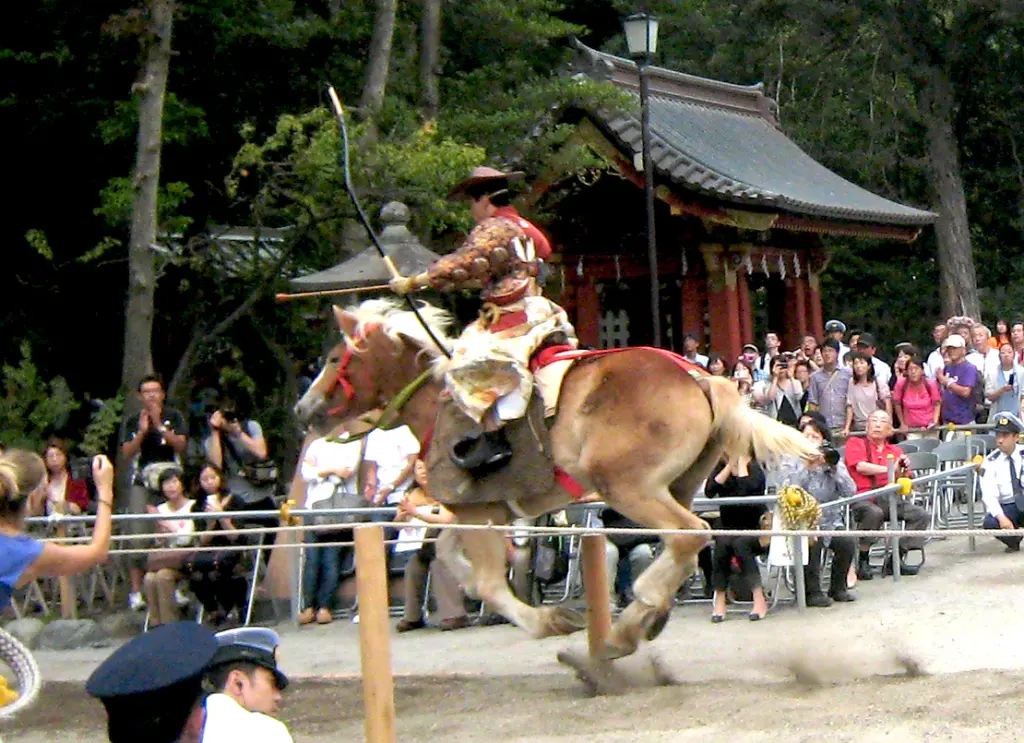
Image: Biliana Nikolova-Lefterova / Wikimedia Commons · CC BY-SA 4.0
Yabusame (流鏑馬) is a ceremonial form of Japanese mounted archery in which a rider gallops along a straight course and shoots at three targets set on the left. It joins demanding horsemanship and bow technique with processions, formal dress, prayers, and shrine-specific ritual. Written references identify yabusame by the late Heian period, and Kamakura-period warrior patronage helped attach it to major religious observances. The practice later declined and was reconstructed in different settings, so it should not be described as one completely unchanged performance surviving from medieval warfare. Today, lineages including the Ogasawara and Takeda traditions present distinct forms at shrines and public events. Tsurugaoka Hachimangū in Kamakura holds a prominent annual yabusame ritual on September 16 during its Grand Festival.
Overview
| Japanese | 流鏑馬 |
|---|---|
| Romanization | Yabusame |
| Classification | Ceremonial Japanese mounted archery |
| Characteristic action | Shooting at three targets to the rider’s left from a galloping horse |
| Historical documentation | Named in late-Heian sources; established in shrine ritual by the Kamakura period |
| Major living traditions | Forms transmitted by Ogasawara- and Takeda-associated organisations and local shrine communities |
| Prominent venue | Tsurugaoka Hachimangū, Kamakura |
Name and scope
Yabusame names a particular formalised mode of shooting from horseback, not every Japanese use of a bow while mounted. It belongs to the wider field of kisha, or mounted archery, alongside forms such as kasagake and the historical inuōmono. Present-day explanations commonly distinguish yabusame by its three targets and its dedication as ritual.
It is also not simply Kyudo performed on a horse. Modern Kyudo is normally range archery practised on foot under its own organisations and teaching systems. The two share parts of Japan’s bow culture, vocabulary, and history, but differ in equipment use, movement, institutions, safety conditions, and ceremonial setting.
Course, targets, and shooting sequence
The rider moves down a straight track and attempts three shots at targets positioned on the left. The short interval between targets requires an archer to control the horse, prepare each arrow, draw, release, and recover without losing posture. Target material, height, riding distance, number of riders, and the wider programme depend on the site and tradition.
A commonly cited traditional course is a little over two hundred metres, while the dedicated yabusame track at Tsurugaoka Hachimangū is described by Japan’s multilingual heritage database as about 250 metres. These figures should not be turned into one universal modern specification. Shrine grounds and transmitting organisations preserve their own practical arrangements.
Riding, shooting, and equipment
An archer must keep the upper body stable while the horse runs and must shoot sideways rather than along the direction of travel. Organisations that teach yabusame describe a raised riding posture that reduces the vertical movement transferred from horse to rider. This is a specialised trained technique, not a posture to imitate without instruction, a prepared horse, and a controlled course.
Formal equipment may include a long bow, target arrows, a quiver or arrows carried at the waist, a wooden saddle with distinctive stirrups, and historical-style hunting or warrior dress. Kokugakuin University lists items such as the ayai-gasa hat, suikan robe, igote arm guard, mukabaki fur chaps, swords, and an ebira quiver. Costume and terminology vary by lineage and occasion, and ritual arrows should not be confused with battlefield points.
Early written records
Mounted bow use in Japan predates the word yabusame in surviving texts, but earlier riding and shooting should not automatically be identified with the later ceremonial form. The Shin-Sarugakki, compiled by Fujiwara no Akihira in the eleventh century, lists yabusame among several shooting arts. The diary Chūyūki records retired Emperor Shirakawa watching yabusame at Toba Palace in 1096.
These sources show that the named practice was known in late-Heian elite and warrior culture. They do not provide a complete manual for every modern sequence. Historical reconstruction depends on diaries, chronicles, school documents, ritual records, surviving equipment, and later efforts to codify or revive forms.
Kamakura warrior patronage
During the transition from the Heian to Kamakura periods, yabusame became closely associated with warrior display and offerings at shrines and temples. Tsurugaoka Hachimangū states that the Azuma Kagami records Hōjō-e and yabusame there in 1187 under Minamoto no Yoritomo. The event joined public demonstration of mounted skill with prayer and the authority of the new warrior government.
Kamakura is therefore central to the public memory of yabusame, but it was not the only place where ritual mounted archery developed. Other shrines formed their own observances, sponsors, transmitting groups, and meanings. A famous Kamakura performance should not be used as the template for every local event.
Decline, revival, and transmission
Kokugakuin University’s reference account describes yabusame declining after the Kamakura period and disappearing as a common warrior practice by the Muromachi period. In the eighteenth century, Tokugawa Yoshimune ordered records to be collected for a revival, and Urakami Yagozaemon compiled material that helped establish reconstructed rules and forms.
Modern performance is thus a history of transmission, interruption, recovery, and institutional interpretation. Ogasawara- and Takeda-associated groups preserve different genealogies and procedures, while shrine communities sustain the calendar, participants, and religious framework. Claims of continuity should identify which lineage, documents, and local observance they describe.
Shrine dedication and meaning
At many living venues, yabusame is hōnō—an offering or dedication—rather than only a contest over who hits most targets. Prayers may concern peace, harvest, health, protection, or the successful completion of a festival. Processions, prayer recitation, sounding the bowstring, and other preliminary actions can be as important to the ritual as the three galloping shots.
The religious meaning is site-specific. Not every mounted-archery demonstration is a Shinto rite, and not every shrine performance uses an identical prayer or ceremonial sequence. Describing the organiser and event name is more accurate than treating yabusame as a single nationwide liturgy.
Tsurugaoka Hachimangū
Tsurugaoka Hachimangū’s Grand Festival runs from September 14 to 16. Its official calendar places the yabusame ritual on September 16, when archers in hunting dress ride the east–west track through the grounds and shoot at three targets. The shrine links the observance to the 1187 Hōjō-e recorded in the Azuma Kagami.
The date is stable in the shrine’s annual description, but access arrangements, viewing areas, start times, crowd controls, and weather responses can change. Visitors should consult current shrine notices before travelling and follow restrictions around horses, the course, photography, and sacred spaces.
Practice, safety, and horse welfare
Yabusame requires trained riders, trained horses, specialist tack, controlled distances, target crews, and strict separation between the course and spectators. It is not an activity for informal experimentation. The speed of modern horses and the limited time between targets add practical difficulty even when the ceremonial layout follows historical precedent.
Responsible interpretation also includes the horse as a participant rather than treating it as stage equipment. Training, transport, footing, weather, veterinary care, noise, and crowd management affect welfare. Public information may emphasise visual drama, but safe practice depends on extensive preparation that a brief performance does not reveal.
Interpretation and boundaries
Yabusame can be studied as archery, horsemanship, warrior culture, ritual, costume, performance, and local heritage. No single lens explains the whole practice. Calling it a sport alone overlooks dedication and ceremony, while calling it timeless sacred warfare overlooks historical change, revival, and the variety of present-day organisers.
The clearest description identifies the venue, lineage, date, and purpose. That approach preserves what is distinctive about a shrine rite without suggesting that every public exhibition has the same religious status or that every element has remained fixed since the medieval period.
Sources
- Tsurugaoka Hachimangū, Festivals.
- Tsurugaoka Hachimangū, Horseback Archery Range.
- Kokugakuin University Digital Museum, Yabusame.
- Kokugakuin University, Kurabeuma and yabusame attached to martial arts and Shinto rituals.
- Japan Equestrian Archery Association, On Yabusame.
- Ministry of Land, Infrastructure, Transport and Tourism, Yabusame Riding Ground.
Last updated: