Literature
Ryōma ga Yuku
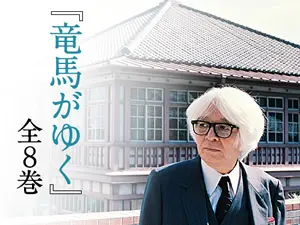
Image: Promotional design uncredited; © Ryōtarō Shiba / Bungeishunjū / Bungeishunjū official ebook feature · Copyrighted; limited low-resolution identification and critical commentary
Ryōma ga Yuku (竜馬がゆく, commonly rendered “Ryōma Goes His Way”) is a historical novel by Ryōtarō Shiba about the final years of the Tokugawa shogunate and the life of Sakamoto Ryōma. It was serialized in the Sankei Shimbun from June 1962 to May 1966 and then published in book form by Bungeishunjū. The widely read Bunshun Bunko edition comprises eight volumes. Shiba presents Ryōma as mobile, open-minded, humorous, commercially alert, and able to connect political enemies during a period of institutional collapse. This characterization became highly influential in postwar popular memory and later screen portrayals. The novel draws on research and historical actors, including Katsu Kaishū, but its dialogue, interior life, chronology, and causal emphasis belong to historical fiction, not documentary biography.
Overview
| Japanese title | 竜馬がゆく |
|---|---|
| Romanization | Ryōma ga Yuku |
| Author | Ryōtarō Shiba |
| Form | Serialized historical novel |
| Newspaper serialization | Sankei Shimbun, June 1962–May 1966 |
| Publisher | Bungeishunjū |
| Bunshun Bunko edition | 8 volumes |
Serialization and editions
The novel appeared in daily newspaper instalments over nearly four years. Book publication began while serialization was continuing, and later editions changed the physical division of the text. The eight-volume Bunshun Bunko edition became a standard form. Dates and volume numbers should therefore identify the edition rather than imply one original eight-volume release.
Historical setting
The action moves through Tosa, Edo, Kyoto, Nagasaki, and maritime routes during the Bakumatsu. Domain loyalty, imperial politics, shogunal reform, foreign pressure, sword schools, merchant networks, and new naval knowledge intersect. Ryōma’s movement across these settings lets the novel explain national transformation through encounters rather than through an impersonal chronology.
Shiba’s Ryōma
Shiba’s protagonist is less a doctrinaire ideologue than an imaginative broker who sees beyond inherited status. His curiosity, informality, and practical judgment align him with the novel’s postwar horizon of mobility and enterprise. This vivid personality is one interpretation constructed from records, later memories, local traditions, and invention; historians continue to debate Ryōma’s precise political influence.
Katsu Kaishū and maritime vision
The relationship with Katsu Kaishū gives Ryōma access to naval modernization and a language of Japan beyond one domain. Katsu becomes both mentor and institutional bridge. The novel turns their connection into a decisive expansion of Ryōma’s worldview, while archival study is needed to distinguish documented meetings and projects from narrative reconstruction.
Political mediation
The Satsuma–Chōshū alliance, Kameyama Shachū and Kaientai, the transfer of political authority, and proposals associated with the Senchū Hassaku form major narrative stages. Shiba emphasizes Ryōma’s ability to connect people and ideas across factional boundaries. Modern scholarship cautions against assigning every development to one heroic mediator.
Historical fiction and spelling
The title uses 竜馬, whereas the historical name is normally written 龍馬. That distinction has become a useful reminder that “Shiba’s Ryōma” is a literary construction. The novel incorporates historical documents and authorial commentary but also supplies scenes no source could record. It should be cited as a novel when discussing motives, private conversations, or personality.
Adaptations
The work has been adapted repeatedly for television and other media, including NHK’s 1968 Taiga drama. Later portrayals of Sakamoto Ryōma do not all adapt the novel directly, yet many inherit its narrative situations and energetic character type. This circulation helped blur the border between a popular fictional Ryōma and the more fragmentary historical record.
Influence on cultural memory
Research on film, television, tourism, and historical memory identifies Ryōma ga Yuku as a decisive force in making Ryōma a national postwar figure. Museums, monuments, travel routes, business discourse, and later fiction all participate in that memory. The novel’s continuing importance lies both in its narrative achievement and in the need to examine how historical fiction can become the default public image of a person.
Sources
- National Diet Library Search.
- CiNii Research.
- Bungeishunjū, Ryōma ga Yuku e-book guide.
- Shiba Ryōtarō Memorial Museum, works and Bunko list.
- National Diet Library, Sakamoto Ryōma no Eigashi.
- Okayama University Repository, study of Shiba Ryōtarō and publication chronology.
- Nippon.com, Sakamoto Ryōma and the novel’s influence.
Last updated: