
Kesa-gatame
袈裟固けさがため
Scarf hold
- Osaekomi-waza
- Katame-no-kata
Key idea
Control uke’s shoulder line and near arm from a diagonal side position, using a broad base that can adjust as uke moves.
Kodokan official demonstration
Kodokan technique list (opens in a new tab)YouTube (opens in a new tab)
VISUAL GUIDE
How to read the movement
Look for diagonal control from uke’s side, securing the head-and-shoulder line and one arm over a stable base.
- Tori
- the person applying the technique
- Uke
- the person receiving the technique
- Red line
- main direction or point of contact
AT A GLANCE
Technique shape
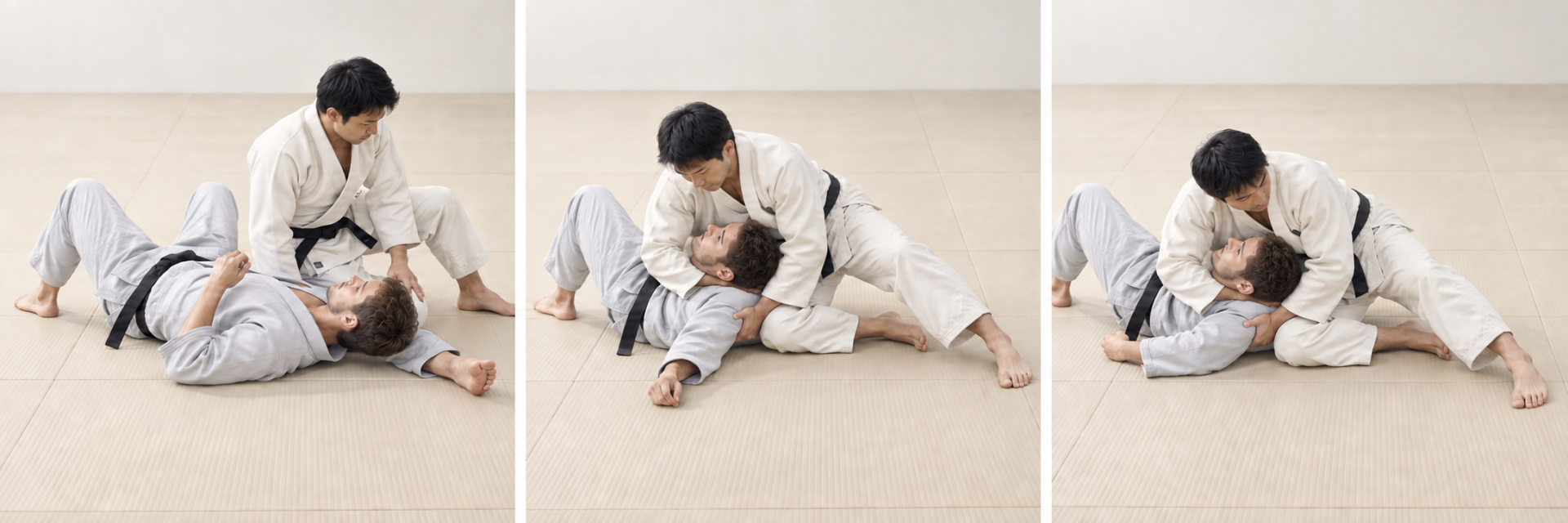
IN SEQUENCE
Three-frame concept
- 1Take the side position
- 2Control the head, shoulder, and arm
- 3Stabilise the upper body
Original AI-generated educational illustration for TokyoWaltz, 2026. A simplified three-stage concept; practise under qualified instruction.
PLAY WHEN NEEDED
Watch the movement slowly
- 1Starting pointTake the side position
- 2Decisive actionControl the head, shoulder, and arm
- 3CompletionStabilise the upper body
1 / 3Starting point— Take the side position
Follow the red line and phase indicator. The guide does not autoplay or loop.
How it works
Kesa-gatame maintains diagonal upper-body control while the holder adjusts contact and base to uke’s movement.
Entry
Reach a stable side position
Move beside uke and establish the recognised diagonal relationship around the near arm and head-and-shoulder line.
Control
Restrict upper-body rotation
Use chest-and-side contact to control the shoulder line and near arm without relying on uncontrolled neck pressure.
Hold
Maintain a responsive base
Spread the legs into a stable base and adjust as uke turns, bridges, or tries to recover leg control.
Key points
- Control the shoulder line and near arm from the diagonal side position.
- Distribute weight through a broad, stable base.
- Adjust the base as uke moves; effective control is dynamic.
Common mistakes
- Building the hold on one narrow point of support. Spread the base so movement in one direction does not remove all stability.
- Holding a fixed shape while uke turns or bridges. Adjust contact and base while preserving upper-body control.
- Using uncontrolled pressure on the neck or shoulder. Prioritise positional control and stop whenever the position becomes unsafe.
Similar techniques
| Technique | Japanese name | Key difference |
|---|---|---|
| Kuzure-kesa-gatame | 崩袈裟固 | 崩袈裟固は袈裟固に近い向きを保ちながら、上半身の制し方を変えます。 |
| Ushiro-kesa-gatame | 後袈裟固 | 後袈裟固は標準的な袈裟固に対して取の向きが反対になります。 |
| Kata-gatame | 肩固 | 肩固は異なる胸の位置から頭と腕の線を制します。 |
Reference
Open the detailed source material when you need definitions, technical distinctions, training context, or references.
Official definition
Kodokan definition
The Kodokan representative definition describes control from the opponent’s side, with the near arm held and the head-and-shoulder region secured while the holder’s chest and side restrain the upper body. The essential feature is stable upper-body control from the scarf-hold relationship.
The current Kodokan list separately names kuzure-kesa-gatame and ushiro-kesa-gatame. Those are not merely any personal adjustment to kesa-gatame; each has its own recognised control relationship.
Control principle
Kesa-gatame controls the opponent’s shoulder line and near arm while the holder spreads weight and base away from a single unstable point. Chest and side contact restrict upper-body rotation without requiring the holder to face directly down the length of the opponent.
Effective control is dynamic. The holder adjusts base and pressure as the opponent turns, bridges, or seeks to recover leg control.
Name and classification
Overview
| Japanese | 袈裟固 |
|---|---|
| Reading | けさがため |
| Romanisation | kesa-gatame; common search form: kesa gatame |
| Meaning | Scarf hold |
| Martial art | Judo |
| Official classification | Kodokan osaekomi-waza |
| Kata | Katame-no-kata, osaekomi-waza set |
Classification
The Kodokan classifies kesa-gatame as osaekomi-waza, one of the three branches of katame-waza alongside shime-waza and kansetsu-waza. It is one of ten holds in the current Kodokan technique list.
Kesa-gatame is usually studied in Ne-waza, but the two terms are not synonyms. Ne-waza is the broader phase of groundwork; osaekomi-waza is an official technical category.
Meaning of kesa-gatame
Kesa is the robe or stole worn diagonally by Buddhist clergy. The name refers descriptively to the holder’s diagonal orientation across the opponent’s upper body. Gatame is the combining form of katame, meaning control or hold.
The name records the visible relationship of the bodies; it does not imply a religious origin for the technique.
Detailed execution
Position
In the representative right-side position, the holder sits beside the opponent’s right side, controls the opponent’s right arm with the left arm, and controls around the head-and-shoulder line with the right arm. The torso lies diagonally across the upper body while the legs create a broad base.
This description identifies the recognised position without prescribing one rigid leg angle or grip. Body proportions, movement, kata, randori, and contest conditions produce legitimate adjustments.
Escapes and transitions — overview
Escape study examines how the lower judoka can create space, turn the upper body, recover control with the legs, or force the holder to change position. Training should focus on posture, timing, and safe movement rather than on wrenching the neck or isolated arm.
The holder may respond by changing base or transitioning to another recognised hold. Under IJF rules, osaekomi time can continue through a change of valid holding technique if control is not lost.
Kesa-gatame in Katame-no-kata
Kesa-gatame is the first of five osaekomi-waza in Katame-no-kata. It is followed by kata-gatame, kami-shiho-gatame, yoko-shiho-gatame, and kuzure-kami-shiho-gatame.
The kata presents a formal attack, control, escape attempts, and responses. It studies principles and relationships; it is not a list of every contest variation or every Kodokan hold.
Variations
Training and safety
Training context
Kesa-gatame is practised through positional drills, kata, transitions, and randori. The Kodokan youth curriculum includes it, but the pace and resistance should match age and experience.
Partners should communicate, protect the neck and shoulder, and stop when control becomes unsafe. A pin is studied as positional control, not as permission to apply uncontrolled pressure.
Competition rules
Competition
Current IJF rules researched: 14 August 2026. A valid osaekomi can score yuko at 5–9 seconds, waza-ari at 10–19 seconds, and ippon at 20 seconds. In golden score, five seconds of valid osaekomi earns yuko and ends the contest.
The referee’s declaration depends on control and position, not the technique name alone. The opponent must be controlled on the back or complete upper-back area, the holder must be above and applying pressure, and the holder’s body or legs must not be trapped by the opponent’s legs. National and youth rules may differ.
Sources
Sources
- Kodokan Judo Institute, Judo Technique Names.
- Kodokan Judo Institute, Definitions of Judo Techniques, 2022.
- Kodokan Judo Institute, Katame-no-kata.
- Kodokan Judo Institute, Youth Division Curriculum.
- International Judo Federation, Sport and Organisation Rules, 14 August 2026.
- All Japan Judo Federation, Application of the 2025–2028 IJF rules from 1 April 2026.
- Yoshida et al., Learning and Assessment of Kesa-gatame, Journal of Physical Arts.