Seasonal Customs
Hanami
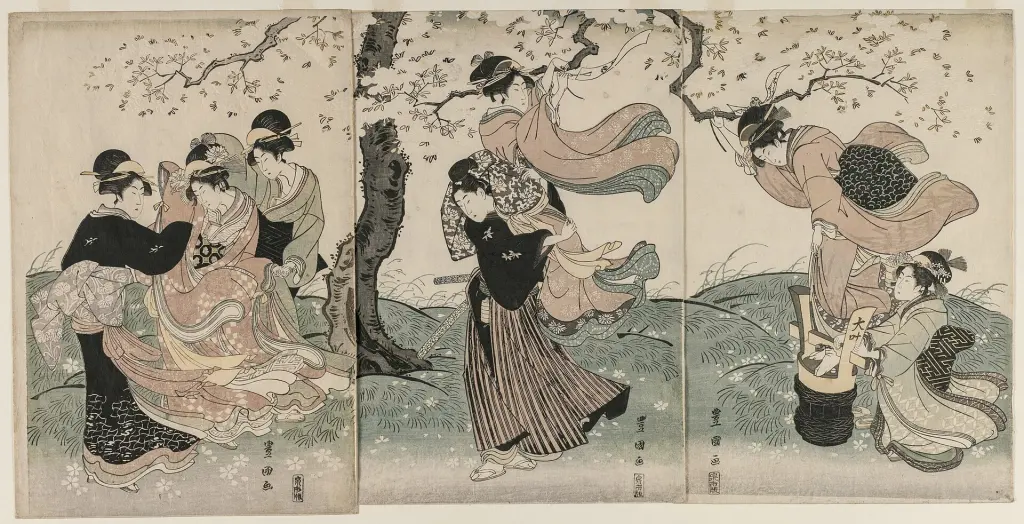
Image: Utagawa Toyokuni I / Wikimedia Commons; Cleveland Museum of Art · CC0 1.0
Hanami (花見), literally “flower viewing,” is the Japanese practice of appreciating blossoms in season. The word is now especially associated with cherry blossoms, or sakura, and with spring gatherings beneath flowering trees. Hanami can be quiet observation, a walk, an evening illumination, or a picnic shared by families, friends, colleagues, and local groups. Its history includes earlier attention to plum blossoms, courtly poetry and banquets, warrior and urban patronage, temple and shrine landscapes, and the planting of accessible viewing sites. Because cherry bloom is brief and moves across the archipelago at different times, hanami also organizes travel, weather reporting, local economies, and public space. It is a custom rather than one centrally governed national festival.
Overview
| Japanese | 花見 |
|---|---|
| Literal meaning | Flower viewing |
| Principal modern flower | Sakura, or cherry blossom |
| Usual season | Spring, varying by region and elevation |
| Common forms | Walking, picnics, parties, and night viewing |
| Important concept | Bloom is brief and geographically staggered |
Meaning and scope
Although hana can mean flowers generally, unqualified hanami usually means cherry-blossom viewing today. Plum, wisteria, chrysanthemum, and other flowers have their own viewing histories. Hanami is defined by attentive seasonal encounter and sociability, not by one prescribed ceremony, religious affiliation, or style of gathering.
From plum to cherry
Plum blossoms introduced from continental Asia held an important place in early elite poetry and garden culture. Native cherry increasingly became central to courtly spring imagery during the Heian period. This was not an abrupt nationwide replacement; literary preference, horticulture, landscape, and regional species all shaped the changing prominence of the two flowers.
Court, warrior, and urban hanami
Aristocratic banquets joined blossoms with poetry, music, dress, and cultivated landscape. Later rulers sponsored celebrated gatherings, while early modern authorities and residents planted cherries at temples, riverbanks, hills, and urban recreation grounds. Commercial prints depict hanami as a public social scene, showing how elite practices became entangled with city leisure.
How hanami is practised
A typical outing may involve walking beneath trees or reserving a place for food and conversation. Some sites allow large picnics; others restrict eating, alcohol, or ground sheets. Yozakura refers to viewing blossoms at night, often with lanterns or illumination. Local rules and the protection of roots and branches matter more than any universal etiquette formula.
The blossom front
Flowering time depends on latitude, elevation, weather, species, and cultivar. Forecasts follow the so-called cherry-blossom front from warmer southern areas toward northern Japan, although Okinawa’s winter-flowering season and Hokkaido’s later spring complicate a single south-to-north story. Dates change each year, making live local information essential for travel.
Varieties and landscapes
The pale, five-petalled Somei-yoshino dominates many modern streets and parks, but Japan has numerous wild species and cultivated varieties with different colours, forms, and bloom times. Mountain cherries, weeping trees, double blossoms, and local cultivars create distinct regional landscapes. Treating every historical image as Somei-yoshino is anachronistic because that cultivar spread widely only in the modern era.
Art, memory, and transience
Poetry, painting, prints, photography, school calendars, songs, and advertising have made sakura an unusually dense cultural symbol. Falling petals can suggest time, separation, renewal, or mortality, but no one idea exhausts their meaning. Hanami is enduring precisely because it joins public repetition with an encounter that cannot be held: each bloom is local, weather-dependent, and short.
Sources
Last updated: