other-martial-arts
Dohyō-matsuri

Image: OtharLuin / Wikimedia Commons · CC BY 4.0
Dohyō-matsuri
Prayer and offerings before the contest.
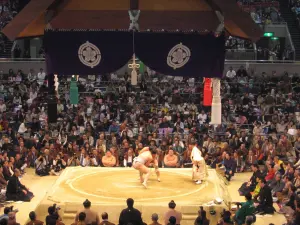
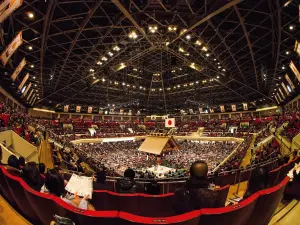
Dohyō-matsuri (土俵祭) is the ceremony associated with consecrating a sumo ring and praying for its safe use. Before a professional tournament, a senior referee acts as principal officiant, prayers are recited and offerings are placed in the centre of the ring. The Japan Sumo Association describes its aims in terms of safety, a successful tournament and wider well-being. The ceremony is distinct from dohyō-iri, the ring-entering performances seen during tournament days. It also belongs to a broader range of settings: documented ring dedications outside the professional tournament circuit show that the occasion and participating officials need to be identified in each case.
Officiants
A principal officiant and two assistants.
Offerings
Six kinds of shizumemono.
Occasion
The setting determines the form and arrangements.
At a glance
- Japanese
- 土俵祭 — dohyō-matsuri
- Professional tournament timing
- The day before the opening day
- Principal officiant
- A tate-gyōji in the Association’s tournament ceremony
- Assistants
- Two waki-gyōji; a ceremonial role, not a separate grade
- Central act
- Prayers and the placement of shizumemono offerings
01
A ceremony centred on the ring
The Association’s explanation connects the ceremony with safety during the tournament, the success of the event, national peace and a good harvest. These are the stated intentions of the rite. They describe its cultural and religious purpose, rather than a claim that ritual can guarantee an outcome.
02
The principal officiant and two assistants
The tate-gyōji serves as saishu, the principal officiant. Two waki-gyōji assist. The Association explains that waki-gyōji names a task in the ceremony rather than a permanent rank: an official retains a professional grade while serving in that ritual role.
03
Six offerings are placed beneath the centre
The offerings are known as shizumemono. The Association lists six kinds and describes placing them in an earthenware vessel wrapped in paper, setting them in a small central opening and pouring sacred sake.
- Kachiguri
- Dried, husked chestnuts.
- Senmai
- Washed rice.
- Kombu
- Kelp.
- Surume
- Dried squid.
- Shio
- Salt.
- Kaya no mi
- Torreya nuts.
04
Dohyō-matsuri and dohyō-iri are different
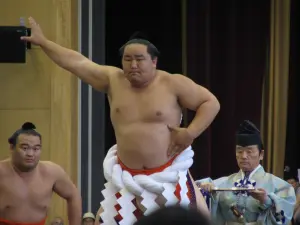
Dohyō-matsuri prepares the ring through prayer and offerings. Dohyō-iri is a ring-entering ceremony performed by wrestlers, with a distinctive form for yokozuna. Similar vocabulary should not collapse these into one event. The calendar, participants and purpose help identify which ceremony a photograph or programme describes.
05
Ring dedications also occur elsewhere
Osaka University documented a dohyō-matsuri at the dedication of its ring in March 2017, led by Kimura Asanosuke. The ceremony was followed by other elements of the opening event and the students’ first practice. This university record shows why the tournament template should not be applied as a universal rule to every local or institutional ring dedication.
06
Public arrangements belong to a particular event
The Association’s September 2026 notice listed the people attending and set specific conditions for public observation. Such notices provide evidence for that occasion; they are not a permanent timetable or a guarantee of access at future tournaments. For a historical account, identify the date and setting. For attendance, consult the announcement for the particular event.
Sources
Last updated: