Performing Arts
Bo-no-te
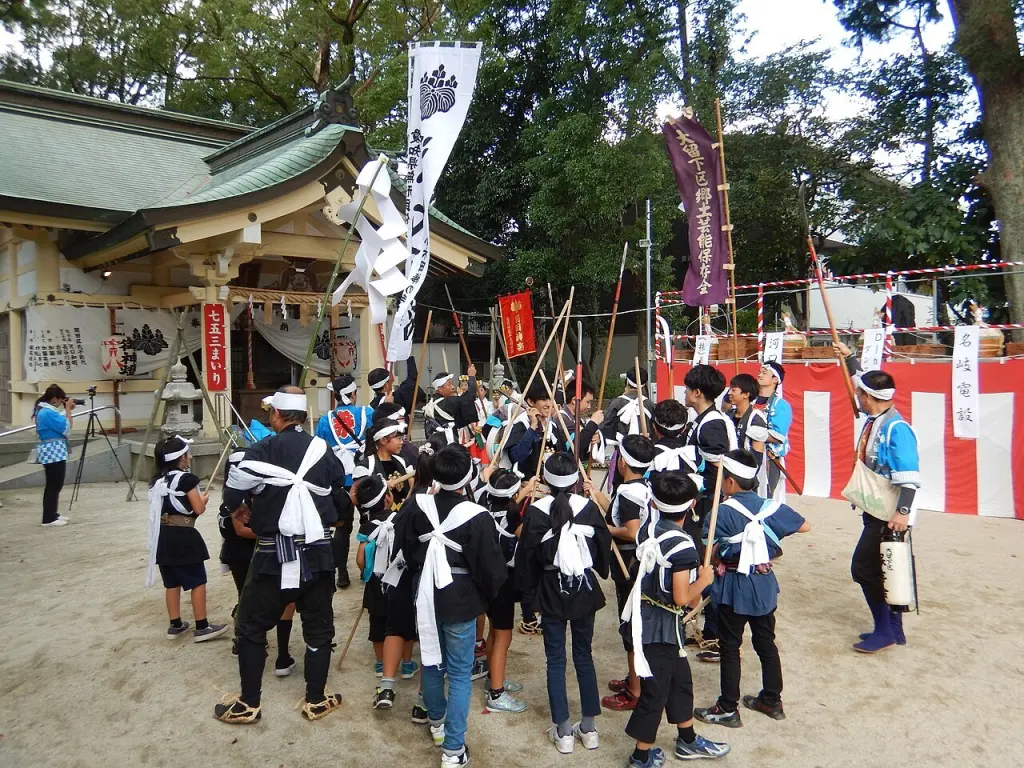
Image: 堀尾久人 / Wikimedia Commons · CC BY-SA 4.0
Overview
Martial movement within a local festival tradition.
Bō-no-te (棒の手), also written bo-no-te or bō no te, is a group of martial folk performances especially associated with Aichi Prefecture’s Owari and Mikawa regions. Practitioners present patterned exchanges using staffs and, in some traditions, swords, spears, naginata or other implements. The performances belong to local festival and shrine life as well as to the history of martial practice. They are transmitted through distinct community groups and schools rather than a single nationwide syllabus. Explanations linking them to rural self-defence in the age of civil war are widespread, but the evidence does not establish one origin for every lineage. Their ceremonial setting and local transmission are essential to understanding them.
Weapons and paired patterns vary by tradition.
Performances belong to shrine and festival settings.
Local groups carry knowledge between generations.
At a glance
- Japanese name
- 棒の手
- Romanisation
- Bō-no-te; bō no te
- Core region
- Aichi Prefecture, especially Owari and Mikawa
- Form
- Martial folk performance
- Implements
- Staffs; additional weapons vary by school
- Transmission
- Local schools and preservation associations
01
A martial performance rooted in community life
The name refers to a staff, but the repertoire is not restricted to staff techniques. Nagoya’s cultural-property account also names swords, spears and naginata. Bō-no-te is therefore more specific than the general word bōjutsu, or staff technique: it identifies regional traditions with festival settings, costumes and organised transmission. The martial and ceremonial aspects coexist.
02
Origin accounts need to be tied to a named tradition
Aichi’s cultural-property record for Ogita describes possible connections with farmers’ self-defence during the Sengoku period and with mountain ascetic practice, while acknowledging uncertainty. Such accounts should be presented as explanations of development rather than a proven founding event. A named community’s documented transmission can be much more precise than the general origin story.
03
Weapons, partners and occasion shape the display
The Sanage Festival account published by Japan’s tourism authorities describes a ceremonial display of fighting skill and folk entertainment, using patterned movements with several weapons. The combination of movements and implements varies by school. A performance is best identified by its troupe, local tradition and festival, rather than by treating any demonstration with a wooden staff as bō-no-te.
Implements
- What to observe
- Staffs and the additional weapons of that repertoire.
Exchanges
- What to observe
- The relationship between partners and patterned movements.
Setting
- What to observe
- The shrine, procession or festival in which the performance belongs.
04
Local names preserve meaningful differences
Nagoya records several traditions in Takabari and neighbouring areas, while Ogita in Kasugai has a named preservation association. Nagakute’s bō-no-te was designated a prefectural intangible folk cultural property in 1956. These are particular local designations; they should not be turned into a claim that every form has an identical protected status.
Nagoya · Meitō
- Documented context
- Several local schools and city-designated traditions.
Kasugai · Ogita
- Documented context
- Genjiten-ryū Sekita bō-no-te preservation association.
Nagakute
- Documented context
- Prefectural intangible folk cultural property designated in 1956.
Toyota · Sanage Shrine
- Documented context
- Performances within the annual Sanage Festival.
05
Shrine offerings link technique with ritual
At Sanage, performances form part of a festival that prays for a plentiful harvest. Nagoya’s historical account connects bō-no-te with decorated-horse offerings and processions. These settings explain why the tradition cannot be understood only through the categories of modern sport or combat training. Matsuri provides broader context for community festivals.
06
Continuity depends on people who teach and perform
Nagoya describes the earlier role of youth organisations and the continuing work of preservation groups. Learning movements is only one aspect of continuity: equipment, local names, festival responsibilities and collective memory are also transmitted. Public demonstrations offer a way to encounter the tradition, but schedules and participating schools should be checked with the relevant local organiser.
Sources
Last updated: