Other Martial Arts
Sumo
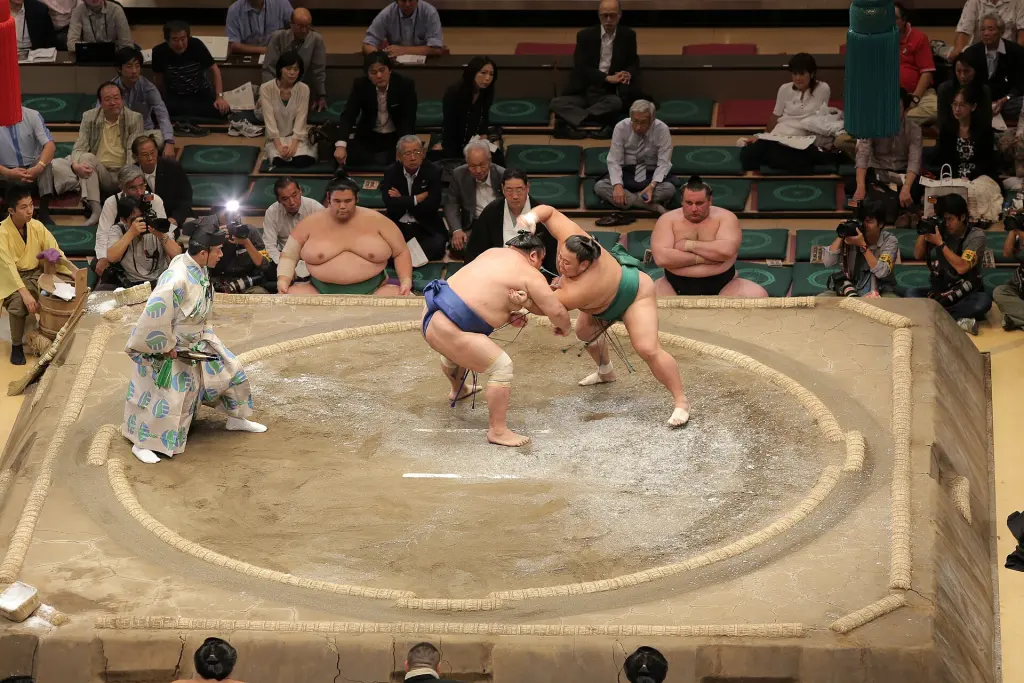
Image: Lars Heineken (ElHeineken) / Wikimedia Commons · CC BY-SA 4.0
Overview
Simple victory conditions support a complex institution.
A Sumo bout is lost by leaving the ring or touching the ground with anything other than the soles of the feet. Around that compact rule sit dozens of named winning techniques, a clay dohyō, a ranking cycle, residential training stables, public ceremonies, and ritual references. To understand it clearly, separate the immediate logic of a bout from the professional system that trains, ranks, and presents its wrestlers. Grand Sumo is the best-known form, but school, university, amateur, women’s, shrine, and community Sumo do not share every professional rule or custom.
Stay inside the ring and keep every body part but the feet off the surface.
Heya, tournaments, and the banzuke organise professional life.
Purification, costume, ceremony, and arena space shape public meaning.
- Japanese
- 相撲
Sumō - Victory
- Ring-out or non-foot ground contact
- Contest area
- Dohyō
4.55-metre inner ring - Professional body
- Japan Sumo Association
- Training unit
- Heya
commonly “stable” - Annual cycle
- Six 15-day Grand Tournaments
01Historical frame
Long history, repeated reinvention.
Chronicles, court observances, shrine offerings, public entertainment, professional promotion, modern arenas, and mass media belong to different moments. Continuity matters, but “unchanged sacred sport since antiquity” is too simple.
- Early records
Legend, court, and rite
Ancient narratives preserve wrestling stories, while court and community practice connected contests with display, agriculture, and offerings.
- Edo period
Urban public spectacle
Promoters, groups of professional wrestlers, officials, and public venues developed important precedents for the modern system.
- Meiji–Shōwa
National institution
Arena design, codified ceremonies, rankings, newspapers, radio, and tours made Sumo a highly visible emblem of Japan.
- Present
Professional and amateur worlds
Grand Sumo follows the Japan Sumo Association’s institutional cycle, while schools, universities, clubs, and international bodies support other formats.
02Bout logic
The edge and the ground are the two decisive surfaces.
The final charge begins by mutual commitment rather than a starting gun. From there, balance, angle, grip, pressure, and foot placement determine who can preserve the smaller usable space.
Cross the boundary
If any part of the wrestler touches outside the inner ring first, the bout is lost.
Touch with more than the feet
A hand, knee, torso, or other body part touching the surface first ends the bout.
The referee announces a decision; ringside judges may call a conference and can order a rematch when the result is unclear. See Dohyō for the ring’s construction, markings, and consecration.
03Technique families
Kimarite names the action that decided the bout.
The official result records a winning technique. These study groups are not a replacement for the official list; they are a way to see how body position and contact change the route to the same boundary.
Push & thrust
Drive through the opponent’s structure without relying on a belt grip.
Force-out & belt work
Use a mawashi grip, body position, and continuous pressure to remove space.
Throw, trip & twist
Change the opponent’s base or direction so the ground arrives before the boundary.
Professional Sumo has no weight classes. Mass matters, but balance, footwork, grip, timing, and tactical preparation also decide bouts. The Japan Sumo Association’s kimarite guide is the authoritative reference for the named results.
04Professional system
Training, tournament record, and rank form a repeating loop.
The banzuke is not just a list of names. It translates recent records into an East–West hierarchy for the next Grand Tournament.
Prepare
Training, meals, mentorship, and daily duties are organised in a stable.
Compete
Rikishi accumulate winning and losing records across fifteen days.
Evaluate
Performance and rank-specific standards shape promotion or demotion.
Reorder
A new ranking list sets the hierarchy for the next tournament.
Promotion is not one universal formula. Yokozuna and ōzeki involve special standards; lower ranks respond more directly to recent winning and losing records.
05Ritual & performance
Sacred references frame the spectacle without turning every bout into a religious service.
Purification, costume, architecture, and ring-entering ceremonies make professional Sumo visually distinctive. Their forms were shaped and formalised at different historical moments.
Purify & present
Salt, water, clapping, stamping, the suspended shrine-like roof, referee costume, and the dohyō-iri establish an ordered public setting.
Shinto vocabulary helps explain many references, while local practices such as shrine-dedicated wrestling have their own context.
Contest & decide
Once contact begins, victory still turns on the boundary and ground. Ritual framing does not replace athletic technique, refereeing, or institutional rules.
This combination of sport, theatre, custom, and sacred reference is a defining feature of Grand Sumo—not a template for every amateur match.
06The wider field
Use the setting before generalising a rule or custom.
Professional, amateur, school, university, women’s, shrine, community, and international practice overlap through wrestling but differ in organisation, eligibility, weight classes, calendar, and ceremony.
- 1Name the institution.
Is the claim about the Japan Sumo Association, an amateur federation, a school programme, or a local event?
- 2Name the competition format.
Professional Sumo has no weight divisions; amateur events may organise competitors differently.
- 3Separate bout rule from surrounding custom.
Shared victory conditions do not imply identical clothing, ceremonies, rankings, or daily life.
- 4Avoid the MMA shortcut.
Individual athletes may cross sports, but Sumo has its own rules, institutions, and historical vocabulary.
Sources and further reading
- Japan Sumo Association, Introduction to Sumo.
- Japan Sumo Association, History of Sumo.
- Japan Sumo Association, Kimarite Winning Techniques.
- Nippon Budokan, Introduction of Sumo.
- Web Japan, Martial Arts: From Ancient Tradition to Modern Sport.
- Japanese Academy of Budo, An Introductory Study of the History of Budo Technique.
Last updated: