Buddhism
Pure Land Buddhism
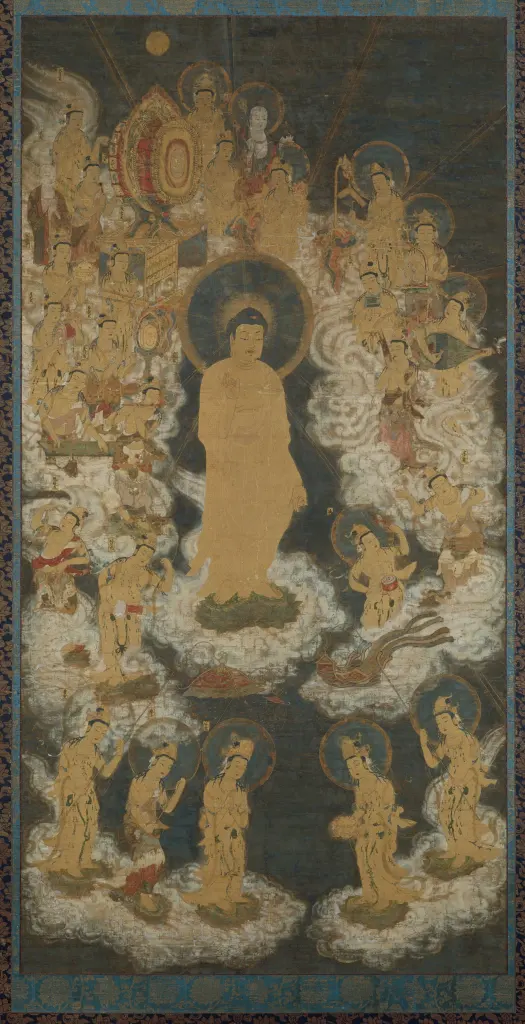
Image: Anonymous Japanese artist / Wikimedia Commons; Metropolitan Museum of Art · CC0 1.0
Pure Land Buddhism in Japan (浄土教, Jōdokyō) refers to teachings and practices centred on Amida Buddha, his vows, and birth in the Pure Land as the path to awakening. It is a broad current, not one denomination. Pure Land devotion developed within Tendai and other settings before Hōnen founded Jōdo Shū; his disciples and later interpreters formed Jōdo Shinshū, Ji-shū, and additional lineages. The recitation Namu Amida Butsu, usually called nembutsu, is central, but its meaning differs among traditions—as invocation, contemplated presence, expression of entrusting, gratitude, or practice directed toward birth. Pure Land ideas also shaped painting, sculpture, architecture, funerals, preaching, household devotion, and communities in Japan and overseas. “Faith alone” is therefore too narrow a summary of a varied Buddhist field.
Overview
| Japanese | 浄土教 |
|---|---|
| Romanization | Jōdokyō |
| Central figure | Amida (Amitābha) Buddha |
| Religious goal | Birth in the Pure Land and attainment of awakening |
| Best-known practice | Nembutsu: Namu Amida Butsu |
| Major Japanese schools | Jōdo Shū, Jōdo Shinshū, and Ji-shū |
Scriptures and the Pure Land
The Larger Sutra, Smaller Amida Sutra, and Contemplation Sutra became the principal textual group for East Asian Pure Land traditions. They describe Amida, his vows, and a buddha-field free from conditions that obstruct practice. Interpretations differ over the ontological status of the Pure Land and the relation between birth there and awakening. It should not be reduced to a permanent heaven or a simple reward after death.
Early development in Japan
Pure Land images and practices existed in Japan from the early centuries of Buddhist transmission. In the Heian period, courtly devotion, temple ritual, mountain asceticism, and concern about mappō—the decline of the Buddhist teachings—gave them new prominence. Genshin’s Ōjōyōshū described the sufferings of the six realms and practices oriented toward Amida’s Pure Land, influencing ritual and visual culture.
Hōnen and Jōdo Shū
Hōnen (1133–1212), trained in Tendai Buddhism on Mount Hiei, taught exclusive reliance on the nembutsu as a path open across social distinctions. Jōdo Shū conventionally dates its founding to 1175. Hōnen attracted varied followers and controversy; a suppression in 1207 led to executions and exile. His disciples preserved different interpretations rather than one uniform succession.
Shinran and Jōdo Shinshū
Shinran (1173–1263), a disciple of Hōnen, interpreted the Pure Land path through Amida’s Primal Vow and shinjin, often translated as entrusting. In Jōdo Shinshū, nembutsu is not treated as a self-generated store of merit but as an expression of Amida’s working and gratitude. Shinran called himself “neither monk nor lay,” married, and formed communities whose later institutions include the Hongwanji traditions.
Other lineages and practices
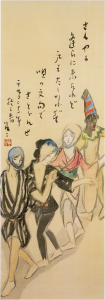
Ippen (1239–1289) and Ji-shū associated nembutsu with itinerant distribution of inscribed slips and ecstatic dance. Yūzū Nembutsu, Seizan, and other lineages developed additional teachings and institutions. Pure Land practices also continued inside Tendai, Shingon, and mixed devotional settings. Recitation, contemplation, preaching, pilgrimage, music, dance, and memorial ritual demonstrate that nembutsu culture was never a single method.
Art and sacred space
The equinoctial sunset also shaped Higan: because the sun sets approximately due west, Japanese observance became associated with contemplation of Amida’s western Pure Land, although Higan is practised beyond Pure Land schools.
Amida triads, raigō paintings of Amida’s welcoming descent, Pure Land mandalas, and halls oriented toward paradise gave visual and architectural form to devotion. Hiraizumi’s temples and gardens are a celebrated example of a landscape representing the Buddhist Pure Land. These works were ritual instruments and settings for practice, not merely illustrations of doctrine.
Temples, households, and diaspora
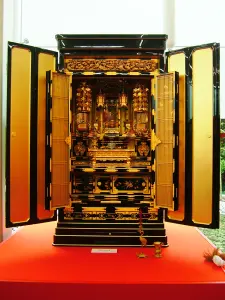
Pure Land schools maintain major head temples and extensive local networks. Jōdo Shinshū especially developed strong lay communities, elaborate Buddhist altars, hymns, sermons, and overseas institutions serving Japanese migrant communities and later converts. Funerals and memorials are important, but living communities also organize study, youth programs, social work, and regular services.
Distinctions and misconceptions
Jōdo Shū and Jōdo Shinshū are related but not interchangeable. Hōnen and Shinran differ in the role assigned to practice, entrusting, and the nembutsu, while each school contains further interpretive diversity. Pure Land Buddhism is also not simply “popular” religion opposed to “philosophical” Zen: its scriptural commentaries and debates address complex questions of agency, compassion, language, and awakening.
Sources
Last updated: