Judo
Golden Score

Image: Roberto Castro / Brasil2016.gov.br / Wikimedia Commons · CC BY 3.0 BR
Golden Score
Level scores. Extra time. A decisive result.
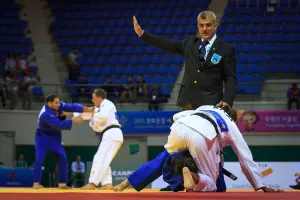
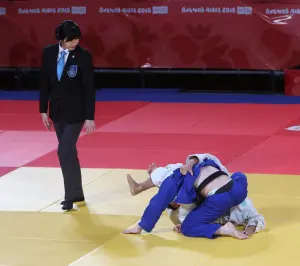
Golden Score is the additional period used to decide a judo contest when the technical scores remain level at the end of regular time. In the senior international individual format, it follows a four-minute contest and has no fixed time limit. Existing scores and penalties carry forward. A technical score decides the contest, as does an opponent’s hansoku-make, including the disqualification produced by a third shido. The first or second shido alone does not end Golden Score. Under the scoring system introduced in 2025, yūkō is again a possible decisive score. Understanding the period therefore requires separating technical scores from ordinary penalties and checking which rules apply to the event.
Continue
Earlier scores and penalties carry forward.
Score
Yūkō, waza-ari or ippon can finish the contest.
Decide
A third shido produces hansoku-make.
At a glance
- Context
- Judo competition
- Trigger
- Technical scores level after regular time
- Senior international regular time
- Four minutes
- Additional period
- No fixed time limit; earlier scores and penalties remain
- Decisive outcomes
- Technical score or opponent’s hansoku-make
- Scope
- Current international individual format; other events may use adaptations
01
The contest continues with its existing record
Golden Score does not erase the contest that preceded it. The athletes enter the additional period with their earlier scores and penalties. The clock measures the extra contest time rather than allocating another standard four-minute round. This makes the earlier penalty record relevant even when the technical scores are level.
02
What ends Golden Score
A technical score ends the additional period. Disqualification also decides it, but an ordinary first or second shido does not. The difference matters when watching a contest with several interruptions and penalty announcements.
- Yūkō, waza-ari or ippon
- A technical score decides the contest.
- First or second shido
- The contest continues; the penalty remains on the record.
- Third shido
- Hansoku-make decides the contest against the penalised athlete.
- Direct hansoku-make
- Disqualification decides the contest.
03
Yūkō changes how a short hold can decide a match
The IJF restored yūkō for the 2025 season, including an osaekomi held for five to nine seconds. British Judo’s implementation guidance explicitly explains the consequence for Golden Score: a valid hold can decide the contest when it reaches five seconds. Older explanations that mention only waza-ari and ippon omit a scoring possibility in the current system.
04
A penalty sequence is different from a score
The IJF’s 2026 report of Primo’s contest against Pont offers a useful example. Both athletes entered Golden Score with one shido, and both later received a second. The contest continued until Pont received a third. The decisive event was the disqualification, not the mere appearance of another penalty on the scoreboard.
05
The name has survived changes to the rules
Research published in the Japanese Academy of Budo’s journal traces Golden Score to international rule changes in the early 2000s. Earlier versions used a limited additional period and could still require a judges’ decision. The current unlimited format should therefore not be projected backwards onto every historical contest described as Golden Score.
06
Read the score, penalties and event together
When watching, first identify whether the match is in regular time or Golden Score, then distinguish the technical scores from the shido count. A brief hold can now be decisive, and a third shido has a different consequence from a first or second. Youth, domestic and other competition formats may apply adaptations, so the event’s own regulations remain important. This overview was checked in September 2026.
Sources
Last updated: