Popular Culture
Volleyball in Japan
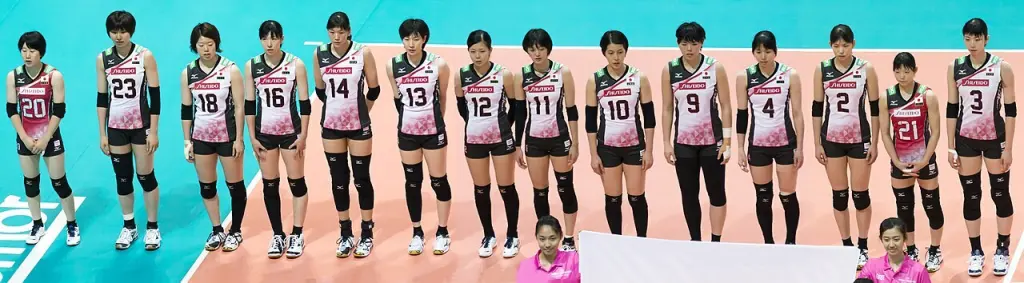
Image: Jeffrey Ng / Wikimedia Commons · CC BY-SA 2.0
Overview
A global game, sustained by many kinds of team.
Volleyball in Japan is a sporting culture built through schools, workplaces, local clubs and international competition. The Japan Volleyball Association traces its introduction to Ōmori Hyōzō at the Tokyo YMCA in 1908. Japan developed a strong nine-player tradition before formally adopting international six-player rules in the 1950s; both forms remain part of the sport. The women’s gold medal at the 1964 Tokyo Olympics and the men’s victory at Munich in 1972 became major points of public recognition. Company teams helped connect elite competition with industrial life, while school tournaments and community play established other routes into participation. League history and national-team results describe different parts of this wider culture.
Introduce and sustain participation.
Company teams shaped elite history.
Domestic leagues connect with international play.
At a glance
- Japanese name
- バレーボール
- Association
- Japan Volleyball Association · JVA
- Introduction recorded by JVA
- 1908, Tokyo YMCA
- Major indoor forms
- Six-player and nine-player
- Olympic milestones
- Women: Tokyo 1964; men: Munich 1972
- League transition
- SV.LEAGUE launched in 2024
01
YMCA teaching preceded national organisation
JVA’s chronology credits Ōmori Hyōzō with introducing volleyball in 1908 and dates the national association’s establishment to 1927. Organised competition developed through educational and other institutions. The sport arrived through international exchange, then acquired formats and networks suited to its Japanese settings. Its subsequent history is therefore both a history of a global game and of local institutional choices.
02
Six-player and nine-player volleyball coexist
JVA formally decided to introduce international six-player rules in 1955. Its beginner guidance also identifies nine-player volleyball as a continuing Japanese form, familiar in community participation including so-called mama-san volleyball. Nine-player competition is not simply an obsolete version of the Olympic game. Rules and competition categories need to be identified before results or styles of play are compared.
Six-player indoor
- Place in Japanese volleyball
- International national-team play and major club competition.
Nine-player
- Place in Japanese volleyball
- A continuing domestic competitive and community tradition.
School and community programmes
- Place in Japanese volleyball
- Participation organised for particular ages and settings.
03
The 1964 team links sport with industrial history
The nickname “Oriental Witches” became associated with the Nichibō Kaizuka women’s team, formed within the textile company’s factory setting. Kaizuka City’s cultural exhibition preserves material relating to the team and the 1964 Tokyo Olympics. The women’s Olympic victory is a sporting landmark, but the company-team context also makes it part of Japan’s postwar social and industrial history.
04
Participation extends beyond the national team
School, university, workplace and local organisations provide different settings for playing the sport. JVA’s participation programmes include introductory activities for primary and junior-high pupils. Community nine-player volleyball adds another route into sustained participation. These networks should not be presented as one automatic ladder to elite selection: their purposes include recreation, local competition and the continuation of sporting relationships.
05
National leagues developed through successive structures
JVA records the beginning of the Japan League in 1967 and the men’s Olympic gold in 1972. More recently, the 2024–25 season introduced SV.LEAGUE alongside V.LEAGUE competition. The official launch announcement dates the opening to October 2024. These are institutional milestones; the names and eligibility structures of a particular season should be checked in that season’s regulations.
06
Teamwork is visible in institutions as well as play
Volleyball’s cultural history can be approached through the groups that sustain it: a factory team, a school club, a local association or a professional club. Photographs and local museum collections record particular teams and moments. The 2017 national-team image here is historical, not a current roster. Comparison with Basketball in Japan reveals another imported team sport shaped by schools, leagues and international competition.
Sources
Last updated: