Popular Culture
Basketball in Japan
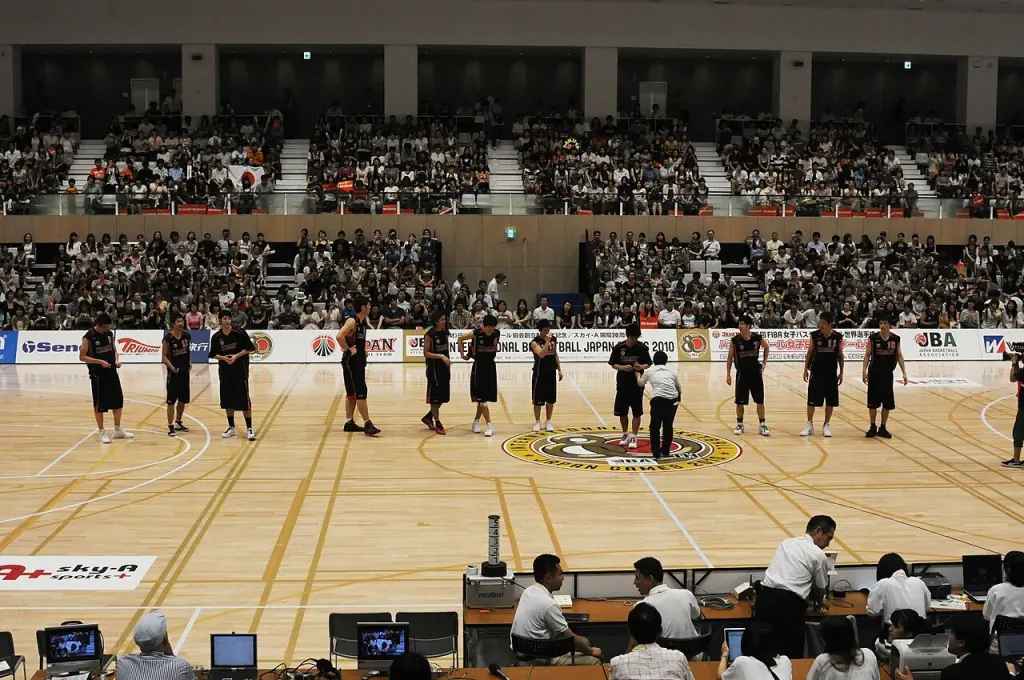
Image: STB-1 / Wikimedia Commons · CC BY-SA 3.0
Overview
Schools, clubs and national teams form different networks.
Basketball in Japan connects educational history, organised club competition and popular sporting culture. Early introductions included adapted games for women as well as YMCA instruction in the international sport. School and university teams became important institutions, while national championships and later leagues created wider competitive networks. The Japan Basketball Association was founded in 1930. The launch of B.LEAGUE in 2016 marked a major reorganisation of the men’s club game, and the women’s silver medal at the Tokyo 2020 Olympics, held in 2021, became another landmark. Five-player basketball and 3×3 have separate competitive structures. Neither a national-team result nor a professional league alone represents the full range of basketball participation in Japan.
An early route for women and men.
League structures change over time.
Results require a format and edition.
At a glance
- Japanese name
- バスケットボール
- National association
- Japan Basketball Association · JBA
- Association founded
- 1930
- Major formats
- Five-player and 3×3
- Men’s league landmark
- B.LEAGUE opened in September 2016
- Women’s Olympic landmark
- Silver at Tokyo 2020, held in 2021
01
Women’s education belongs in the origin story
Sports historian Tanigama Hironori’s account for Toyo University describes Naruse Jinzō’s introduction of adapted basket games in women’s education in the 1890s and at Japan Women’s University. It also identifies Ōmori Hyōzō’s YMCA teaching in 1908. These were related but distinct routes. A single “first arrival” date can conceal differences between an adapted educational game and the international competitive form.
02
School competition helped establish durable networks
Basketball entered the 1913 school physical-education syllabus, according to Tanigama’s historical account. JBA’s championship history dates the men’s national tournament to 1921 and the women’s to 1930. Such institutions connected local practice with competition beyond one school. They also made women’s basketball part of the organised national game long before the recent prominence of professional men’s clubs.
03
Associations, clubs and national teams do different work
JBA’s foundation in 1930 provided a national organisational framework. A national team represents Japan in a specified international competition, whereas a club competes within its own league or tournament. School and university teams have separate eligibility structures. Keeping these levels distinct makes the sport easier to follow and prevents a club championship from being mistaken for a national-team achievement.
School or university
- What the team represents
- An educational institution.
Club league
- What the team represents
- A club in a domestic competition.
National team
- What the team represents
- Japan at a specified international tournament.
3×3
- What the team represents
- A separate format with its own events and selection.
04
B.LEAGUE opened a new chapter in 2016
The men’s B.LEAGUE opened on 22 September 2016 with Alvark Tokyo against Ryukyu Golden Kings at Yoyogi. Its official announcement placed the launch after a period of divided leagues and organisational difficulty. The opening is a clear historical milestone. Later changes in divisions, licensing and commercial structure belong to subsequent seasons and should not be projected backwards onto the inaugural competition.
05
The women’s Olympic silver widened the historical record
Japan reached its first women’s Olympic final at the Tokyo Games held in 2021. FIBA records the United States’ 90–75 victory in the final and Japan’s silver medal. The event belongs to the Tokyo 2020 edition despite its 2021 playing date. It is a women’s five-player result, separate from the men’s tournament and the Olympic 3×3 events.
06
Basketball reaches audiences through more than match results
School settings, team identities and player narratives also appear in Manga and Anime. The related Slam Dunk Anime Songs entry explores one part of that media connection. Fiction and sporting institutions can be studied together without treating a fictional team as evidence of real competition rules or attributing every increase in participation to one cultural work.
Sources
Last updated: