Performing Arts
Tsukkomi
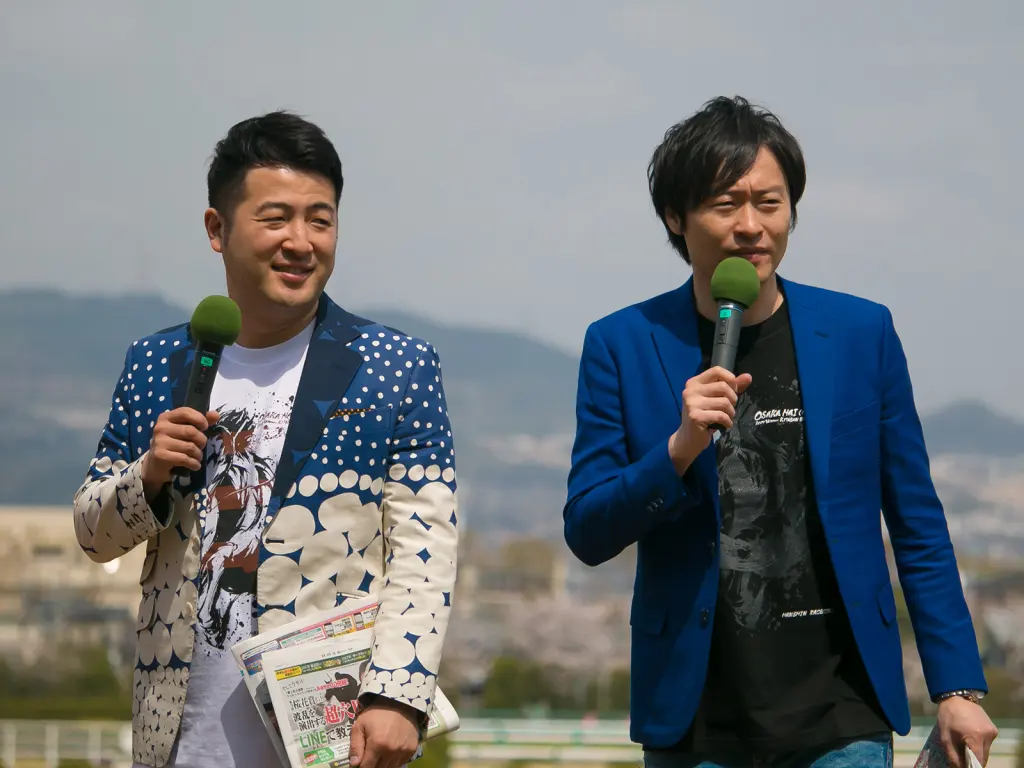
Image: Ogiyoshisan / Wikimedia Commons · Creative Commons Attribution-ShareAlike 4.0 International
Overview
The response gives the mismatch its shape.
Tsukkomi (ツッコミ) is a comic response to an incongruity and the name of a role associated with making that response. In manzai, the tsukkomi reacts to the boke’s unlikely statement, misunderstanding or behaviour. The response can clarify a mismatch, add another comic image or shape the direction of the exchange. English descriptions often use “straight man”, but that shorthand can obscure the role’s active contribution to humour. Tsukkomi is relevant to Kamigata manzai and to the broader form, as well as some conversational uses. It should be understood through its function in a particular exchange rather than through shouting, physical contact or a fixed personality type.
What is unexpected in the boke?
What should the audience compare?
How does the reaction reshape the exchange?
At a glance
- Japanese
- ツッコミ · tsukkomi
- Type
- Comic response and performer role
- Partner role
- Boke
- Common English shorthand
- Straight man
- Central function
- Make a comic mismatch salient
01
A response can create humour of its own
The tsukkomi helps organise how a Boke is understood. Masuya’s 2006 analysis argues that the response can make a contrast clear and, in some cases, supply an expected frame that had not been stated. The conclusion concerns the analysed material; it does not require every routine to follow identical stages.
02
Correction is one possible response
Xiong’s undergraduate thesis surveys responses including comparison, briefly going along with a premise before rejecting it, and deliberate silence. The terminology is descriptive rather than one universally regulated classification.
These possibilities make “the person who says the sensible line” only an initial approximation. A response can be inventive in its own wording and delivery.
03
Compare two responses to the same invented boke
This illustration is newly written for the page. It is not a quotation from a comedy act, and does not claim to reproduce a standard Japanese routine.
Boke
- Invented dialogue
- I set my alarm for yesterday.
- Effect
- Makes an impossible plan.
Direct response
- Invented dialogue
- An alarm cannot take you back a day.
- Effect
- States the mismatch.
Alternative response
- Invented dialogue
- Excellent. You can be early for the meeting we already missed.
- Effect
- Briefly follows the impossible premise.
04
The role is a function in the exchange
The performer described as a duo’s tsukkomi need not retain that function in every moment. The Japan Arts Council notes role changes within routines. Looking for the effect of a particular response is therefore more useful than treating the performers’ labels as inflexible rules.
05
Words and their presentation belong together
The scholarly sources approach tsukkomi through different methods: Masuya closely analyses spoken material, while Xiong offers a broader cultural discussion. Their scope matters when using them. A written exchange makes some contrasts easy to inspect, but cannot preserve every feature of a live response.
A useful viewing question is: what does this reaction invite the audience to notice? That question keeps attention on the performed interaction without assuming that volume or physical force defines the role.
06
Conversational use requires its own context
Xiong discusses tsukkomi beyond professional manzai, while the Gakushuin repository describes research on humorous interaction between close friends. These are reasons to recognise uses outside a theatre, not to assume that every correction or disagreement is a comic act.
For the broader performance setting, see Manzai. For the Osaka-centred tradition, see Kamigata Manzai. The geographical tradition and the interactional role remain different kinds of description.
Sources
- Japan Arts Council, Boke and tsukkomi: the interplay of dialogue.
- Tomoyuki Masuya, Remarks on tsukkomi in Manzai (2006), pp. 150–157.
- Zesheng Xiong, The Art of Tsukkomi (2015), undergraduate thesis, Tufts University.
- Halina Zawiszová, Manzai-like humor sequences: Exploring a particular form of highly collaborative conversational humor in Japanese interactions (2021).
Last updated: