Other Martial Arts
Dohyō
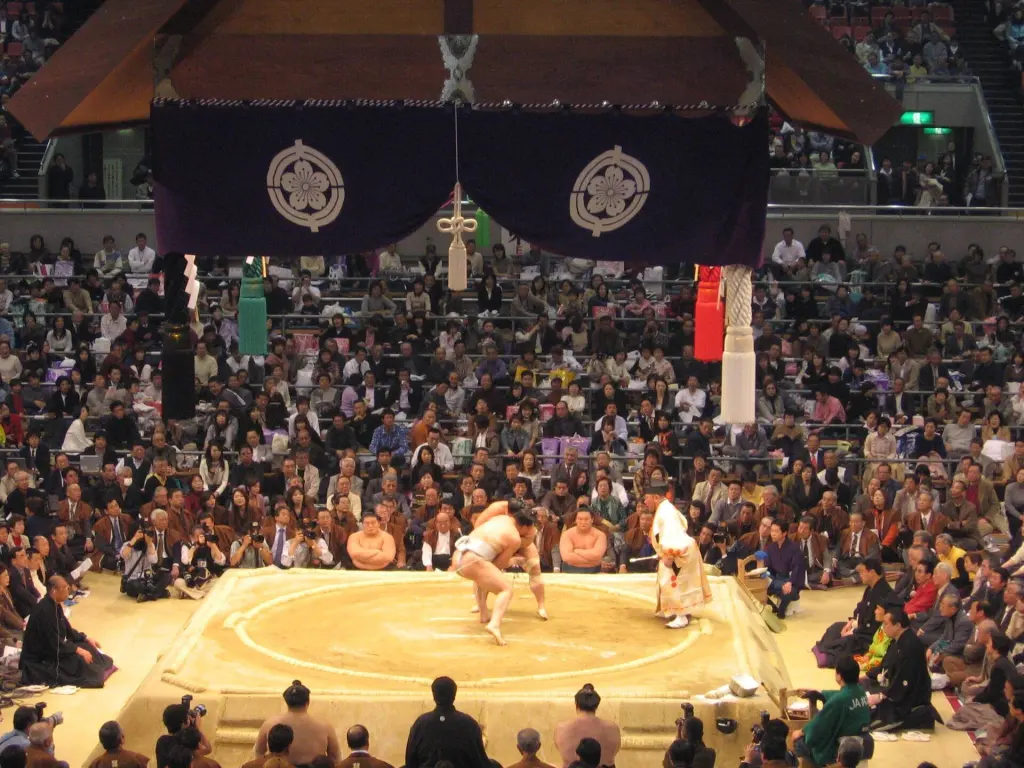
Image: Peter 111 / Wikimedia Commons · Creative Commons Attribution-ShareAlike 3.0 Unported
A dohyō (土俵) is the prepared contest area used for sumo. In professional Grand Sumo, the familiar form is a raised clay platform with a circular boundary made from partially buried rice-straw bales, a sanded surface, starting lines, and a suspended roof above it. The inner circle is fifteen shaku, about 4.55 metres, in diameter. This space is both practical and ceremonial: it defines how a bout is won or lost, is rebuilt for tournaments, and is consecrated in a dohyō-matsuri before competition. The term also applies to rings used in amateur, school, shrine, and community sumo, which do not always reproduce the professional platform or its customs. Dohyō therefore names a family of regulated spaces, not one timeless structure shared without variation across all sumo.
Overview
| Japanese name | 土俵 |
|---|---|
| Romanization | Dohyō |
| Primary function | Prepared contest area for sumo |
| Grand Sumo inner diameter | 15 shaku, approximately 4.55 metres |
| Boundary material | Partially buried rice-straw bales called tawara |
| Professional surface | Compacted clay covered with a thin layer of sand |
| Consecration ceremony | Dohyō-matsuri before a professional tournament |
Name and scope
The word dohyō literally refers to the earthen or straw-marked ring used for sumo, and by extension can mean the competitive arena itself. It appears in compounds such as dohyō-iri, a ring-entering ceremony, and dohyō-matsuri, the ceremony that consecrates a newly prepared ring.
English often translates dohyō simply as “sumo ring,” which is useful but incomplete. In Sumo, the boundary, raised platform, sand, starting marks, roof, attendants, judges, and ritual preparation work together as a staged environment. Smaller or level rings used outside Grand Sumo may omit several of these features.
Platform and inner circle
The Japan Sumo Association describes the professional dohyō as a square raised platform made from a special clay. Its contest circle is marked by straw bales set mostly into the surface. The official inner diameter is fifteen shaku, approximately 4.55 metres. Sand spread over the hardened top makes foot contact and marks at the edge easier to read.
The square platform and the circular contest area serve different functions. A wrestler can step on the platform outside the circle before or after a bout, but touching beyond the circular boundary during competition normally decides the result. The visible monument is therefore larger than the legal field of play.
Tawara, starting lines, and sand
The straw bales that define the circle are called tawara. Most of each bale is buried, leaving a firm rounded boundary. Four sections are set slightly farther out; these are commonly called toku-dawara. Their arrangement preserves an opening-like form associated with earlier outdoor rings and also creates limited extra space at those points.
Two white shikiri-sen mark where the wrestlers prepare for the tachi-ai. Fine sand outside the bales, sometimes called the “snake’s eye,” records whether a foot or another body part has touched down. Sweepers and attendants maintain the surface because a disturbed edge can affect both safety and judgment.
How the dohyō decides a bout
A wrestler loses by touching the ground with any part of the body other than the soles of the feet or by touching outside the circular boundary. A hand, knee, torso, topknot, heel, or toe can therefore decide a bout even when no dramatic throw occurs. The dohyō turns balance and edge awareness into central technical problems.
The gyōji gives the initial decision. Five ringside judges can call a mono-ii conference if the result is uncertain and may uphold or reverse the call or order a rematch. The sand and bale line are not decoration: they provide evidence for a decision that may occur within fractions of a second.
Construction and renewal
A professional tournament dohyō is built and finished by yobidashi, the specialized attendants who also announce wrestlers and perform other arena work. Clay is shaped, compacted, measured, and marked; tawara are installed; the surface is dried and repeatedly maintained. The process combines physical craft with exact sporting requirements.
The ring is not a permanent stage transported intact through the annual calendar. It is prepared for a venue and occasion, repaired during use, and ultimately removed or remade. This repeated construction helps explain why knowledge of materials, moisture, surface hardness, and finish belongs to the institutional practice of Grand Sumo.
Dohyō-matsuri and offerings
The separate entry on Dohyō-matsuri explains the principal officiant, assisting gyōji and six kinds of offerings, while distinguishing the ceremony from dohyō-iri.
Before a Grand Sumo tournament, gyōji conduct a dohyō-matsuri at the completed ring. The Japan Sumo Association describes offerings placed in a central cavity, including items such as salt, kelp, dried squid, chestnuts, washed rice, and kaya nuts. Prayers address safety and the successful conduct of the tournament.
The ceremony relates professional sumo to Shinto vocabulary, but the ring should not be described as a shrine or every bout as a religious service. Grand Sumo combines athletic rules, professional organization, entertainment, historical costume, and rites whose present forms developed at different times.
Suspended roof and arena staging
Above the professional ring hangs a roof shaped like shrine architecture. Modern arenas suspend it from cables, leaving the sightlines open where roof-supporting posts once stood. Large tassels at the corners use four colours associated with directions and seasons, making the dohyō visually legible within a large indoor venue.
The space around the ring is also carefully organized. Judges sit at its sides, salt and water are positioned for the wrestlers, yobidashi enter to maintain the surface, and prize banners or envelopes appear at designated moments. The dohyō is therefore the centre of a timed performance system as well as the site of the bout.
The dohyō in the honbasho cycle
The Yokozuna Dohyō-iri gives the grand champion a distinct ceremonial entrance on this platform, separate from both a bout and the collective top-division entrance.
At a Great Sumo Tournament, bouts from lower divisions through makuuchi use the same central ring in a daily sequence. Ring-entering ceremonies, sponsor banners, preparation, matches, decisions, and surface maintenance accumulate around it from morning to evening. The banzuke determines the ranked order in which wrestlers enter this system.
The 2026 September Tournament at Ryōgoku Kokugikan is scheduled from 13 to 27 September, with the dohyō-matsuri listed for 12 September. These dates give the topic immediate relevance, while the recurring cycle of construction, consecration, fifteen competition days, and removal is the more durable institutional pattern.
Professional, amateur, and local variation
Amateur, school, university, women’s, children’s, shrine, and community sumo can use rings with different platforms, materials, permanence, and ceremony. International competition requires a clearly regulated contest boundary but not every architectural feature seen at Kokugikan. Practice rings in stables also serve training rather than public spectacle.
For this reason, the raised clay Grand Sumo dohyō is the best-known form, not the universal minimum definition. A level ring marked on another suitable surface can still organize sumo competition when the governing rules allow it. Context determines which professional customs are reproduced.
Access and contested tradition
Professional Grand Sumo maintains a rule barring women from its dohyō, a practice that has drawn sustained criticism, especially when public officials, prize presenters, or emergency responders are involved. Historical and scholarly work shows that women have participated in forms of sumo, so the restriction should not be projected backward as a timeless definition of the sport or the ring.
Women compete in amateur sumo in Japan and internationally. Distinguishing the Japan Sumo Association’s professional custom from other sumo institutions makes the disagreement clearer: it concerns access to a particular professional ritual space, not an absence of women’s sumo or an intrinsic physical property of every dohyō.
Sources
- Introduction to Sumo — Japan Sumo Association.
- For the Tradition and Future of Ōzumō — Japan Sumo Association Expert Panel.
- Dohyō Matsuri information — Japan Sumo Association.
- Grand Tournament Schedule — Japan Sumo Association.
- Dohyo (sumo ring): where gods dwell — Kokugakuin University.
- The Emergence of Kanjin Zumō Tournaments — Edo-Tokyo Digital Museum, Tokyo Metropolitan Library.
- 相撲の女人禁制と伝統の再構築 — CiNii Research.
Last updated: