
Harai-goshi
払腰はらいごし
Sweeping hip
- Koshi-waza
- Gokyō: Dai-nikyō
- Nage-no-kata
Key idea
The defining action creates a turning hip relationship and then extends the opponent’s trajectory with an upward sweep.
Kodokan official demonstration
Kodokan technique list (opens in a new tab)YouTube (opens in a new tab)
VISUAL GUIDE
How to read the movement
Harai-goshi creates a turning hip relationship and then extends the opponent’s trajectory with an upward sweep.
- Tori
- the person applying the technique
- Uke
- the person receiving the technique
- Red line
- main direction or point of contact
AT A GLANCE
Classification representative
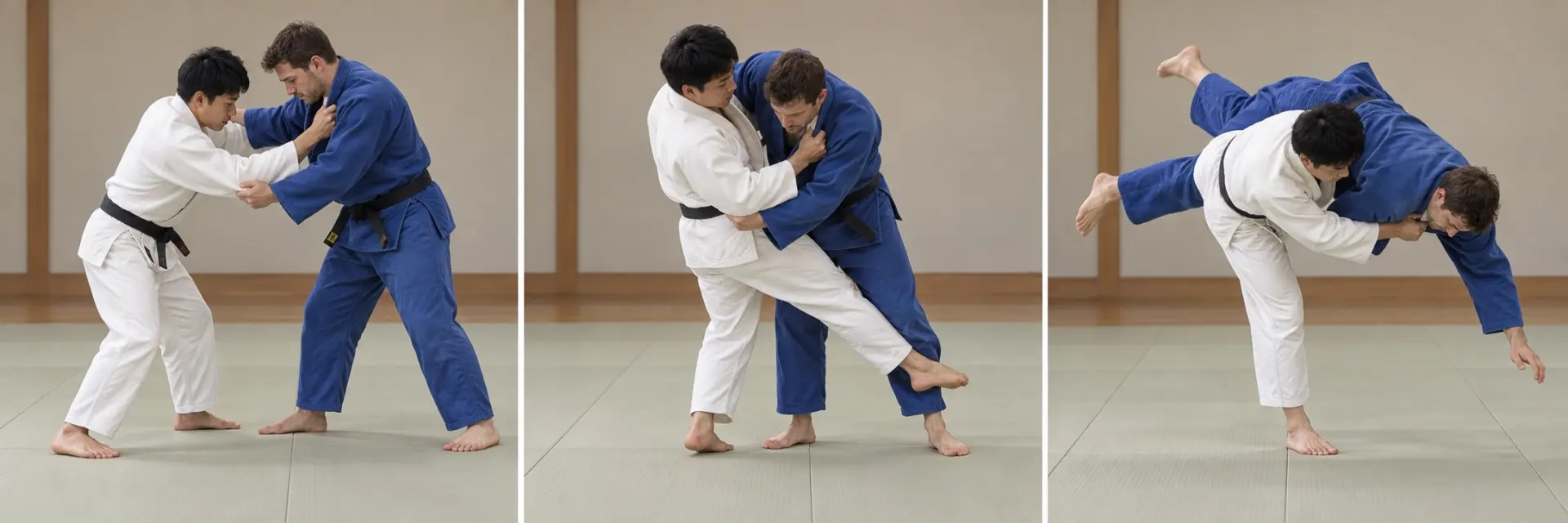
IN SEQUENCE
Three basic phases
- 1Create the imbalance
- 2Enter with control
- 3Complete the action
Original AI-generated educational illustration for TokyoWaltz, 2026. A simplified three-stage concept; practise under qualified instruction.
PLAY WHEN NEEDED
Watch the basic movement slowly
- 1Starting pointCreate the imbalance
- 2Decisive actionEnter with control
- 3CompletionComplete the action
1 / 3Starting point— Create the imbalance
Follow the red line and phase indicator. The guide does not autoplay or loop.
How it works
Harai-goshi creates a turning hip relationship and then extends the opponent’s trajectory with an upward sweep.
Kuzushi
Create the imbalance
Kuzushi is forward or toward a front corner. The goal is to make the opponent move onto the hip relationship rather than remain upright behind it.
Tsukuri
Enter with control
Tsukuri turns the body and places the rear hip into the opponent’s path while the hands draw the upper body forward. The supporting foot and trunk create the axis from which the sweeping leg can move freely.
Kake
Complete the action
Kake combines continued rotation and hand control with an upward sweep of the same-side leg. The opponent is projected over and beyond the established hip line under control.
Key points
- Kuzushi is forward or toward a front corner. The goal is to make the opponent move onto the hip relationship rather than remain upright behind it.
- Tsukuri turns the body and places the rear hip into the opponent’s path while the hands draw the upper body forward. The supporting foot and trunk create the axis from…
- Kake combines continued rotation and hand control with an upward sweep of the same-side leg. The opponent is projected over and beyond the established hip line under control.
Similar techniques
| Technique | Japanese name | Key difference |
|---|---|---|
| Sode-tsurikomi-goshi | 袖釣込腰 | Sode-tsurikomi-goshi uses a lifting sleeve grip to load uke onto the back of the hip and turn forward; Harai-goshi creates a turning hip relationship and. |
| Tsuri-goshi | 釣腰 | Tsuri-goshi lifts from a grip on the back of the belt and carries uke across the back of the hip; Harai-goshi creates a turning hip relationship and. |
| Tsurikomi-goshi | 釣込腰 | Tsurikomi-goshi lifts through a lapel grip while loading uke onto the back of the hip for a forward throw; Harai-goshi creates a turning hip relationship and. |
Reference
Open the detailed source material when you need definitions, technical distinctions, training context, or references.
Official definition
Official definition
The Kodokan defines harai-goshi by breaking the opponent straight forward or toward a front corner, drawing and loading the opponent onto the thrower’s rear hip, and sweeping upward with the leg on that same side. The right-sided and left-sided forms mirror one another.
Both elements matter: a sweeping leg without the characteristic hip loading may belong to another ashi-waza, while hip placement without the sweep may resemble a different koshi-waza.
Technical principle
Harai-goshi creates a turning hip relationship and then extends the opponent’s trajectory with an upward sweep. The rear hip supports and redirects the opponent while the hands maintain forward and rotational control.
The sweep is not independent of the hip. Effective performance coordinates the supporting leg, trunk, and grip so that the opponent is already vulnerable before the sweeping leg completes the projection.
Name and classification
Overview
| Japanese | 払腰 |
|---|---|
| Reading | はらいごし |
| Romanisation | harai-goshi; common search form: harai goshi |
| Meaning | Sweeping hip |
| Martial art | Judo |
| Official classification | Kodokan koshi-waza |
| Gokyō no Waza | Dai-nikyō |
| Kata | Nage-no-kata, koshi-waza set |
Name and classification
Harai (払) means sweeping or brushing away, while goshi is the voiced form of koshi (腰), hip. The name identifies a hip throw completed with a sweeping leg action.
The Kodokan classifies harai-goshi as koshi-waza. It appears in Dai-nikyō of the Gokyō no Waza and is the middle technique in the koshi-waza set of Nage-no-kata.
Detailed execution
Kuzushi
Kuzushi is forward or toward a front corner. The goal is to make the opponent move onto the hip relationship rather than remain upright behind it.
Movement, grip changes, or a reaction to another attack can supply the opening. The throw is less efficient when the opponent is pulled onto a static hip without first losing the ability to step.
Tsukuri
Tsukuri turns the body and places the rear hip into the opponent’s path while the hands draw the upper body forward. The supporting foot and trunk create the axis from which the sweeping leg can move freely.
The exact depth varies. The Kodokan description focuses on loading onto the rear hip, which distinguishes the technique from a purely leg-led inner-thigh action.
Kake
Kake combines continued rotation and hand control with an upward sweep of the same-side leg. The opponent is projected over and beyond the established hip line under control.
A high or forceful leg swing cannot compensate for missing hip placement and kuzushi. In safe practice, the thrower preserves a stable supporting leg and guides the receiving partner’s descent.
Common variations
Harai-goshi can be performed from standard sleeve-and-lapel grips, over-the-back grips, and same- or opposite-stance situations. Entries range from a relatively close hip fit to more open competition forms.
Grip, sweep height, and approach may vary without changing the name. Classification should follow whether the opponent is loaded on the rear hip and projected by the associated sweep.
Historical association with Jigoro Kano
The Kodokan page preserves Kanō’s account that Shirō Saigō learned to evade his uki-goshi by jumping forward. Kanō responded by using his leg and thigh to stop and sweep the escaping leg while modifying the upper-body control, producing the form he taught as harai-goshi.
This is documentary evidence for harai-goshi’s technical development within the Kodokan and for Kanō’s association with the named form. It should not be expanded into the stronger claim that no comparable action existed earlier. Kanō himself acknowledged that people before him may have used something similar.
Variations
Relationship to Uki-goshi
The Kodokan explicitly explains harai-goshi as developing from uki-goshi, the floating-hip throw. Uki-goshi uses a shallower hip action and turning projection without the same sweeping leg completion.
In the Kodokan’s Nage-no-kata materials, the tsukuri of harai-goshi is based on uki-goshi. This relationship makes the two techniques useful to study together: the earlier hip entry remains visible, while the sweep answers a different movement by the opponent.
Relationship to Uchi-mata
Harai-goshi and uchi-mata can look similar because both may turn, balance on one leg, and sweep upward. The official categories are different: harai-goshi is koshi-waza, while uchi-mata is ashi-waza.
Harai-goshi loads the opponent onto the rear hip and sweeps with the same-side leg. Uchi-mata is defined by sweeping the opponent’s inner-thigh line with the back of the attacking thigh. In variable competition forms, the actual loading relationship is more reliable than surface appearance.
Training and safety
Training
Harai-goshi is studied formally in Nage-no-kata and practically through uchikomi, controlled throwing, combinations, and randori. Training can compare it directly with uki-goshi and uchi-mata to clarify where the opponent is loaded and what action completes the throw.
The supporting leg and hip should remain stable before speed or sweep height is increased. Reliable ukemi and controlled follow-through are necessary because the receiving partner may rotate from a raised position.
Competition rules
Competition
Harai-goshi is legal in IJF competition. Under the Sport and Organisation Rules dated 14 August 2026, scoring depends on the landing and general throwing criteria, while grip and transition rules apply to the action actually performed.
A deliberate head-first dive during harai-goshi is punished by direct hansoku-make. Youth and national rules can add safety restrictions beyond the IJF senior standard.
Sources
Sources
- Kodokan Judo Institute, Harai-goshi.
- Kodokan Judo Institute, Judo Technique Names.
- Kodokan Judo Institute, Definitions of Judo Techniques, 2022.
- Kodokan Judo Institute, Nage-no-kata.
- Historical Study of the Technical Development of Kodokan Judo.
- Fujioka, Review of Biomechanical Studies of Judo Throwing Techniques.
- International Judo Federation, Sport and Organisation Rules, 14 August 2026.