Judo
Kumi-kata
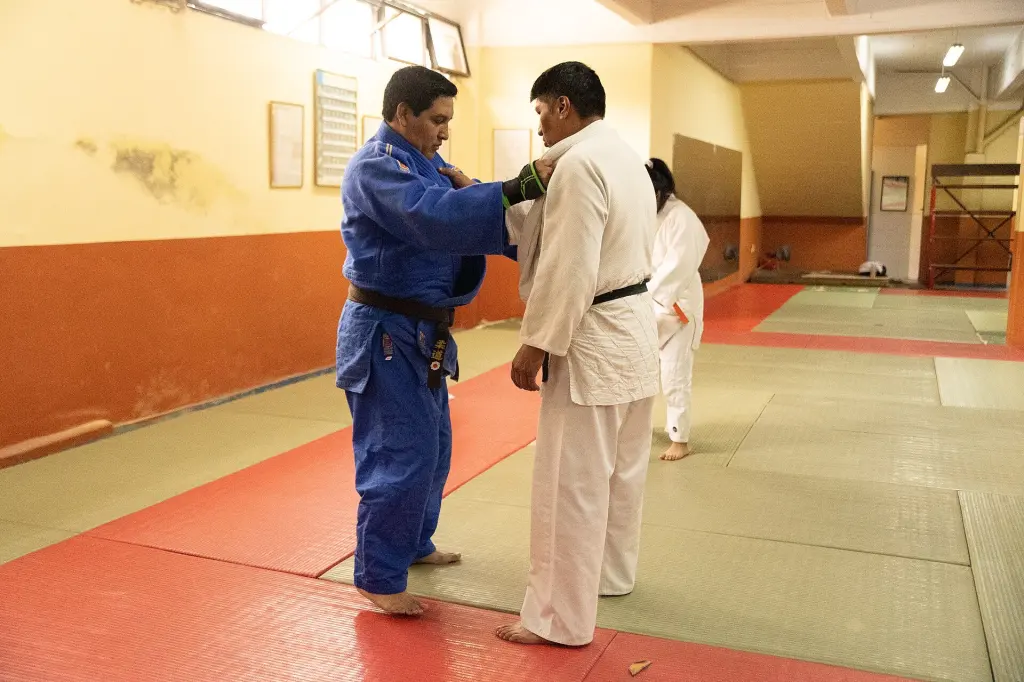
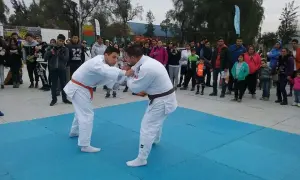
Image: Saidalefotografia / Wikimedia Commons · CC BY-SA 4.0
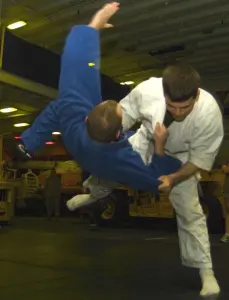
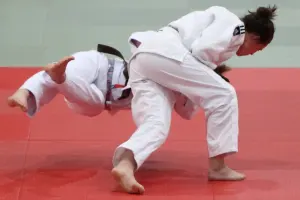
Kumi-kata (組み方, method of gripping or engagement) is the way judoka establish and use contact through the judogi. It belongs to the standing technical foundation of Judo rather than to the Kodokan list of named throws. A conventional right-handed grip places the right hand on the opponent's left lapel or upper jacket and the left hand on the opponent's right sleeve, with the arrangement reversed for a left-handed grip. Kumi-kata matters because it connects posture, distance, movement, kuzushi, attack, and defence. It is also rule-sensitive: the IJF permits a wider range of positive non-classical grips than a simple sleeve-and-lapel formula suggests, while penalising avoidance, blocking, and prohibited leg contact.
Overview
| Japanese | 組み方 |
|---|---|
| Reading | くみかた |
| Romanisation | kumi-kata; common search form: kumi kata |
| Meaning | Method of gripping or engagement |
| Martial art | Judo |
| Context | Standing practice, randori and contest |
| Rule authority researched | IJF SOR, 14 August 2026 |
Meaning of kumi-kata
The verb kumu (組む) means to join, engage, or grapple, while kata (方) means way or method. In Judo English, kumi-kata may mean an established grip, the method of taking it, or the broader struggle for useful contact.
Related terms distinguish the two hands by function. Tsurite is the lifting or steering hand, commonly on the lapel; hikite is the pulling hand, commonly on the sleeve. These are functional names, not rules requiring the hands to remain fixed.
Role of gripping in Judo
A grip transmits information and force between the athletes. Through it, a judoka can sense movement, regulate distance, turn the opponent's shoulders, limit an attacking line, and prepare a throw. The same contact can change rapidly from defensive to attacking use.
Kumi-kata should not be reduced to hand strength. Foot position, stance, trunk alignment, timing, and the ability to relax or change pressure all affect whether a grip creates useful control. Research on elite competition has also found that scoring attacks frequently use at least one grip outside the conventional sleeve-and-lapel locations.
Standard sleeve-and-lapel grip
In a conventional right-handed arrangement, the right hand usually takes the opponent's left lapel, chest, shoulder, or upper back area and the left hand the opponent's right sleeve. A left-handed arrangement reverses the sides. The IJF's current definition of normal kumi-kata is broader than one exact hand placement: it includes permitted jacket areas above the belt on opposite sides.
The familiar sleeve-and-lapel grip is a teaching reference because it supports posture, directional control, and many throws. It is not the only legitimate grip in Kodokan practice or current IJF competition.
Posture and movement
Useful kumi-kata allows movement in more than one direction. Locking both arms rigidly may hold an opponent briefly but can also transmit intention, restrict footwork, and invite counters. The relationship between the hands and the athlete's centre matters more than the isolated position of the fingers.
Grip and stance interact. Two right-handed or two left-handed athletes are commonly described as ai-yotsu, same-sided stances. Opposite stances are kenka-yotsu. The terms describe tactical relationships, not different rulesets.
Kumi-kata and kuzushi
Kuzushi is the creation or recognition of instability. Kumi-kata helps produce it through pulling, lifting, steering, rotation, and changes of direction, but imbalance also comes from the opponent's own step, reaction, or attack.
Grip, tsukuri, and kake therefore overlap. A change from sleeve to back grip may alter distance and entry angle at the same time; a throw can begin as the hands exploit a step rather than after a separate, visible pull.
Grip fighting in randori
In randori, judoka learn to establish contact without turning the exercise into a static strength contest. They may change grips, break a grip, circle, or attack before a preferred arrangement is complete. Training partners should preserve the purpose of free practice rather than imitate every tactical delay of high-level competition.
A grip is evaluated by what it enables: posture, movement, attack, safe defence, and transition. Habitually preventing all contact can reduce learning and, under contest rules, may also be penalised.
Right-versus-left situations
In kenka-yotsu, both athletes often seek the inside lapel position, control of the leading sleeve, or a favourable angle outside the opponent's lead foot. The available entry lines differ from ai-yotsu, and the same named throw may require a different route.
These are tactical tendencies, not universal prescriptions. Body proportions, preferred techniques, and an athlete's ability to attack from temporary grips can outweigh a nominal right- or left-handed label.
Kumi-kata in competition
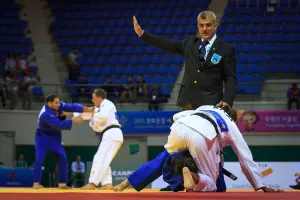
Current IJF rules researched: 14 August 2026. A conventional grip may be held for up to 45 seconds before an attack when there is positive progression. Referees are instructed to penalise athletes who avoid engagement, adopt a negative posture, or use grips only to block.
Non-classical grips—including same-side, cross, belt, pocket, pistol, and collar-and-lapel grips—are permitted when the athlete acts positively and prepares an attack. The earlier idea that every unusual grip must be followed by an immediate attack is therefore no longer an accurate general description.
Rules affecting grips
The 2026 SOR permits jacket grips and contact under the belt only down to the top of the inner thigh, provided they are used positively. Hooking a standing opponent's leg, gripping the trousers, or touching below that line is shido. Leg contact becomes possible only after both athletes are clearly in Ne-waza and the standing action has ended.
Breaking with one hand is allowed even if no grip remains. Breaking with two hands without retaining at least one grip is shido. Defensive sleeve-end control, finger interlocking, covering the lapel, blocking the opponent's hand, and avoiding grips are also regulated. These details apply to IJF competition and may differ in youth, national, kata, or dojo contexts.
The All Japan Judo Federation adopted its January 2026 IJF interpretations for AJJF-hosted events from 1 April 2026, while noting that particular domestic events may specify adjustments. Competitors should therefore check the current event notice rather than rely on a timeless summary.
Training
Kumi-kata can be studied through light movement drills, entries from changing grips, task-based randori, and normal randori. A useful progression teaches safe fingers and wrists, upright mobility, permitted gripping areas, and attack from more than one contact pattern.
Competition grip fighting should be introduced with the ruleset being trained. A drill built around a past rule interpretation can teach habits that are currently penalised, while an IJF-specific tactic should not be presented as the only correct form of Judo gripping.
Sources
- International Judo Federation, Sport and Organisation Rules, version 14 August 2026.
- International Judo Federation, Rules documents.
- All Japan Judo Federation, Refereeing regulations and rules.
- All Japan Judo Federation, Application of the 2025–2028 IJF rules from 1 April 2026.
- All Japan Judo Federation, Handling of yuko at non-AJJF-hosted competitions, 21 April 2026.
- All Japan Judo Federation, 2025–2028 IJF rule changes.
- Murayama Terushi, Changes in the refereeing rules of Judo and Kendo, Japan Journal of Budo.
- Kodokan Judo Institute, Promotion Examination Text: Kodokan Judo, 2026.
- Ito Kiyoshi, Hirose Nobuyoshi and Maekawa Naoya, Tactical gripping actions in Judo, J-STAGE.
- Ito Kiyoshi et al., Changes in gripping tactics after IJF rule revisions, J-STAGE.
Last updated: