other-martial-arts
Sokubiotoshi
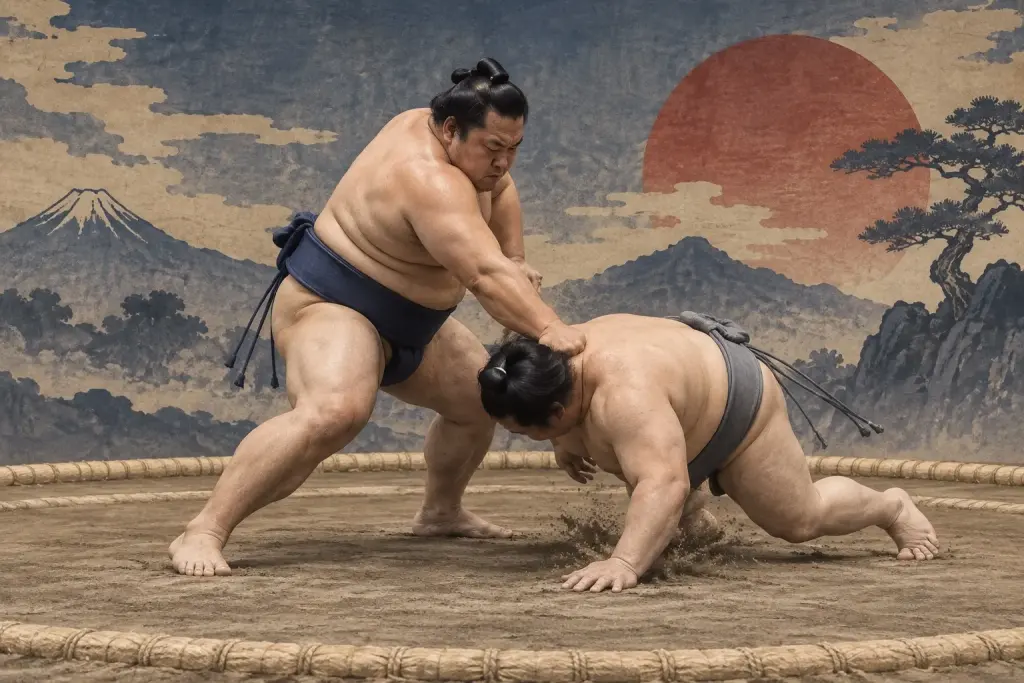
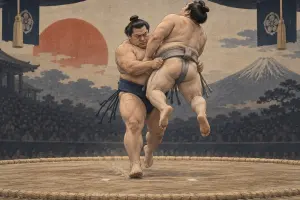
Image: TokyoWaltz / Original illustration · All rights reserved
Sokubiotoshi is an official sumo kimarite in which the wrist or forearm strikes down at the opponent’s neck or back of the head to cause a fall. The clearest cue is that a compact downward forearm action lands high at the neck rather than across the whole upper back. Sokubiotoshi targets the neck or back of the head with the wrist or forearm; Hatakikomi is a broader slap-down to the upper back or shoulders. The practical English gloss “Head or neck chop-down” is a viewing aid rather than an official translation. Focus on the contact that causes the final movement and on whether the opponent is forced out, falls, or is thrown. Earlier exchanges may create the opening, but the kimarite names the action that actually decides the bout.
Overview
| Japanese | 素首落とし |
|---|---|
| Reading | そくびおとし |
| Group | Special techniques (特殊技) |
| English guide | Head or neck chop-down |
| Official no. | 67 |
What happens
The result is recorded when the wrist or forearm strikes down at the opponent’s neck or back of the head to cause a fall.
How to spot it
Watch the decisive action, then confirm the result and the closest alternative.
- Action a compact downward forearm action lands high at the neck rather than across the whole upper back.
- Result the wrist or forearm strikes down at the opponent’s neck or back of the head to cause a fall.
- Compare Sokubiotoshi targets the neck or back of the head with the wrist or forearm; Hatakikomi is a broader slap-down to the upper back or shoulders.
Similar techniques
Sokubiotoshi targets the neck or back of the head with the wrist or forearm; Hatakikomi is a broader slap-down to the upper back or shoulders. The related pages Tsuridashi and Okuritsuridashi offer useful visual comparisons.
Name
Sokubiotoshi is written 素首落とし and read そくびおとし. It belongs to Special techniques (特殊技); “Head or neck chop-down” is a practical English guide, not an official translation.
Context
Sokubiotoshi can emerge directly from the tachiai, after a prolonged exchange, or as a counter when posture and footing change. Left-right orientation, wrestler size, and camera angle can alter its appearance without changing the classification.
Statistics
The Japan Sumo Association table consulted on 12 September 2026 counted 91 Sokubiotoshi results, 0.05% of 190,450 bouts from January 2013 through the final day of the July 2026 tournament, and listed the technique 42nd in that bounded dataset. This is a dated sample, not a timeless probability; check the association’s live page for later totals.
Sources
Last updated: