Film & Television
Japanese Film Directors
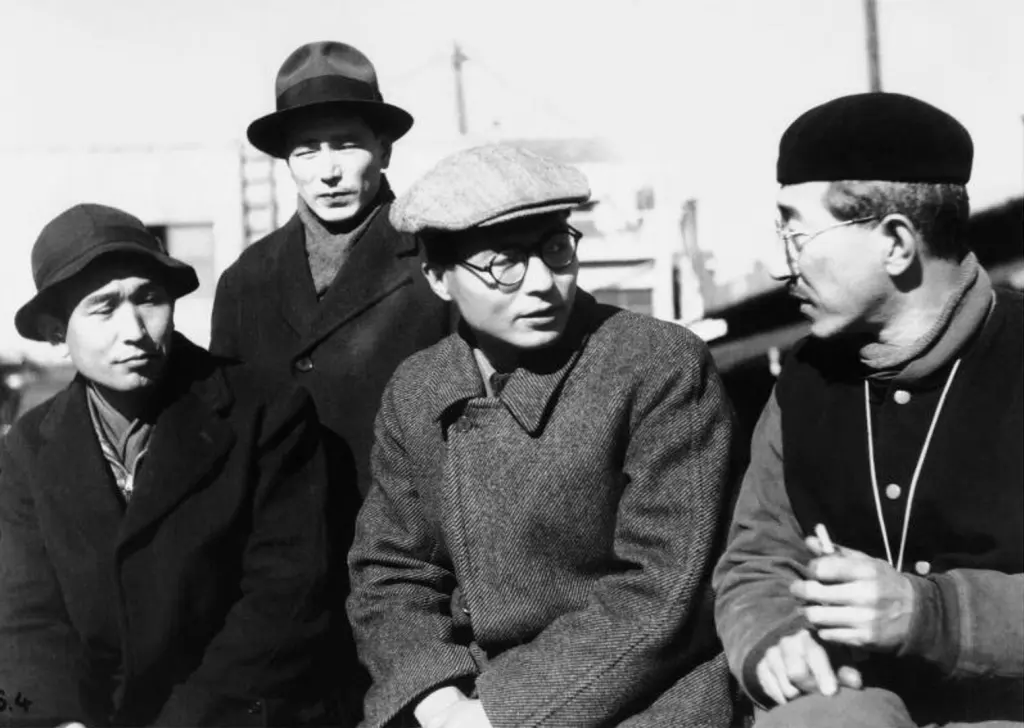
Image: Kurosawa Productions (repository credit) / Wikimedia Commons · Public domain
Overview
Many directors. Different ways of seeing.
Japanese film directors have worked across commercial studios, independent production, documentary and animation, with very different approaches to storytelling, performance and visual form. International accounts often begin with Yasujirō Ozu, Kenji Mizoguchi and Akira Kurosawa, but those names represent only part of the field. Women directors, popular genres, documentary traditions and later generations complicate any compact canon. This entry offers a selective map of directors and practices within Japanese Cinema, rather than a ranking or exhaustive directory. A director’s signature is also collaborative: scripts, acting, cinematography, editing, sound, production conditions and distribution all influence what reaches the screen.
Careers develop through different routes.
Collaborators and institutions shape possibilities.
Individual works reveal differences within a career.
At a glance
- Japanese term
- 映画監督 · eiga kantoku
- Field
- Film direction in and in relation to Japan
- Production contexts
- Studios, independent companies and international collaborations
- Forms
- Live-action fiction, documentary and animation
- Historical span
- Silent cinema to contemporary production
- Scope of this entry
- Selective overview, not an exhaustive ranking
01
A director’s work belongs to a production network
The director coordinates the film’s interpretation and staging, but the finished work depends on many contributors. Japan’s studio history created durable working relationships among filmmakers, performers and technicians. The photograph above shows Kurosawa, Ishirō Honda and Senkichi Taniguchi with Kajirō Yamamoto in the late 1930s, illustrating one such professional circle rather than a complete generation.
02
Classical cinema contains contrasting approaches
The Japan Foundation’s guide, prepared with the National Film Archive of Japan, selects twenty directors and forty films. Its breadth places familiar names alongside Gosho Heinosuke, Kawashima Yūzō and others. “Classical Japanese cinema” is thus a useful historical grouping, not a uniform method. Comparing a domestic drama, a period film and a popular comedy reveals differences that a national label can conceal.
Yasujirō Ozu
- One route into the work
- Family relationships and the organisation of everyday space.
Kenji Mizoguchi
- One route into the work
- Social pressures and the lives of women.
Akira Kurosawa
- One route into the work
- Moral conflict across period and contemporary settings.
Mikio Naruse
- One route into the work
- Economic pressure, relationships and everyday endurance.
03
Women’s direction changes the historical picture
Kinuyo Tanaka was both an established actress and a director. Her Forever a Woman (1955), written by Sumie Tanaka, follows a poet confronting illness and the constraints of her social setting. MoMA’s restoration programme highlights the film’s direct treatment of female experience. Including her directing work changes an account that might otherwise treat women only as performers in films made by men.
04
Later generations questioned established forms
The Japan Foundation’s classical selection extends to filmmakers including Ōshima Nagisa, Imamura Shōhei, Shinoda Masahiro and the documentarian Haneda Sumiko. Their inclusion helps broaden the field beyond its internationally familiar 1950s image. Different production contexts and approaches to social life need to be considered individually; a generational label does not mean that all these filmmakers shared one manifesto or visual language.
05
Contemporary careers can cross media and borders
Odoru Daisousasen offers an example of connected television and film work, with directing credits that differ between main entries and spin-offs.
Hirokazu Kore-eda provides one documented example of a career shaped by television documentary and feature filmmaking. The Japan Foundation’s 2021 award profile connects his work with ordinary lives, family relationships and neglected people. Contemporary Japanese film also belongs to wider networks of festivals, financing and international collaboration. Animation, discussed in Anime, forms another major part of the moving-image field.
06
Filmographies are most useful when context stays visible
A selective introduction should distinguish a director’s best-known export titles from the full body of work. Restoration programmes and archive catalogues can reveal films that were difficult to see, while programme notes supply production dates, collaborators and alternative titles. The selection here is deliberately limited. It is an orientation to different practices, not evidence that omitted directors are less significant or that festival recognition measures every kind of achievement.
Sources
- Japan Foundation, Film Catalogs: An Introduction to Japanese Film Classics.
- Japan Foundation and National Film Archive of Japan, Directors and Films.
- MoMA, Forever a Woman (1955), directed by Kinuyo Tanaka.
- Japan Foundation, 2021 Awards: Koreeda Hirokazu.
- BFI, A great Japanese film for every year from 1925 to now.
Last updated: