other-martial-arts
Tsukiotoshi
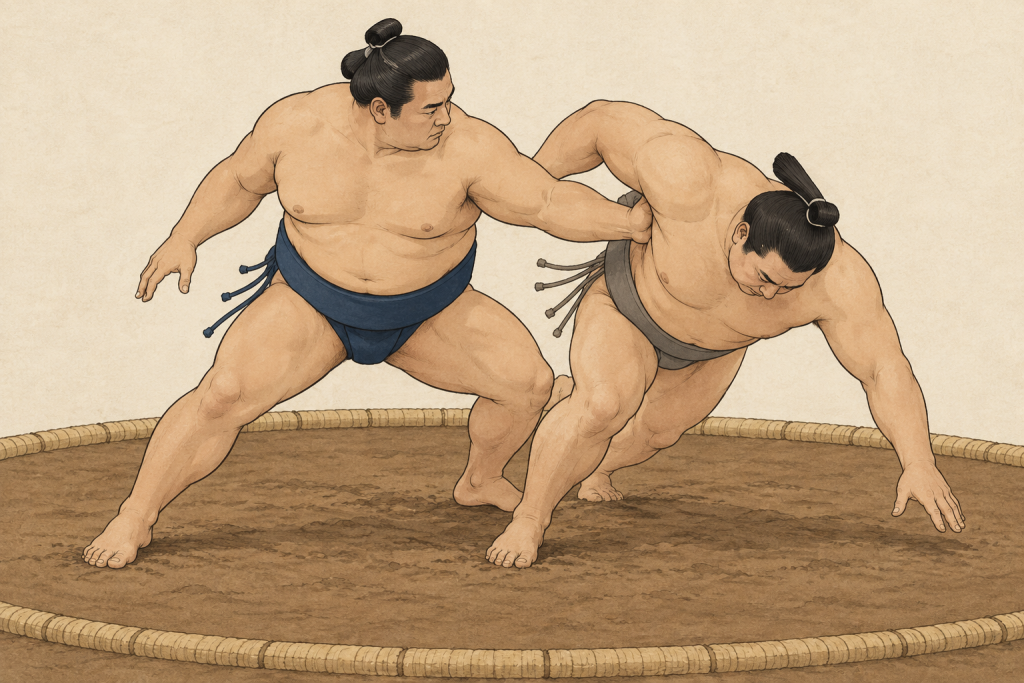
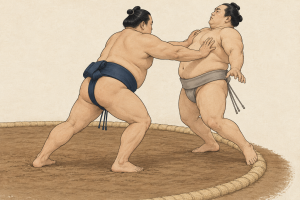
Image: TokyoWaltz / Original illustration · All rights reserved
Tsukiotoshi is a sumo thrust-down using one hand at the side of the torso to tip an opponent diagonally downward. The winner opens the body as the opponent advances or resists, places a hazu-shaped hand beneath the armpit or against the side ribs, and directs pressure down and across. Hatakikomi generally acts downward on a low opponent’s shoulder, back, or arm, often with one or both hands. The practical English gloss “Thrust-down” is a viewing aid rather than an official translation. Focus on the contact that causes the final movement and on whether the opponent is forced out, falls, or is thrown. Earlier exchanges may create the opening, but the kimarite names the action that actually decides the bout.
Overview
| Japanese | 突き落とし |
|---|---|
| Reading | つきおとし |
| Group | Twist-down techniques (捻り手) |
| English guide | Thrust-down |
| Official no. | 45 |
What happens
The loser is turned or tilted away from a stable base and pressed diagonally downward.
How to spot it
Watch the decisive action, then confirm the result and the closest alternative.
- Action the winner opens the body as the opponent advances or resists, places a hazu-shaped hand beneath the armpit or against the side ribs, and directs pressure down and across.
- Result the loser is turned or tilted away from a stable base and pressed diagonally downward.
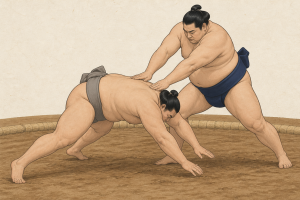
- Compare Hatakikomi generally acts downward on a low opponent’s shoulder, back, or arm, often with one or both hands.
Similar techniques
Hatakikomi generally acts downward on a low opponent’s shoulder, back, or arm, often with one or both hands. Oshidashi keeps open-hand pressure driving outward across the boundary. Hikiotoshi uses a pulling action. Tsukiotoshi is identified by its one-sided contact and diagonal thrust-down while the body opens.
Name
Tsukiotoshi is written 突き落とし and read つきおとし. Its usual English gloss joins “thrust” and “down,” yet the official Japanese description specifies a one-handed contact at the armpit or flank combined with opening the body. The association places it among hinerite, the twist-down group.
Context
Tsukiotoshi may be an immediate counter to forward pressure, a rescue at the tawara, or a finish produced after the wrestlers disengage from a grip. Camera angle can hide the hand under the opponent’s arm, making the result resemble a generic sidestep. Slow replay and the officials’ view clarify where the decisive pressure was applied.
Statistics
The Japan Sumo Association table consulted on 12 September 2026 counted 10,348 tsukiotoshi results, 5.4 percent of 190,450 bouts from January 2013 through the final day of the July 2026 tournament, ranking it fourth in that dataset. This is a dated sample, not a timeless probability; check the association’s live page for later totals.
Sources
Last updated: