other-martial-arts
Oshidashi
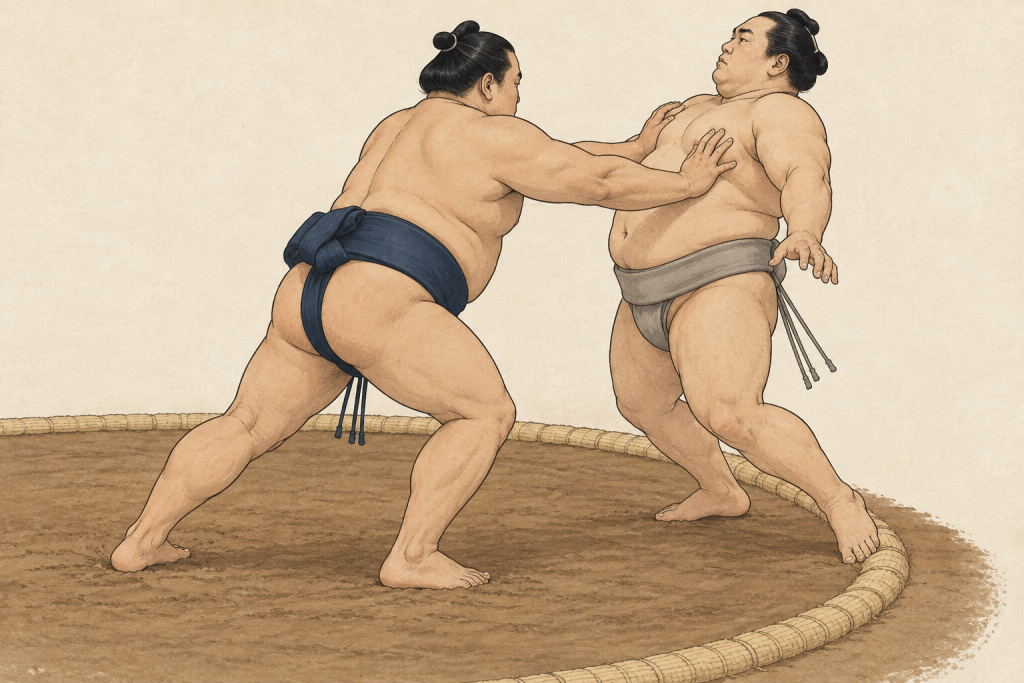
Image: TokyoWaltz / Original illustration · All rights reserved
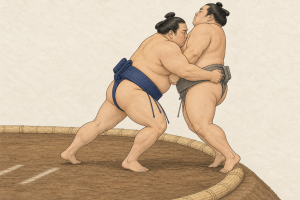
Oshidashi is a basic sumo push-out using open-hand pressure against the torso to send an opponent beyond the boundary. The attacker builds forward pressure through the feet and hips while keeping the hands connected to the opponent’s torso. Yorikiri is a close-body force-out, often with a mawashi grip, while tsukidashi is built from decisive thrusting rather than sustained palm pressure. The practical English gloss “Frontal push-out” is a viewing aid rather than an official translation. Focus on the contact that causes the final movement and on whether the opponent is forced out, falls, or is thrown. Earlier exchanges may create the opening, but the kimarite names the action that actually decides the bout.
Overview
| Japanese | 押し出し |
|---|---|
| Reading | おしだし |
| Group | Basic techniques (基本技) |
| English guide | Frontal push-out |
| Official no. | 3 |
What happens
The loser crosses the dohyō boundary under a continuing push applied to the upper torso.
How to spot it
Watch the decisive action, then confirm the result and the closest alternative.
- Action the attacker builds forward pressure through the feet and hips while keeping the hands connected to the opponent’s torso.
- Result the loser crosses the dohyō boundary under a continuing push applied to the upper torso.
- Compare Yorikiri is a close-body force-out, often with a mawashi grip, while tsukidashi is built from decisive thrusting rather than sustained palm pressure.
Similar techniques
Yorikiri is a close-body force-out, often with a mawashi grip, while tsukidashi is built from decisive thrusting rather than sustained palm pressure. Oshitaoshi is the related push-down result. A late defensive turn that redirects the attacker diagonally may instead produce Tsukiotoshi or a pull-down such as Hatakikomi, depending on the decisive action.
Name
Oshidashi is written 押し出し and read おしだし. The compound joins “push” with “send out,” matching its placement among the seven basic techniques. The English phrase “frontal push-out” is widely useful, but the bodies can become angled as the defender turns near the boundary; the decisive feature is open-hand pushing that ends outside.
Context
Oshidashi may follow an immediate driving charge, repeated attempts to establish inside hand position, or a recovery after the opponent breaks contact. The same winner can alternate thrusts and connected pushes within one bout. The official call focuses on the finishing phase, so viewers should watch how the final pressure is delivered rather than classify the entire exchange from its opening seconds.
Statistics
The Japan Sumo Association table consulted on 12 September 2026 counted 47,936 oshidashi results, 25.2 percent of 190,450 bouts from January 2013 through the final day of the July 2026 tournament, ranking it first in that dataset. This is a dated sample, not a timeless probability; check the association’s live page for later totals.
Sources
Last updated: