other-martial-arts
Yorikiri
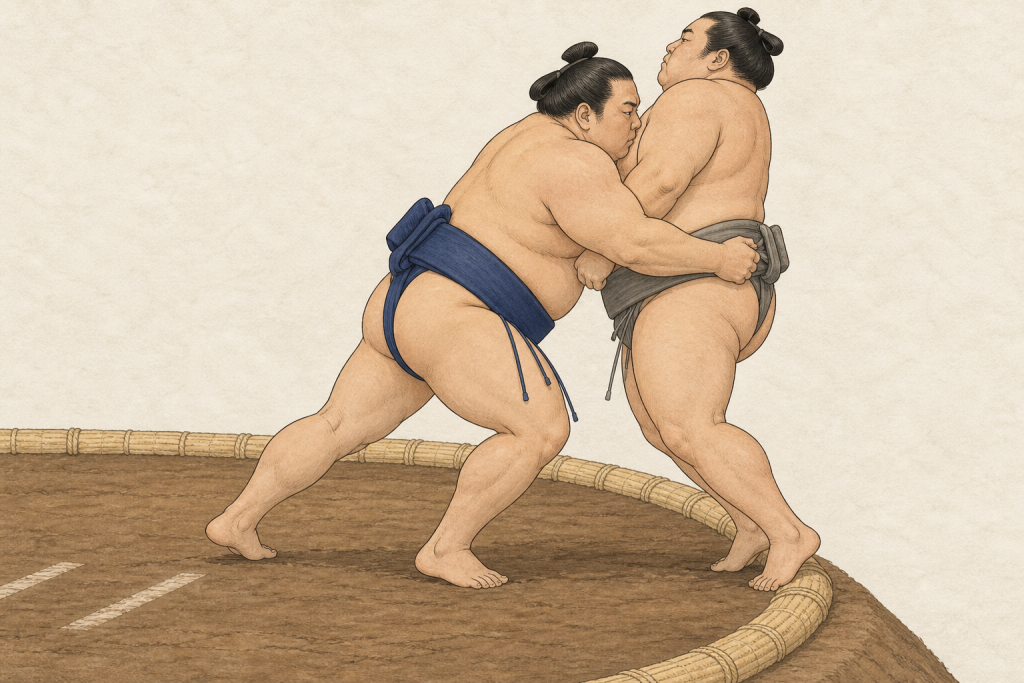
Image: TokyoWaltz / Original illustration · All rights reserved
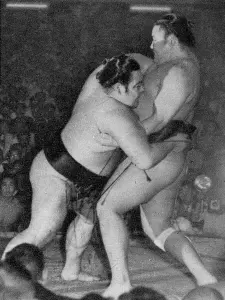
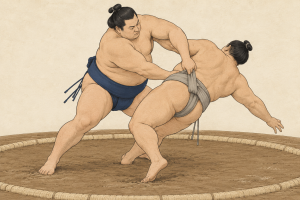
Yorikiri is a basic sumo force-out in which close body pressure drives an opponent across the dohyō boundary. A typical finish begins from yotsu-sumo, with the wrestlers chest-to-chest or shoulder-to-chest and one or both holding the mawashi. Oshidashi uses open-hand pressure against the torso without the same close-body force-out pattern. The practical English gloss “Frontal force-out” is a viewing aid rather than an official translation. Focus on the contact that causes the final movement and on whether the opponent is forced out, falls, or is thrown. Earlier exchanges may create the opening, but the kimarite names the action that actually decides the bout.
Overview
| Japanese | 寄り切り |
|---|---|
| Reading | よりきり |
| Group | Basic techniques (基本技) |
| English guide | Frontal force-out |
| Official no. | 5 |
What happens
The recorded result is that the loser is carried across the dohyō boundary by sustained close-body advance.
How to spot it
Watch the decisive action, then confirm the result and the closest alternative.
- Action a typical finish begins from yotsu-sumo, with the wrestlers chest-to-chest or shoulder-to-chest and one or both holding the mawashi.
- Result the loser is carried across the dohyō boundary by sustained close-body advance.
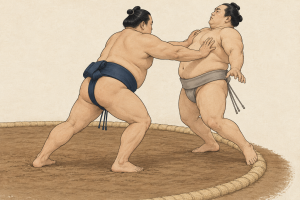
- Compare Oshidashi uses open-hand pressure against the torso without the same close-body force-out pattern.
Similar techniques
Oshidashi uses open-hand pressure against the torso without the same close-body force-out pattern. Yoritaoshi is the related close-pressure result when the opponent is driven down in the finish. Uwatenage and Shitatenage may begin from a similar grip, but their decisive action is a throw produced from an outside or inside hold.
Name
Yorikiri is written 寄り切り and read よりきり. The verb yoru conveys closing in or pressing forward, while kiru marks completion in this compound. The Japan Sumo Association places it among the seven basic techniques. “Frontal force-out” is a useful broadcast gloss, but the finish can develop forward or sideways and does not require the bodies to face the camera squarely.
Context
Yorikiri can emerge from a strong initial charge, a prolonged belt contest, a defensive recovery, or a lateral march along the tawara. Grip configuration affects leverage, yet the official label does not encode every left-right combination. Viewers should track the moment one wrestler secures posture and continuous forward control rather than assuming the technique begins only at the edge.
Statistics
The Japan Sumo Association table consulted on 12 September 2026 counted 47,473 yorikiri results, 24.9 percent of 190,450 bouts from January 2013 through the final day of the July 2026 tournament, ranking it second in that bounded dataset. This is a dated sample, not a timeless probability; check the association’s live page for later totals.
Sources
Last updated: