
Daki-wakare
抱分だきわかれ
- Yoko-sutemi-waza
Key idea
The defining action controls uke’s upper body from behind and twists into a side sacrifice as uke is on hands and feet.
Kodokan official demonstration
Kodokan technique list (opens in a new tab)YouTube (opens in a new tab)
VISUAL GUIDE
How to read the movement
The central principle of Daki-wakare is the coordinated action that controls uke’s upper body from behind and twists into a side sacrifice as uke is on hands and feet.
- Tori
- the person applying the technique
- Uke
- the person receiving the technique
- Red line
- main direction or point of contact
AT A GLANCE
Classification representative
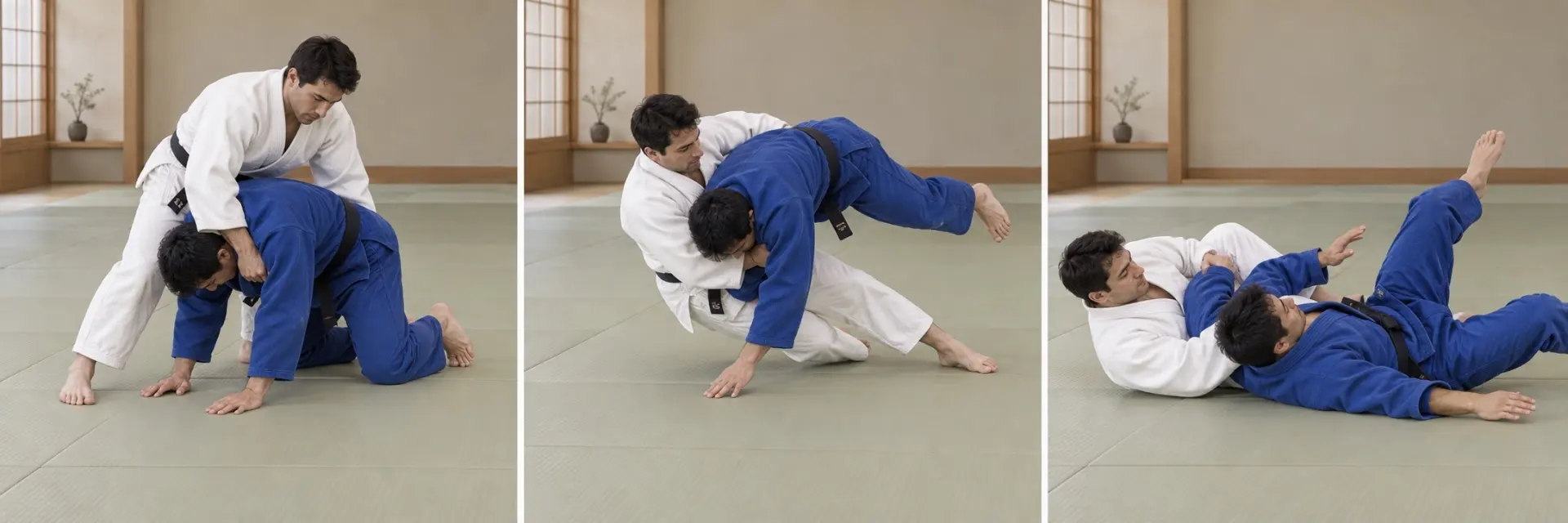
IN SEQUENCE
Three basic phases
- 1Create usable imbalance
- 2Enter and stay connected
- 3Complete the defining action
Original AI-generated educational illustration for TokyoWaltz, 2026. A simplified three-stage concept; practise under qualified instruction.
PLAY WHEN NEEDED
Watch the basic movement slowly
- 1Starting pointCreate usable imbalance
- 2Decisive actionEnter and stay connected
- 3CompletionComplete the defining action
1 / 3Starting point— Create usable imbalance
Follow the red line and phase indicator. The guide does not autoplay or loop.
How it works
The central principle of Daki-wakare is the coordinated action that controls uke’s upper body from behind and twists into a side sacrifice as uke is on hands and feet.
Kuzushi
Create usable imbalance
Create the imbalance described by the official definition and continue it into the entry. Uke should not be able to recover stable support before the decisive action.
Tsukuri
Enter and stay connected
Enter with stable posture and continuous control. Use the official demonstration to check the required position, contact line, and direction.
Kake
Complete the defining action
Complete the defining action described in the official definition and shown in the demonstration. Maintain control through uke’s fall.
Key points
- To identify Daki-wakare, watch for the moment the side sacrifice becomes decisive rather than naming the technique from the landing alone.
- The official definition centres on an action that controls uke’s upper body from behind and twists into a side sacrifice as uke is on hands and feet.
- When reviewing Daki-wakare, check that balance breaking, contact and direction stay connected from entry through the controlled finish.
Similar techniques
| Technique | Japanese name | Key difference |
|---|---|---|
| Yoko-wakare | 横分 | Yoko-wakare places both feet outside uke’s foot and drops sideways so uke rotates across the line of the body; Daki-wakare controls uke’s upper body from behind and twists into a side sacrifice as uke is on hands and feet. |
| Yoko-gake | 横掛 | Yoko-gake sweeps or pushes the outside ankle; Daki-wakare controls uke’s upper body from behind and twists into a side sacrifice as uke is on hands and feet. |
| O-soto-makikomi | 大外巻込 | O-soto-makikomi turns an O-soto-gari entry into a wrapping sacrifice by trapping uke’s arm at the armpit; Daki-wakare controls uke’s upper body from behind and twists into a side sacrifice as uke is on hands and feet. |
Reference
Open the detailed source material when you need definitions, technical distinctions, training context, or references.
Official definition
What this technique is
Within the Kodokan list, Daki-wakare belongs to side sacrifice techniques. Its name is attached to the action that controls uke’s upper body from behind and twists into a side sacrifice as uke is on hands and feet, not to every contest exchange that ends in a similar fall or final position. The official Daki-wakare demonstration is therefore the best starting point for recognizing the technique before comparing variations in timing, grip or stance.
Core principle
The central principle of Daki-wakare is the coordinated action that controls uke’s upper body from behind and twists into a side sacrifice as uke is on hands and feet. In this technique, timing, balance breaking and continuous control must work together. Pause the official Daki-wakare demonstration before the decisive action and check what support remains, where contact is maintained and whether tori is lifting, reaping, blocking, rotating, wrapping or applying controlled pressure.
Detailed execution
Key recognition points
- To identify Daki-wakare, watch for the moment the side sacrifice becomes decisive rather than naming the technique from the landing alone.
- The official definition centres on an action that controls uke’s upper body from behind and twists into a side sacrifice as uke is on hands and feet.
- When reviewing Daki-wakare, check that balance breaking, contact and direction stay connected from entry through the controlled finish.
Distinguishing this technique
The practical identifying feature of Daki-wakare is the side sacrifice: controls uke’s upper body from behind and twists into a side sacrifice as uke is on hands and feet. Compare that action with neighbouring names in the same Kodokan category. If the contact point, control route or sacrifice direction changes, the result may belong under a different official name even when the landing position looks similar.
Training and safety
Training and safety
Practise entries, controlled finishes, and ukemi under a qualified Judo instructor. Competition rules and permitted applications can vary, so confirm the current ruleset before competitive use.