Judo
Renraku-waza
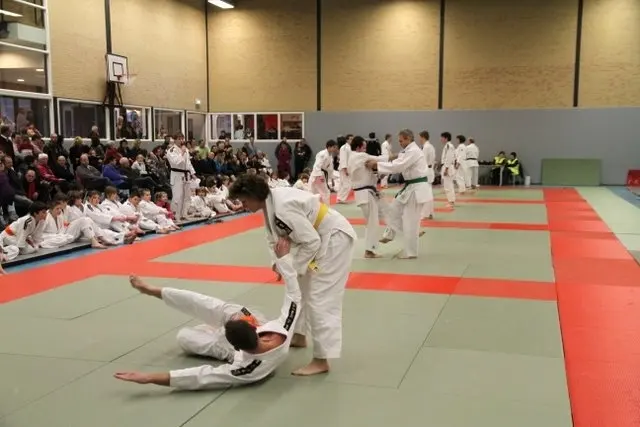
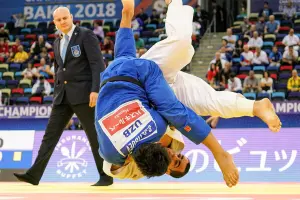
Image: Gerrit van Kempen / Wikimedia Commons · CC BY 2.5 Netherlands
Renraku-waza (連絡技) are connected or combination techniques in Judo: an initial attack changes the opponent’s posture or response, creating the conditions for another attack. They matter because Judo Techniques are rarely applied as isolated textbook shapes in randori or contest. Kodokan teaching describes renraku-waza as a natural continuation when one’s initiated technique does not succeed, while the IJF Academy uses a narrower teaching distinction between renzoku-waza—repeating the same technique—and renraku-waza—linking different techniques. Usage is not perfectly uniform across Japanese coaching literature, so this article treats the terms as explanatory frameworks rather than a fixed official list of combinations.
Overview
| Japanese | 連絡技 |
|---|---|
| Reading | れんらくわざ |
| Romanisation | renraku-waza; common search form: renraku waza |
| Meaning | Linked or combination techniques |
| Martial art | Judo |
| Classification | Tactical and teaching concept, not a Kodokan throw class |
| Related term | Renzoku-waza, successive use of the same technique in IJF Academy terminology |
Meaning of renraku-waza
Renraku means connection, coordination or linkage, and waza means technique. In Judo the expression describes attacks joined by movement and response. The second technique is not merely performed after the first; it uses the new balance, stance or direction produced by the exchange.
The Kodokan promotion text places renraku-waza within renraku henka, connected and changing techniques. It contrasts continuing one’s unsuccessful attack with henka-waza, in which the judoka changes in response to the opponent’s technique.
Why combinations work
A committed attack prompts a defensive action: the opponent may step, stiffen, lower the centre of gravity, turn the hips or move weight away from danger. That reaction can close the first opportunity while opening another.
The first action must remain credible. Kodokan teaching cautions that it should be intended to throw, not reduced to a token feint whose only purpose is the second attack. This distinguishes technical connection from a memorised two-count sequence.
Reaction and kuzushi
Kuzushi in combinations develops across time. An opponent who recovers from one imbalance may cross through another unstable position; the next attack follows that recovery rather than restarting from neutral posture.
Grip, posture and foot position determine which connection is available. The same named pair can therefore look different in right-versus-right, right-versus-left or rapidly changing Kumi-kata.
Forward-to-backward combinations
A forward throw can cause the opponent to withdraw the hips or step back. That response may create a rearward opening for o-uchi-gari or ko-uchi-gari. Seoi-nage to o-uchi-gari and uchi-mata to ko-uchi-gari are common teaching examples.
These are not compulsory Kodokan pairings. The classification describes the change in direction; whether the connection is technically sound depends on the actual reaction and continuity.
Backward-to-forward combinations
A rearward attack can draw an opponent’s weight back and then provoke a forward recovery. O-uchi-gari to tai-otoshi or seoi-nage, and ko-uchi-gari to uchi-mata, are established examples of using that change.
The second attack begins as the opponent reorganises the stance. Waiting until balance is fully restored turns the actions into two separate attempts rather than one connected attack.
Same-direction combinations
Combinations do not always reverse direction. O-uchi-gari to ko-uchi-gari can continue rearward while changing the attacked support. Closely related forward attacks can likewise change the point of contact while preserving the opponent’s general movement.
“Same direction” is an analytical label, not a separate Kodokan classification. Direction, support and rotational line all matter, so a simple forward/backward diagram cannot describe every connection.
Renraku-waza in uchikomi
Uchikomi can rehearse posture, distance and transition between attacks. Cooperative practice is useful for learning where the second entry begins, but the partner’s reaction should be realistic enough to preserve the reason for the connection.
Drilling should progress from agreed reactions to variable movement. Repeating a fixed combination without reading weight transfer can produce fluent choreography without transferable timing.
Renraku-waza in randori
In Randori, combinations emerge from resistance and recovery. The judoka learns when to continue, when to change direction and when to abandon the sequence to preserve balance.
Combination study also includes transitions from throwing attacks into ne-waza. Such links remain subject to safety and the applicable contest or dojo rules, and they should not be treated as permission to force a failed action.
Relationship with renzoku-waza terminology
The IJF Academy handbook uses renzoku-waza for successive use of the same technique and renraku-waza for different techniques. Its examples distinguish repeated o-uchi-gari from links such as o-uchi-gari to ko-uchi-gari or tai-otoshi.
Japanese Kodokan and academic writing often uses renraku-waza more broadly for successive connected attacks, while renraku henka covers connection and change together. The IJF Academy distinction is useful for instruction, but it should not be presented as the only historical usage.
Examples from Kodokan Judo
Kodokan materials discuss connections across right and left attacks, front and rear directions, hip and foot techniques, and standing-to-ground transitions. The examples below are teaching patterns, not an official closed syllabus.
| Connection | Representative example | Reaction used |
|---|---|---|
| Forward to backward | Seoi-nage → o-uchi-gari | Opponent withdraws or settles back |
| Backward to forward | O-uchi-gari → tai-otoshi | Opponent recovers forward |
| Same general direction | O-uchi-gari → ko-uchi-gari | Support changes during rearward defence |
| Standing to ground | Throwing attack → legal ne-waza transition | Posture or base collapses without a completed score |
Competition
Competition rules score the resulting throw, hold or submission; they do not award a separate value for a combination. Each part of the sequence must be legal under the current gripping, throwing, transition and safety provisions.
The IJF rules cited here are dated 14 August 2026. They govern IJF events and can change; national and youth competitions may apply additional provisions. The broader educational study of renraku-waza is not defined by one competition cycle.
Sources
- Kodokan Judo Institute, Promotion Examination Text: Kodokan Judo, 2026.
- Kodokan Judo Institute, Promotion Qualifications.
- International Judo Federation Academy, Student Handbook.
- Sports Movement Studies, Analysis of Judo Combination Tactics, 1999.
- All Japan Judo Federation, School Judo Club Guidebook.
- All Japan Judo Federation, Competitive Technique Analysis.
- International Judo Federation, Sport and Organisation Rules, 14 August 2026.
Learning guide
Five starting points for connected learning
Explore confirmed combinations and reactions around five representative techniques. This learning guide is not an official Kodokan classification.
Verified connections between the five hubs
- O-uchi-gari → Ko-uchi-gariCombinationCommon practical combination
British Judo lists this direction as a renraku-waza example in its Dan-grade skills syllabus.
Why this relation?
- British Judo AssociationTechnical Dan Grade Skills Examination Form (opens in a new tab)Nage-waza: renraku-waza combinationsVerified: September 3, 2026
- Ko-uchi-gari → O-uchi-gariCombinationCommon practical combination
British Judo lists this direction as a renraku-waza example in its Dan-grade skills syllabus.
Why this relation?
- British Judo AssociationTechnical Dan Grade Skills Examination Form (opens in a new tab)Nage-waza: renraku-waza combinationsVerified: September 3, 2026
- O-uchi-gari → Uchi-mataCombinationCommon practical combination
British Judo lists this direction as a renraku-waza example in its Dan-grade skills syllabus.
Why this relation?
- British Judo AssociationTechnical Dan Grade Skills Examination Form (opens in a new tab)Nage-waza: renraku-waza combinationsVerified: September 3, 2026
- Uchi-mata → Ko-uchi-gariCombinationCommon practical combination
British Judo lists this direction as a renraku-waza example in its Dan-grade skills syllabus.
Why this relation?
- British Judo AssociationTechnical Dan Grade Skills Examination Form (opens in a new tab)Nage-waza: renraku-waza combinationsVerified: September 3, 2026
- O-uchi-gari → Seoi-nageCombinationCommon practical combination
Judo Canada lists this direction as a transition skill in its national kyu grading syllabus.
Why this relation?
- Judo CanadaNational Kyu Grading Syllabus (opens in a new tab)4th Kyu to 3rd Kyu: transition skillsVerified: September 3, 2026
No verified hub-to-hub connection is published for this selected technique.
Last updated: