Kendo
Bōgu
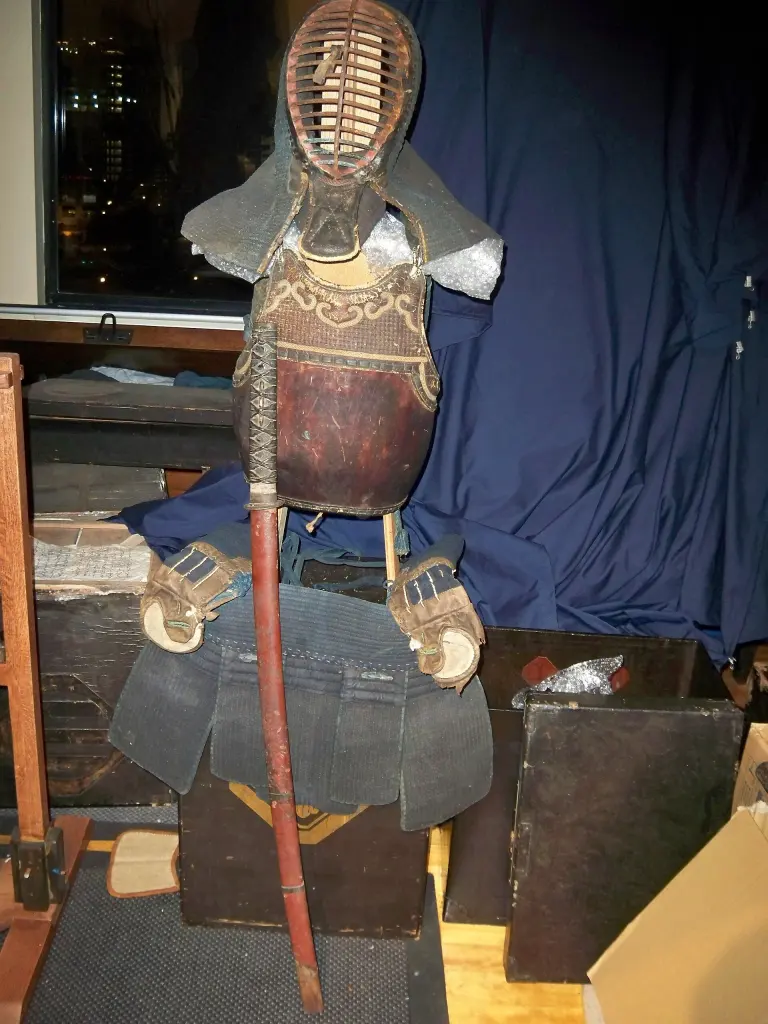
Image: Samuraiantiqueworld / Wikimedia Commons · CC BY-SA 3.0
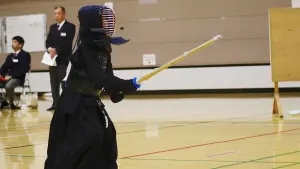
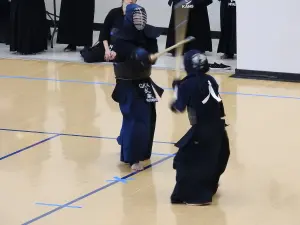
Bōgu (防具) is the common name for the protective equipment worn in Kendo; current competition rules use the more specific term kendōgu (剣道具). The set consists of men, kote, dō and tare, protecting the head and throat, hands and forearms, torso, and lower body. It makes controlled shinai practice possible, but it does not make every covered surface a legal target and cannot eliminate injury. The recognised scoring regions are defined separately by the rules. Fit, fastening, shock absorption and maintenance therefore matter as much as outward appearance. Bōgu developed alongside bamboo-sword training over the Edo period and later standardisation, but antique equipment should not be assumed to meet modern safety or competition requirements.
Overview
| Japanese | 防具; 剣道具 |
|---|---|
| Reading | ぼうぐ; けんどうぐ |
| Romanisation | bōgu; kendōgu |
| Meaning | Protective equipment; Kendo equipment |
| Components | Men, kote, dō and tare |
| Martial art | Kendo |
| Official rules term | Kendōgu |
Bōgu and kendōgu
Bōgu literally means protective equipment and can be used outside Kendo. In Kendo English it usually refers to the complete armour set. The AJKF and FIK rulebooks label the regulated set kendōgu.
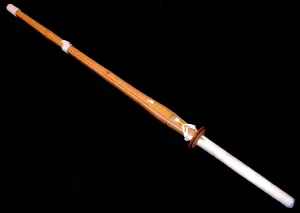
Neither term denotes historical battlefield armour. Kendo equipment was developed for training with Shinai and has its own construction, fastening and target conventions.
The four components
The rulebook identifies four components: men, kote, dō and tare. A kendōgi and hakama are worn underneath but are clothing rather than the four pieces of kendōgu.
The components work as a system. Gaps, incorrect ties or an unsuitable size can expose the wearer or restrict movement, so selecting and fitting equipment is part of supervised instruction.
Men
The men protects the head, face, shoulders and throat. Its metal grille is the men-gane; the padded flaps are men-buton, and the throat guard includes the tsuki-dare.
Competition targets on the men are limited to the defined head and throat regions. The surrounding padding and grille are protective structures, not interchangeable scoring surfaces.
Kote
Kote are padded gloves protecting the hands and part of the forearms. The rules require adequate shock absorption and specify how much of the forearm must be covered.
The kote-bu target depends partly on the opponent’s guard. Current subsidiary rules define the usual right-forearm target in chūdan and additional circumstances for the left or right forearm; this is more precise than saying that any glove contact scores.
Dō
The dō protects the torso and is secured by cords. Its main rigid surface may be made from bamboo, fibre or other accepted materials according to the maker and rule environment.
The right and left dō-bu are recognised targets. Contact on the chest extension or other protected surfaces is not automatically a valid dō strike.
Tare
The tare protects the waist, hips and upper thighs through overlapping padded panels. The centre panel commonly carries the nafuda identifying the practitioner or competitor.
Tare itself is not listed as a scoring target. This distinction is useful for beginners: the equipment set defines protection, while Yūkō-datotsu rules separately define where a valid action may land.
Historical development
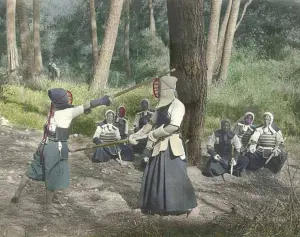
Protective equipment developed within Edo-period sword schools as flexible weapons and armoured striking practice became more widespread. The AJKF history highlights successive adoption and improvement rather than a single moment when the modern set appeared complete.
Nineteenth- and twentieth-century standardisation changed materials, coverage and competition expectations. Museum or antique bōgu documents that history but should not be described as equivalent to equipment certified for present practice.
Competition requirements
AJKF and FIK rules require men, kote, dō and tare and specify protective details. Equipment used in competition is also checked in relation to the shinai, uniform, identifying cloth and event provisions.
Not every variation is treated identically as illegal equipment. The subsidiary rules distinguish equipment that causes a match penalty from some construction issues that currently receive a post-match caution. Competitors must follow the latest governing documents. Current requirements researched: 2 September 2026.
Fit, maintenance and safety
Bōgu should remain secure while allowing vision, breathing, arm movement and footwork. Worn cords, cracked surfaces, compressed padding or damaged leather can reduce protection and should be assessed before practice.
The AJKF’s safety guidance stresses that no equipment creates absolute safety. Contact level, age, experience, heat conditions, shinai inspection and instructor supervision remain material parts of risk control.
Sources
- All Japan Kendo Federation, Regulations and Subsidiary Rules of Kendo Shiai and Shinpan.
- All Japan Kendo Federation, Junior High School Kendo Club Instruction Guide, revised edition.
- International Kendo Federation, Regulations of Kendo Shiai and Shinpan, revised 26 July 2023.
- All Japan Kendo Federation, 2019 Revision of the Kendo Shiai and Shinpan Regulations.
- All Japan Kendo Federation, Kendo Equipment and Striking Areas, figure 3.
- Yoshio Kobayashi, An Introduction to the Historical Changes in Kendo Technique: Equipment and Technique, Research Journal of Budo.
Last updated: