
Kendo
Kendo Terminology
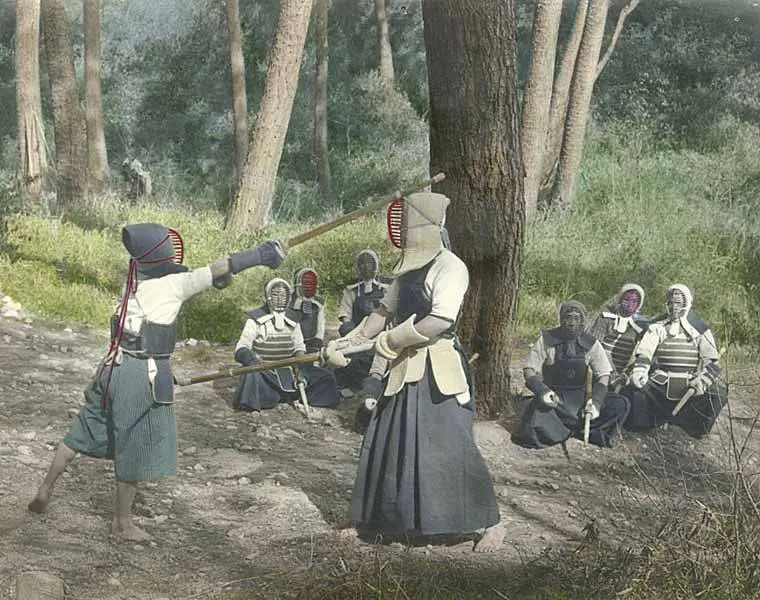
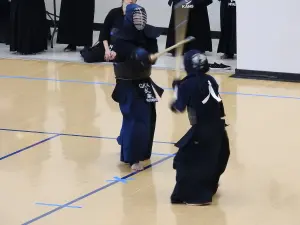
Image: Unknown photographer; University of Washington Libraries Digital Collections / University of Washington Libraries via Wikimedia Commons · No known copyright restrictions
Kendo terminology is the Japanese vocabulary used to teach, practise and referee Kendo. It includes names for equipment such as shinai and bōgu, movement and distance concepts such as ashi-sabaki and maai, training methods such as kirikaeshi and ji-geiko, and competition terms including yūkō-datotsu and hansoku. The vocabulary matters because English substitutions such as “sword,” “armour,” “point” or “spirit” explain only part of the original term. Some expressions belong to modern federation rules, others to teaching convention or older sword traditions. Usage also varies between organisations, countries and individual dōjō, so this article presents widely recognised terms while identifying rule-specific meanings rather than treating one glossary as timeless or universal.
Overview
| Japanese | 剣道用語 |
|---|---|
| Reading | けんどうようご |
| Romanisation | kendō yōgo |
| Meaning | Kendo terminology |
| Martial art | Kendo |
| Main authority in Japan | All Japan Kendo Federation |
| Main international authority | International Kendo Federation |
Writing and pronunciation
TokyoWaltz uses modified Hepburn romanisation and macrons for long vowels: kendō, bōgu, dō and yūkō-datotsu. Federation English often omits macrons, so Kendo, bogu and yuko-datotsu remain common search forms.
Japanese compounds can change pronunciation without changing the underlying word. Kendō combines ken (sword) and dō (way), while datotsu combines the characters for striking and thrusting. Reading and function should be checked together rather than inferred from an English spelling alone.
People and roles
A practitioner is commonly a kendōka, although kenshi—sword practitioner—is also used. Sensei is a form of address for an instructor or senior teacher, not the name of a competitive rank.
In paired training, motodachi provides the receiving or directing role and kakarite performs the assigned work. In Nihon Kendō Kata, the formal roles are uchidachi, who initiates the encounter, and shidachi, who responds and completes the form.
Dōjō, clothing and equipment
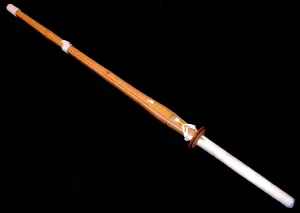
Dōjō means the place of practice. Clothing normally comprises a kendōgi or keikogi and hakama. The bamboo practice sword is the Shinai; the wooden sword used for kata and some basic training is the bokutō or bokken.
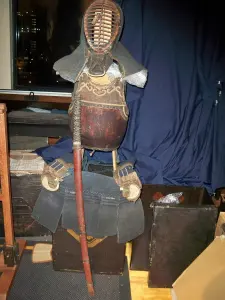
Bōgu is the familiar name for protective equipment. The competition rules use kendōgu and identify four components: men, kote, dō and tare. A nafuda carrying the competitor’s identifying information is fitted to the centre of the tare.
Stance and movement
Kamae means a physical and mental readiness or guard. Chūdan-no-kamae is the central guard used most widely in shinai practice; jōdan, gedan, hassō and waki-gamae also appear in the vocabulary and in kata.
Ashi-sabaki is footwork. The All Japan Kendo Federation teaching glossary identifies okuri-ashi, ayumi-ashi, hiraki-ashi and tsugi-ashi. Fumikomi-ashi describes the stamping step associated with many committed strikes, but it is not used in the same way in Nihon Kendō Kata.
Distance, timing and initiative
Maai is the relational distance and interval between practitioners, not a fixed measurement. Issoku ittō-no-maai is the basic distance from which one can strike by entering one step and avoid by withdrawing one step; tōma and chikama describe longer and closer relationships.
Seme is pressure or initiative used to produce a response or opening. Debana is the moment an opponent begins to act. Terms for initiative such as sen help analyse timing, but their explanations may draw on older sword literature and should not be reduced to simple reaction-speed labels.
Targets and strikes
The principal names called for scoring actions are men, kote, dō and tsuki. The same words can identify equipment, protected target regions or the action directed to them; context determines the meaning.
Datotsu-bu is the permitted striking part of the shinai, centred on the monouchi of the blade side opposite the cord. Datotsu-bui means the recognised target area. Hasuji is blade alignment, one requirement in the official definition of Yūkō-datotsu.
Training terms
Suburi is repeated sword-swing practice. Kirikaeshi coordinates repeated strikes, movement, breathing and distance. Uchikomi-geiko uses presented opportunities, while kakari-geiko asks the attacker to commit continuously without pausing to construct a contest strategy.
Ji-geiko is freer practice between partners, and shiai-geiko is match-oriented practice. These categories overlap in real classes, and English labels such as “sparring” do not convey their different teaching roles or the responsibility of the senior partner.
Kata terminology
Kata is written 形 in the official title 日本剣道形. The ten standard forms are divided into seven tachi-no-kata using long swords and three kodachi-no-kata in which shidachi uses a short sword.
Words such as kamae, maai, hasuji, uchi, tsuki and zanshin occur in both kata and shinai practice, but the prescribed actions and weapons differ. The shared vocabulary connects the two forms of study without making kata a simulated competition bout.
Competition and refereeing terms
Shiai is a contest and shinpan is refereeing or judgement. A valid action is yūkō-datotsu and is awarded one ippon. The usual sanbon-shōbu format is decided by the first two points, although event regulations can use ippon-shōbu or other permitted methods.
Hansoku is an infringement; two ordinary infringements give one point to the opponent. Jōgai is going outside the contest area, gōgi is a referees’ conference, wakare separates a stalled close engagement, and en-chō is extension time. Definitions must follow the governing rules and event date.
Translation limits and variation
Kiai, kisei and ki-ken-tai-itchi are sometimes compressed into “shout” or “spirit.” Official teaching distinguishes energetic intent, sword operation and bodily action, while the scoring rule separately requires full kisei, proper posture, correct contact and zanshin.
Terminology can carry technical, educational and historical layers at once. International readers should retain the Japanese term when an English gloss would erase a rule distinction, and should identify whether an explanation comes from the AJKF, FIK, a school curriculum or an older lineage.
Sources
- All Japan Kendo Federation, Safe and Effective Kendo Teaching in Junior High School, fourth edition.
- All Japan Kendo Federation, Sample Written Examination Questions and Answers for Kendo.
- International Kendo Federation, Regulations of Kendo Shiai and Shinpan, revised 26 July 2023.
- All Japan Kendo Federation, The Concept of Kendo.
- All Japan Kendo Federation, Kendo Shiai, Shinpan and Operational Guide.
Last updated:
.jpg)