
Seasonal Customs
Tori no Ichi
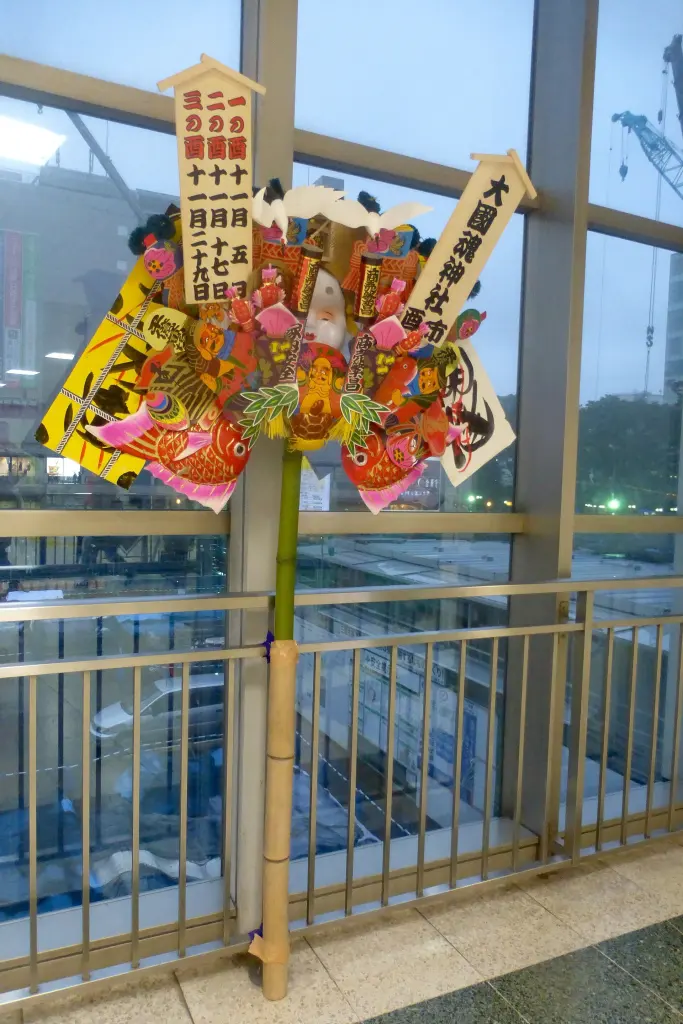
Image: Nesnad / Wikimedia Commons · CC BY-SA 4.0
Tori no Ichi
A November rhythm, gathered in a rake.
Tori no Ichi is a November fair held on days assigned to the rooster in the traditional twelve-sign calendar. Associated especially with shrines and temples in the Tokyo region, it brings worship, market stalls and wishes for prosperity into the same seasonal occasion. Its best-known object is the decorated kumade, a rake understood as gathering good fortune. The Asakusa celebrations at Ōtori Shrine and Chōkokuji illustrate its overlapping shrine and Buddhist histories. There is no single November date for every year: rooster days recur twelve days apart, producing two or three fairs. Local origin traditions, religious offerings and commercial rakes also need to be distinguished.
Calendar
November rooster days recur twelve days apart.
Kumade
A rake gives gathering fortune a visible form.
Renewal
The yearly fair connects worship and livelihood.
At a glance
- Japanese name
- 酉の市 — Tori no Ichi
- Calendar
- Rooster days in November, twelve days apart
- Characteristic object
- 熊手 — kumade, an auspicious decorated rake
- Asakusa venues
- Ōtori Shrine and Chōkokuji
- 2026 Asakusa dates
- 7 and 19 November; checked 5 October 2026
01
Why the date changes
The rooster is one of twelve signs used to name days. The first November occurrence is ichi no tori; the second is ni no tori; a third, when the calendar permits, is san no tori. These are repeated festival days rather than a single fair lasting continuously between them. The National Diet Library’s account sets this calendar beside Edo-period images of the markets.
02
Several histories meet at the fair
Ōtori Shrine relates the celebration to Yamato Takeru in its religious origin tradition. This should be read as a shrine tradition, not as independent evidence dating the present market to antiquity. The National Diet Library also describes Chōkokuji’s temple tradition and the rural fair at Hanamata, showing why a single origin story is inadequate.
Kokugakuin University scholar Naoyuki Ogawa places the emergence of Tori no Ichi in the early eighteenth century and its wider popularity later in that century. His account connects thanksgiving for the harvest with an urban concern for livelihood and business.
03
How a rake became an auspicious object
Kumade literally evokes a bear’s paw and also names a rake. At the fair, its gathering action becomes a metaphor for drawing in fortune. Chōkokuji explains several associations behind the form, including an agricultural implement, an eagle’s grasping claws and a military fan. These explanations belong to a developing symbolic vocabulary rather than one securely documented invention.
Decorated market rakes are engimono, objects associated with good fortune. They should not all be labelled omamori: Ōtori Shrine separately describes its own kumade-shaped amulet. The distinction is between the object’s form, its religious context and how it is obtained.
04
A shrine and a temple share the season
In Asakusa, Ōtori Shrine and neighbouring Chōkokuji are both festival venues. The shrine’s account and the temple’s account provide different devotional explanations for the same seasonal gathering. The fair therefore cannot be described simply as a standard practice at every Shinto shrine.
The event also belongs to the wider world of matsuri, where ritual, stalls and social activity can coexist. A purchase at a market stall and worship at the religious site are related experiences, but they are not identical actions.
05
Returning and replacing a kumade
Ogawa describes the custom of bringing back a previous year’s rake and obtaining a new one. His discussion of otakiage, ritual burning, treats the return as a respectful conclusion to an object’s sacred use rather than ordinary disposal. Acceptance rules belong to the individual site; visitors should check them before bringing an old object.
Renewal gives the fair a yearly rhythm. A rake can express hopes for work or household prosperity, without constituting a promise of financial success. The seasonal setting explains the object more accurately than treating it as a generic souvenir detached from the fair.
06
The 2026 Asakusa fairs
Taitō City lists the 2026 fairs at Ōtori Shrine and Chōkokuji for 7 and 19 November, from midnight to midnight. These dates were checked on 5 October 2026. They apply to the named Asakusa venues; other participating sites should be checked separately.
Consult the city’s current event notice before travelling. For the meaning of entry, purification and worship at a shrine, see the Shinto Shrine Guide. The photograph above shows a kumade near Fuchū Station in 2015, not the 2026 Asakusa fair.
Sources
Last updated:


