
Seasonal Customs
Karatsu Kunchi
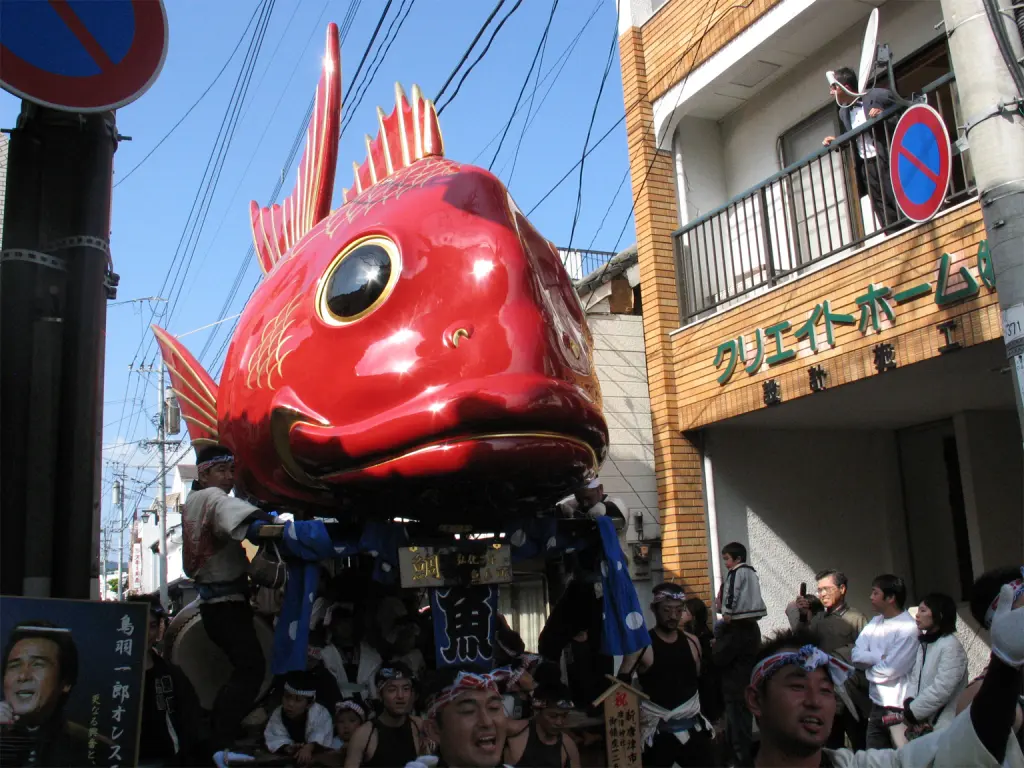
Image: MC MasterChef / Wikimedia Commons · CC BY-SA 2.5
Karatsu Kunchi
A town moves with its fourteen floats.
Karatsu Kunchi is the autumn festival of Karatsu Shrine in Karatsu, Saga Prefecture. Held from 2 to 4 November, it is known for fourteen hikiyama floats shaped as lions, a sea bream, helmets and other large figures. Their lacquered surfaces are only one part of the event: neighbourhood organisation, music and the movement of a shrine procession give the objects their festival setting. The evening procession, the pulling of floats across sand at Nishinohama and the final day’s circuit form different stages. Karatsu’s tradition belongs to Japan’s nationally protected intangible folk culture and to the wider UNESCO float-festival inscription; that status concerns a living practice, not a World Heritage designation for the city.
Evening
2 November: lantern-lit movement.
Nishinohama
3 November: shrine procession and sand.
Town circuit
4 November: the final circuit.
At a glance
- Japanese name
- 唐津くんち — Karatsu Kunchi
- Place
- Karatsu, Saga Prefecture
- Religious centre
- Karatsu Shrine
- Annual dates
- 2–4 November
- Floats
- Fourteen hikiyama
- National designation
- Important Intangible Folk Cultural Property, 1980
01
A shrine festival carried through the town
Karatsu City identifies Kunchi as the autumn festival of Karatsu Shrine. Fourteen floats move through the old town with flute, bell and drum accompaniment and calls of enya or yoisa. The figures are therefore encountered as moving, sounded objects, not simply as sculptures on display.
The shrine’s 2026 volunteer notice confirms preparations for 2, 3 and 4 November. This notice supports the coming year’s dates; it does not replace current operational announcements about routes or access.
02
The oldest float and its origin account
The Agency for Cultural Affairs describes Katana-machi’s red lion, Akajishi, as the oldest hikiyama. Its account relates the float’s inspiration to a local person who saw Kyoto’s Gion festival while returning from an Ise pilgrimage. This is an origin account recorded with the tradition, rather than a reason to assume that Karatsu copied every feature of another festival.
Different neighbourhood floats give the procession its varied forms. Their shared participation in a shrine festival does not make them interchangeable with every other Japanese festival cart.
03
Paper, lacquer and a sculptural surface
Karatsu City describes layers of Japanese paper, lacquer and gilding used to form the great figures. The cultural-property record also identifies an ikkanbari technique. The visible surface combines an underlying structure with built-up materials; the result differs from a float whose main visual character is exposed carved timber.
The sea-bream float in the photograph makes that sculptural approach especially clear. For another local float tradition and its woodworking context, see Danjiri. The comparison is useful precisely because the construction and festival practices vary.
04
Three days, three movements
The city’s outline distinguishes the lantern-lit evening gathering on 2 November, the shrine procession and sandy-ground pulling on 3 November, and the final circuit on 4 November.
- 2 November
- Yoiyama: an evening procession with lantern-lit floats.
- 3 November
- Shrine procession to Nishinohama and pulling on sandy ground.
- 4 November
- A final town circuit before the floats return to storage.
05
Protecting the event as a living practice
The national cultural-property record names the Karatsu Hikiyama Torishimarikai as the protecting organisation and gives 28 January 1980 as the designation date. It also records inclusion in the UNESCO “Yama, Hoko, Yatai” float-festival tradition in 2016.
The distinction matters: intangible-heritage recognition concerns the transmitted event and its associated knowledge. It should not be rewritten as a UNESCO World Heritage listing for Karatsu’s streets or for one float. Matsuri gives broader context for how religious observance and community organisation meet.
06
Reading the procession before planning a visit
A viewer can distinguish the shrine’s portable sanctuary, or mikoshi, from the hikiyama that accompany the festival. On 3 November, the city describes the mikoshi’s journey to Nishinohama and the effort of pulling the floats over sandy ground. This relationship between shrine, route and destination helps explain the event beyond its striking figures.
The 2026 dates were checked on 5 October 2026 against the shrine’s volunteer notice. Confirm current arrangements with Karatsu City and Karatsu Shrine before travelling; this article does not assert unannounced route details or viewing times.
Sources
Last updated:


