Judo
Judo at the Asian Games

Image: Amir Hosseini / Fars News Agency via Wikimedia Commons · CC BY 4.0
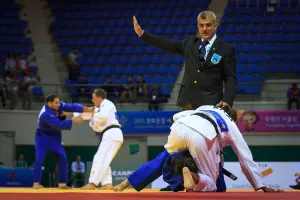
Judo at the Asian Games is the sport’s medal programme within the Olympic Council of Asia’s continental multi-sport event. Judo debuted at the Seoul Games in 1986. The programme has since developed into men’s and women’s individual weight categories and a mixed-team event, with entry through National Olympic Committees and technical competition conducted under the international rules adopted for each edition. The Asian Games are distinct from the Asian Judo Championships and from the Olympic Games even when categories and contest procedures overlap. Results must therefore be read by edition: weight limits, team formats, scoring rules, host arrangements, and nation names can change. For Aichi-Nagoya 2026, individual judo is scheduled from September 30 to October 2 at Aichi International Arena, followed by mixed team competition on October 3.
Overview
| Sport | Judo |
|---|---|
| Multi-sport event | Asian Games |
| Organiser | Olympic Council of Asia |
| Asian federation | Judo Union of Asia |
| Asian Games debut | Seoul 1986 |
| Current programme model | Men’s and women’s individual weight categories plus mixed team |
| Next scheduled edition | Aichi-Nagoya 2026; judo from September 30 to October 3 |
Place in the Asian Games
The Asian Games bring together National Olympic Committees from across Asia in a programme of many sports. Judo is one medal sport within that wider event. The Olympic Council of Asia identifies the International Judo Federation as the international federation and the Judo Union of Asia as the Asian federation associated with the sport.
This structure differs from a standalone judo championship. Athletes represent NOCs as members of national delegations, and the host organising committee controls the Games schedule, venue operations, accreditation, and shared ceremonies. Judo’s technical authorities supply the sport rules and competition expertise for the edition.
Debut at Seoul 1986
The Olympic Council of Asia states that judo was first incorporated into the Asian Games in 1986. The tenth Asian Games took place in Seoul from September 20 to October 5, with judo listed among the sports making their debut at that edition.
The debut date is a programme milestone, not the beginning of Asian judo. Japan had developed Kodokan Judo from the late nineteenth century, and federations, teachers, schools, universities, military and police institutions, and international competitions had already spread the art across Asia. The Asian Games added a recurring continental multi-sport stage.
Development of the programme
Across later editions, the programme expanded to include women’s competition, revised weight limits, and eventually mixed teams. Historical medal lists therefore require an edition-by-edition reading. A category used in one Games may have a different limit, name, or place in the schedule from its apparent equivalent in another.
The modern model gives men and women parallel sets of individual categories. This is a competition structure, not a division of judo technique: every weight category draws from the same broad vocabulary of throwing and grappling, subject to the rules in force. Dan rank and weight eligibility are separate systems.
Individual weight-category events
For Aichi-Nagoya 2026, the programme lists seven men’s categories from −60 kg to +100 kg and seven women’s categories from −48 kg to +78 kg. Each is a separate medal event. The schedule distributes lighter categories on September 30, middle categories on October 1, and heavier categories on October 2.
An athlete competes within the eligibility and entry rules for a category rather than moving freely between weights during the event. Weigh-in, seeding, draw, repechage, contest order, and delegation quotas are governed by the technical handbook for that edition. Current limits should not be projected backward onto early Asian Games results.
| Aichi-Nagoya 2026 date | Men’s events | Women’s events |
|---|---|---|
| September 30 | −60 kg, −66 kg | −48 kg, −52 kg |
| October 1 | −73 kg, −81 kg | −57 kg, −63 kg, −70 kg |
| October 2 | −90 kg, −100 kg, +100 kg | −78 kg, +78 kg |
Mixed-team event
By Jakarta 2018, the Asian Games judo programme included a mixed-team competition in addition to the fourteen individual events. A team contest is not one large open-weight bout. Women and men compete in grouped team categories, and the sequence of individual contests produces an overall team result.
The grouped team limits are not identical to all individual labels, so an athlete’s individual category and team place must be checked separately. The team event also changes tactical responsibility: coaches select a delegation that must cover several body-size ranges, while every contest contributes to one shared medal outcome.
Rules and scoring by edition
Asian Games contests use the international competition framework adopted for the edition, including rules for ippon, intermediate scores, penalties, groundwork, gripping, and golden score. These rules change. The Aichi-Nagoya 2026 organiser’s judo overview names ippon, waza-ari, and yūkō, reflecting the scoring framework current for that Games.
A result book should be read with its contemporary rulebook. The same Japanese technique name may remain valid across decades while the contest score, prohibited entry, gripping condition, or penalty attached to an action changes. A modern summary cannot safely be used to reconstruct every earlier medal bout.
A continental competitive field
Asian Games records reveal a field extending well beyond judo’s Japanese origin. East Asian, Central Asian, West Asian, South Asian, and Southeast Asian NOCs enter athletes under the same event framework. The 2018 Japanese federation results, for example, record contests against opponents from Korea, China, Mongolia, Kazakhstan, Uzbekistan, Kyrgyzstan, the United Arab Emirates, India, and other delegations.
That breadth is more informative than treating the event as a permanent contest between a few powers. Competitive strength changes by category and generation, and political changes can alter delegation names or eligibility. Medal claims should always include an edition, category, and reliable result source.
Relation to other major competitions
The Asian Games are not the Asian Judo Championships. Both are continental settings, but they are separately scheduled events with different organisers, entry systems, and historical records. The Asian Games sit inside an OCA multi-sport festival; the continental championships belong to judo’s own competition calendar.
They are also not the Olympic Games. The same seven senior individual categories may appear in both, and mixed-team formats overlap, but qualification, quotas, delegation selection, event scale, and medal records are distinct. Success in one event should not be relabelled as success in another.
From Hangzhou 2022 to Aichi-Nagoya 2026
Karate at the Asian Games is scheduled earlier in the same 2026 programme, from September 20 to 23 at Toyohashi Gymnasium, with kata and kumite events rather than judo’s throws, groundwork, and mixed-team structure.
The host-city context is covered in Nagoya. The city contains the main ceremony stadium and several Games sites, but Aichi-Nagoya 2026 uses a wider network of venues inside and outside Aichi Prefecture.
The edition officially called Hangzhou 2022 held its judo competition from September 24 to 27, 2023. The retained edition name and later competition date are both important when searching databases: “2022 Asian Games” identifies the Games, while 2023 identifies when the bouts occurred.
Aichi-Nagoya 2026 is scheduled to stage judo at Aichi International Arena. The All Japan Judo Federation lists individual competition from September 30 through October 2 and mixed team on October 3, with preliminary rounds at 11:00 and final blocks at 17:00. This information was checked on September 9, 2026 and remains subject to official change.
Reading results responsibly
A reliable Asian Games judo result identifies the edition, sex, weight category or team event, medal stage, athlete, and NOC. Official result books are especially valuable because they preserve draws, contest outcomes, participation lists, and technical abbreviations in one edition-specific record.
Current athlete lists and entry totals are more volatile than historical results. Withdrawals, replacements, accreditation decisions, and late draw changes can occur. Before the 2026 competition concludes, roster and schedule information should be labelled provisional or date-stamped; after the event, the final official result book should replace preliminary data where the two differ.
Sources
- Olympic Council of Asia, Judo.
- Olympic Council of Asia, Seoul 1986.
- Aichi-Nagoya 2026 Organising Committee, Judo.
- All Japan Judo Federation, 20th Asian Games Aichi-Nagoya 2026—Judo.
- International Judo Federation, 20th Asian Games Aichi-Nagoya.
- All Japan Judo Federation, 18th Asian Games Jakarta 2018—Judo.
- Olympic Council of Asia, Jakarta Palembang 2018 Judo Official Result Book.
Last updated: