Shinto
Fuji-kō & Mount Fuji Worship

Image: Tak1701d / Wikimedia Commons · CC BY-SA 3.0
Fuji-kō & Mount Fuji Worship
A sacred mountain connected distant communities.
Mount Fuji worship encompasses practices that treated the mountain as a sacred presence, a destination for religious ascent and a source of cultural meaning. Fuji-kō were devotional associations within this larger history, especially prominent in Edo-period communities. Their members organised pilgrimage and maintained relationships with religious hosts at the mountain’s foot. Shrines, lakes, routes and local Fuji-shaped mounds made the sacred landscape larger than the summit alone. These traditions drew on interacting forms of mountain religion, Shinto and Buddhism. They should not be reduced to one unchanging doctrine, nor should every historical or present-day ascent be assumed to belong to a Fuji-kō.
Community
Associations sustained shared devotion.
Journey
Oshi, shrines and water shaped pilgrimage.
Local Fuji
Fujizuka brought the mountain into local places.
At a glance
- Japanese terms
- 富士講 — Fuji-kō; 富士山信仰 — Mount Fuji worship
- Association
- A devotional group supporting shared worship and pilgrimage
- Major historical setting
- Edo-period Japan
- Local counterpart
- 富士塚 — fujizuka, a mound modelled on Fuji
- World Heritage inscription
- Fujisan cultural property, 2013
01
A sacred landscape extends beyond the summit
UNESCO describes a cultural property comprising 25 components, including shrines, pilgrimage routes, lakes and springs. Awe at Fuji’s volcanic form became connected with religious practice. The mountain’s significance therefore lies partly in relationships between places: an ascent, a shrine visit and purification at water could form parts of a wider devotional journey.
02
Fuji-kō gave collective form to pilgrimage
Fuji worship predates the associations that flourished in Edo. The Ministry of Land, Infrastructure, Transport and Tourism links their tradition with the ascetic Hasegawa Kakugyō and later teachers including Jikigyō Miroku. Accounts of extreme austerities belong to religious biography and tradition; they should not be treated as independently established measurements of a practitioner’s lifespan or feats.
03
Water, shrines and ascent carried related meanings
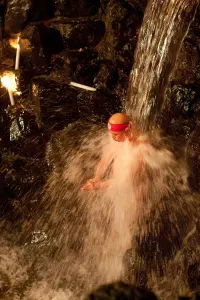
UNESCO identifies Sengen shrines as starting points for pilgrimage and describes cold-water purification at lakes and springs. The crater circuit, ohachimeguri, added another ritual movement. These practices connect the wider subjects of Shinto and Buddhism in Japan, while Misogi provides broader context for purification.
- Water
- Purification at associated lakes and springs.
- Shrine
- Worship at the mountain’s religious approaches.
- Ascent
- A devotional journey that could include the summit circuit.
04
Oshi joined religious guidance with hospitality
Oshi in settlements such as Yoshida and Kawaguchi supported pilgrims with accommodation and religious guidance. Their relationships with associations extended beyond the climbing season through visits to affiliated groups. A pilgrim’s journey consequently depended on people and institutions as well as a route up the mountain; lodging was part of a continuing devotional connection.
05
A local mound could represent a distant mountain
Fujizuka reproduced Fuji on a smaller scale. They offered participation to people unable to undertake the long journey, including women historically excluded from ascent. The Shizuoka World Heritage Centre explains the form through a modern outdoor example made by plaster craftsman Shūhei Hasado using lava stone. That contemporary monument interprets the tradition; it is not itself an Edo-period survival.
06
Images and preserved places transmit different evidence
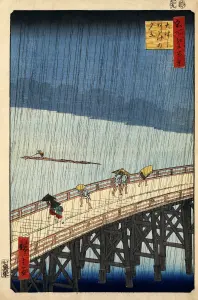
Fuji’s nineteenth-century representation by Hokusai and Hiroshige helped give the mountain international recognition. Ukiyo-e explains the print culture behind those views. A print, an oshi house and a fujizuka each preserve a different relationship with Fuji. The World Heritage designation recognises cultural associations and artistic influence, rather than treating the mountain simply as a scenic natural object.
Sources
Last updated: