Other Martial Arts
Yoseikan Budo
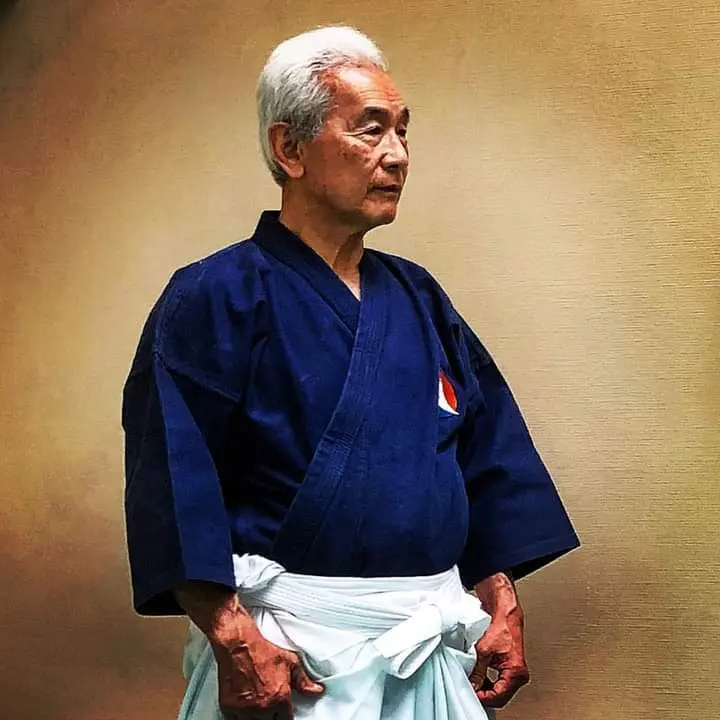
Image: DREOF / Wikimedia Commons · CC BY-SA 4.0
Yoseikan Budo is a modern composite martial art developed principally by Hiroo Mochizuki in France from the late 1960s and early 1970s. Its historical roots lie in the Yoseikan dojo founded in Shizuoka by his father, Minoru Mochizuki, who studied Judo, Aikido, karate, and classical weapons traditions. Hiroo reorganised this inheritance around shared body mechanics, especially a wave-like transfer of force, and created training formats that connect striking, throwing, joint control, groundwork, and weapons. Protective equipment and competition make some forms of resistance possible, while kata and technical drills preserve a wider curriculum. Yoseikan Budo should be distinguished from Yoseikan Aikido and from Minoru's earlier composite teaching: related names mark a lineage, but the modern system has its own pedagogy and organisations.
Overview
| Japanese name | 養正館武道 |
|---|---|
| Developer | Hiroo Mochizuki |
| Historical root | Minoru Mochizuki's Yoseikan dojo, founded in 1931 |
| Modern formation | France, late 1960s to early 1970s |
| Technical scope | Striking, throws, controls, groundwork, and weapons |
| International body | World Yoseikan Federation |
Name and scope
Yoseikan was the name chosen by Minoru Mochizuki for his Shizuoka dojo. Translations vary, but the characters suggest a hall for cultivating what is right or true. Budo identifies the modern system's broad martial scope.
The name is close to Yoshinkan Aikido but refers to a different lineage. It is also broader than Yoseikan Aikido, one important component of the earlier Mochizuki curriculum.
Minoru Mochizuki's Yoseikan
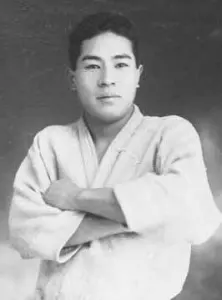
Minoru Mochizuki opened the Yoseikan dojo in 1931 after training in Kodokan Judo, Morihei Ueshiba's aiki methods, and several classical and modern arts. His teaching compared techniques across systems instead of isolating them.
This inheritance supplied the technical library and research attitude from which later Yoseikan Budo grew. Calling Minoru the sole founder of the modern system, however, obscures the changes made by Hiroo in France.
Hiroo Mochizuki and modern formation
Hiroo Mochizuki trained from childhood in the arts taught around his family and later worked extensively in France. During the late 1960s he began developing a more explicitly unified method, at first using names including Yoken.
The name Yoseikan Budo became established in the early 1970s. A French federation followed in 1975 and an international organisation in 1978, giving the developing method a formal structure distinct from the older Shizuoka dojo.
The wave principle
Yoseikan Budo uses a wave-like or undulating action as a common explanation for generating and transmitting power. Movement initiated through the legs and hips travels through the torso into a strike, throw, control, or weapon action.
The principle is a pedagogical model rather than a claim that every technique looks identical. Its purpose is to give students transferable body mechanics while they move between different ranges and tools.
Technical curriculum
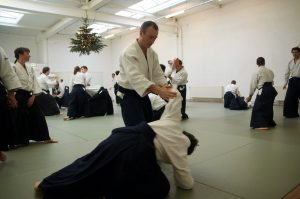
Training may include punches, kicks, evasions, throws, joint controls, pins, groundwork, and practice with weapons or padded implements. Drills connect these elements so that a student can change range without treating each phase as a separate art.
The breadth of the curriculum requires careful progression. Beginners learn posture, falling, distance, and controlled contact before complex combinations or stronger resistance are introduced.
Equipment and competition
Protective equipment allows selected striking, throwing, and weapon actions to be tested with greater speed. Competition formats create common rules and visible objectives, while excluding techniques judged too hazardous for open resistance.
Competition is one training environment rather than the whole art. Kata, paired technical study, self-defence exercises, and educational practice preserve material that cannot be represented by a score.
Symbols and training culture
The Yoseikan emblem uses a circular design commonly explained through contrasts of light and dark, warm and cool colour, and the wave at the centre. Institutional explanations connect these elements with balance, openness, and international identity.
Uniform details and rank structures may vary by organisation and country. The shared identity rests more securely on lineage, curriculum, and pedagogical principles than on assuming every dojo follows identical presentation.
International organisation and identity
Yoseikan Budo spread through European and international federations. The World Yoseikan Federation was established in 2010 as a major coordinating body for the modern system.
Organisational names and affiliations have changed over time, and not every group using Yoseikan belongs to the same body. Historical description should therefore identify the Mochizuki lineage and the specific organisation being discussed.
Sources
Last updated: