People
Itō Jakuchū

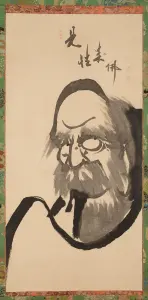
Image: Kubota Beisen (1852–1906) / Shōkoku-ji, via Wikimedia Commons · Public domain
Artist · Edo period
Birds, plants, and temple rooms
Itō Jakuchū (1716–1800) was a painter active in eighteenth-century Kyoto, known for closely observed birds, plants and other living things. His work ranges from the richly coloured silk scrolls of Colorful Realm of Living Beings to expansive ink paintings for temple rooms. A background in the city’s produce trade and relationships with Buddhist monks help place those images within a particular social world. His paintings connect Zen institutions with experiments in colour, brushwork and composition. They also offer concrete examples for discussing Japanese aesthetics without reducing its many histories to one style. Chickens are a familiar motif, but vegetables, insects, religious figures and architectural settings reveal a wider practice.
Overview
- Japanese name
- 伊藤若冲 · Itō Jakuchū
- Lived
- 1716–1800
- Principal setting
- Kyoto, eighteenth century
- Practice
- Painting in colour and ink; hanging scrolls, handscrolls and architectural paintings
- Known for
- Colorful Realm of Living Beings; bird-and-flower and vegetable subjects
- Institutional relationship
- Shōkoku-ji and its affiliated temples
01
Kyoto and the produce trade
Jakuchū came from a Kyoto produce-dealing family and became the fourth head of its business. The Sano museum’s account relates this background to his recurring fruit-and-vegetable subjects. Those subjects appear at several stages of his career, rather than belonging only to its final years. His commercial background offers context for the paintings; it does not explain every pictorial choice.
02
Colorful Realm of Living Beings
The thirty hanging scrolls of Dōshoku sai-e, usually translated as Colorful Realm of Living Beings, date to approximately 1757–1766. The National Gallery of Art situates their birds, flowers and other creatures within East Asian pictorial traditions and Buddhist meaning. Jakuchū donated the series and a triptych of Śākyamuni to Shōkoku-ji, where the works were displayed during religious rituals.
Technical examination has shown how he varied mineral and plant-based pigments, sometimes adding colour to the reverse of the silk. The resulting effects depend on layers, opacity and translucency as well as the shapes drawn on the surface. This material account gives a more precise explanation of the paintings than a general label such as “realistic.”
03
Shōkoku-ji and Daiten
The monk Daiten Kenjō was an important figure in Jakuchū’s religious and artistic network. Shōkoku-ji’s museum records a donation and agreement for memorial services in 1765, followed in 1766 by a tomb prepared during the painter’s lifetime with an inscription by Daiten. These records place the paintings within continuing relationships and obligations, not simply a modern collection of masterpieces.
The temple’s account dates the donation to 1765; the National Gallery dates the production of the thirty-scroll ensemble to approximately 1757–1766. These describe different aspects of the work’s history and should not be collapsed into a single, exact completion date.
04
Ink and architectural painting
Jakuchū’s practice also included the fifty paintings associated with the large study at Rokuon-ji, better known as Kinkaku-ji. The Jōtenkaku Museum explains sujime-gaki, a technique using the behaviour of spreading ink to give forms a sense of volume. Monochrome work offered a different set of possibilities from the layered colours of his silk scrolls.
The Kyoto National Museum’s Chickens comes from the abbot’s quarters of Kaihō-ji in Fushimi and is dated 1790. Its surviving nine surfaces formed part of a continuous architectural ensemble. The museum identifies it as a reference work for his late ink painting. The movement between individual scrolls and paintings distributed through a room is essential to understanding his range.
05
Late vegetable handscrolls
Saichūfu, held by the Sano City Yoshizawa Memorial Museum, combines vegetables and fruit with small living creatures. The related Kasozukan, in the Fukuda Art Museum, carries an inscription placing it one year earlier. Sano’s exhibition research identifies the latter scroll’s discovery as 2023. Its later exhibition is a separate event, not a new discovery in 2026.
The inscriptions give the artist’s ages as seventy-seven and seventy-six. These historical age statements should be retained as inscriptions rather than silently converted into modern birthday-based ages. Comparing the scrolls offers a way to study repetition and variation within a subject that Jakuchū returned to throughout his career.
06
Legacy and ways of looking
Jakuchū died in 1800. His surviving paintings are now studied across temple and museum collections. The different settings invite different questions: how colour was built on silk, how ink defined a bird’s body, or how an image continued across the surfaces of a room. No one of these questions describes the whole career.
The portrait reproduced here was painted by Kubota Beisen in 1885, long after Jakuchū’s death. It is a historical representation of the painter, not a portrait made from life. The image record identifies the artist, date and Shōkoku-ji association.
07
Timeline
- 1716 — Born; his career developed in Kyoto.
- c. 1757–1766 — Production period assigned to Colorful Realm of Living Beings by the National Gallery of Art.
- 1765–1766 — Shōkoku-ji records the donation and memorial agreement, followed by a lifetime tomb with Daiten’s inscription.
- 1790 — Chickens for Kaihō-ji, now held by Kyoto National Museum.
- 1800 — Died.
08
Sources
- Sano City Yoshizawa Memorial Museum, Jakuchū exhibition and handscroll research.
- National Gallery of Art, Colorful Realm exhibition and technical interpretation, 2012 exhibition; historical research source.
- Shōkoku-ji Jōtenkaku Museum, Jakuchu, 2021 exhibition archive; donation and memorial records.
- Kyoto National Museum, Chickens by Itō Jakuchū.
- Shōkoku-ji Jōtenkaku Museum, Maruyama Okyo and Ito Jakuchu.
Last updated: