Seasonal Customs
Danjiri

Image: Mr.ちゅらさん / Wikimedia Commons · CC BY-SA 4.0
Danjiri
Woodworking moves with a community.
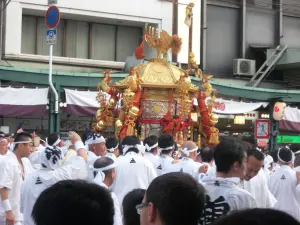
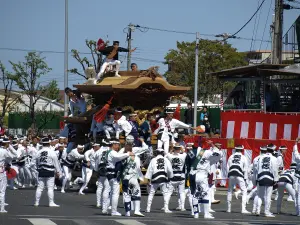
Danjiri is a regional name for festival floats, especially associated with the wooden floats of Osaka and neighbouring areas. The term often appears as 地車. A float combines built structure and carved decoration with the work of a community that maintains and moves it. Kishiwada’s fast corner turns are a famous example, but they do not define every danjiri tradition. Local construction, procession practices and festival calendars differ. Studying the object alongside its community reveals a history of carpenters, carvers, repairs, transfers and changing streets. A danjiri is therefore both a crafted artefact and part of a living event, with different evidence preserved by each.
Structure
An architectural frame carries the float.
Carving
Makers give surfaces narrative detail.
Procession
Coordinated roles bring the object into the street.
At a glance
- Japanese spelling
- 地車; だんじり
- Object type
- Festival float
- Principal focus here
- Osaka and neighbouring Kansai traditions
- Associated crafts
- Carpentry and wood carving
- Important distinction
- The float is not the same thing as one named festival
01
Kishiwada belongs to a wider regional field
Kishiwada City describes floats across the former Settsu, Kawachi and Izumi regions and neighbouring Nara and northern Wakayama. Its own account also distinguishes spring, summer and autumn festival settings. The Kishiwada Danjiri Festival is a particular celebration within the broader subject of Festival Floats in Japan.
For a contrasting float tradition, Karatsu Kunchi uses large sculptural hikiyama formed with paper and lacquer. The comparison helps distinguish the exposed woodworking associated with danjiri from other materials and forms used in Japanese festival floats.
02
Architecture and sculpture share the same object
Roofs, columns, brackets and a supporting base give these floats an architectural character. Carving introduces animals, plants and narrative subjects. Hamayashiki’s account of Suita’s Hamanodō float stresses the contrast between slender structural members and large carvings, with a relatively restrained upper part. Other examples place greater emphasis on ornament: one visual formula cannot describe the entire tradition.
03
Kami and shimo identify construction families
An Osaka architects’ association study distinguishes kami-danjiri from shimo-danjiri. It places several forms, including the Sumiyoshi type, within the former, while using the latter for the Kishiwada type. These are descriptions of structure and appearance, not rankings of artistic merit. The study’s Sumida example also shows how an older Kishiwada-type float can be preserved in another locality.
- Kami-danjiri
- A grouping containing several construction types.
- Shimo-danjiri
- The Kishiwada construction family in the cited classification.
04
Movement requires coordinated community roles
Kishiwada’s yarimawashi turns depend on coordination between rope pullers, lever teams and people signalling from the float. The spectacle is produced by different roles acting together. Those specific arrangements should not be projected onto every region. Matsuri supplies the larger setting of local festivals, while Omikoshi describes a different kind of ritual object.
05
Inscriptions and alterations preserve a working history
Hamayashiki values Suita’s floats for surviving building inscriptions, makers’ names and original material. Its account of the 1835 Torosu float also records widening the wheel spacing to improve stability. Such evidence shows that preservation does not necessarily mean an object has never changed. Construction, repair and adaptation can each leave historically useful traces.
06
A museum float records changes in the streets outside
Cultural Heritage Online records an 1886 float later purchased by a Suita neighbourhood. Overhead wires and crowded streets eventually prevented its use there, and it was donated to the Harano Agricultural Museum in 1963. This individual history shows how urban infrastructure can alter a float’s role. Exhibition preserves the object, while a procession preserves additional skills and community relationships.
Sources
Last updated: