Games
Puyo Puyo

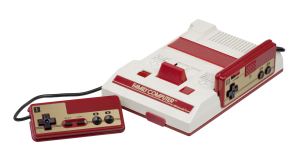
Image: Evan-Amos / Wikimedia Commons · Public domain
Puyo Puyo
One clear changes the next arrangement.
Puyo Puyo is a Japanese puzzle-game series built around arranging falling coloured pieces and clearing connected groups. It began with Compile in 1991 and became especially associated with competitive play through its arcade and home-console development. The basic action is easy to recognise: four or more touching Puyos of one colour disappear. The strategic depth comes from arranging later falls so that one clear triggers another, while attacks interfere with the opponent’s field. Different releases and rule sets alter that exchange. Puyo Puyo is therefore both a recognisable family of games and a collection of distinct competitive systems, rather than one rulebook that applies unchanged to every version.
Connect
Bring matching colours together.
Clear & fall
Removing a group changes the field.
Chain
A new connection continues the sequence.
At a glance
- Japanese title
- ぷよぷよ
- Original developer
- Compile
- First release year
- 1991
- Arcade milestone
- Sega arcade release, October 1992
- Central concepts
- Connected clears, chains and nuisance Puyos
01
Home releases and arcade competition have different dates
Sega’s official history distinguishes the 1991 MSX2 and Famicom Disk System beginnings from the 1992 arcade and Mega Drive releases. Its arcade archive dates that version to October 1992. The series’ thirty-fifth anniversary in 2026 counts from the original release, not from the later arcade version. These dates describe successive formats within the same history.
02
A chain is a sequence of clears
In the familiar paired-piece format, the player places falling Puyos to connect colours. Clearing a group removes its support, allowing pieces above to fall. If the new arrangement creates another qualifying group, the next link clears. Several pieces disappearing at once and several successive links are different events; chain length counts the continuing sequence.
- Connect
- Four or more adjacent Puyos of one colour form a clear.
- Fall
- Pieces above the cleared space settle downwards.
- Continue
- A new qualifying connection produces another chain link.
03
Nuisance pieces connect the two playing fields
Sega’s arcade archive describes sending ojama Puyo, or nuisance Puyos, to an opponent through successful clears and chains. These pieces occupy space and complicate the opponent’s arrangement. Watching a match therefore means following both fields: an apparently quiet period of construction may be preparing an attack, while a crowded field changes what can be built.
04
Tsu and Fever organise counterplay differently
Sega’s producer explains that Puyo Puyo Tsu rules allow sōsai: outgoing attack strength offsets incoming nuisance pieces. The original rules lack that system. Fever adds a different mode using prepared chain formations, reached through its own gauge mechanics. A tournament or replay should identify its rule set before comparisons are made.
- Original rules
- No Tsu-style offsetting of incoming nuisance attacks.
- Tsu rules
- Attacks can offset incoming nuisance pieces.
- Fever rules
- A gauge can lead to a mode built around prepared chains.
05
Chain building is also a subject of research
A 2011 paper by researchers at the Japan Advanced Institute of Science and Technology, catalogued by JST’s J-GLOBAL, studies constructing standard chain patterns with relationship matrices. Its abstract treats these patterns as accumulated player knowledge that can inform computer play. This supplies a scholarly perspective on spatial planning, without implying that one pattern or algorithm determines every match.
06
Competition is one part of a wider game culture
Sega presents competitive events and licensed professional play as part of the series’ modern development. Esports in Japan supplies institutional context, while Japanese Video Games places Puyo Puyo within a wider medium. Home play, arcade history and organised tournaments are connected settings, but participation in the series does not require professional competition.
Sources
Last updated: